
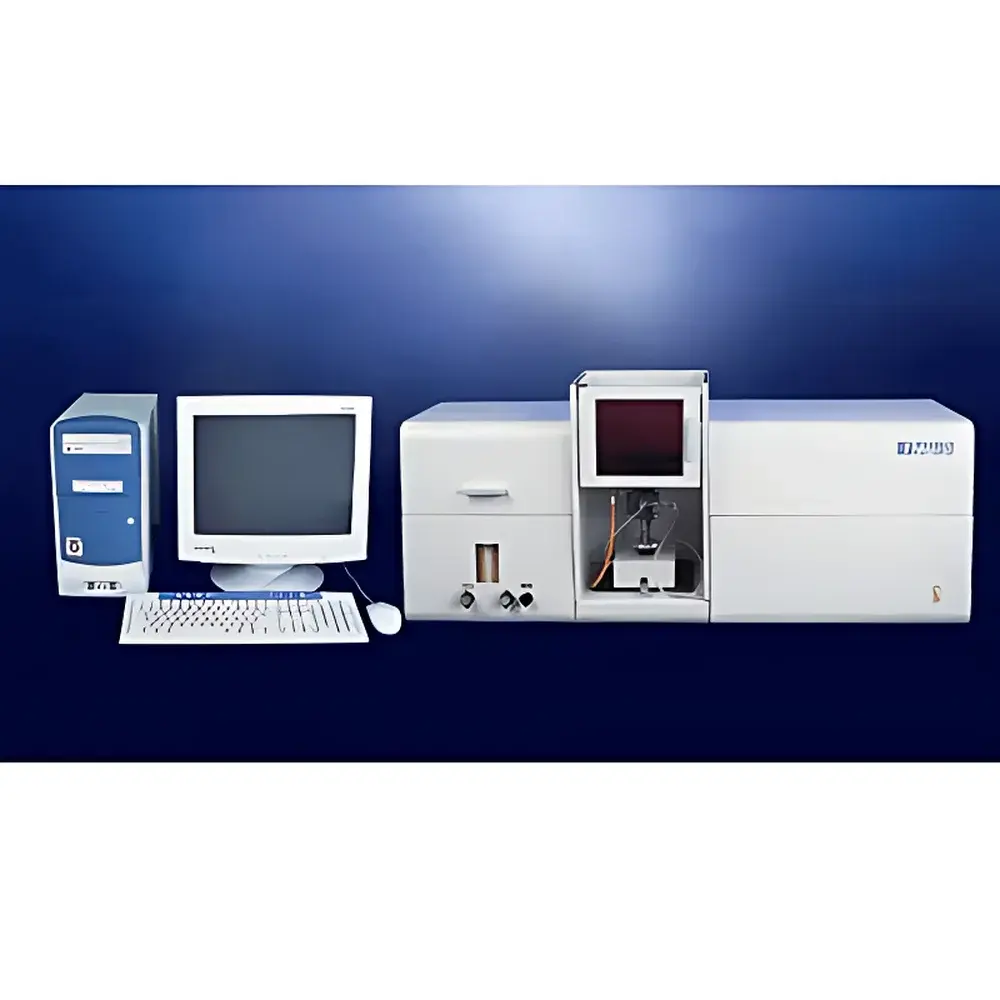
AA2610 Atomic Absorption Spectrometer
| Origin | Beijing, China |
|---|---|
| Manufacturer Type | Authorized Distributor |
| Origin Category | Domestic (PRC) |
| Model | AA2610 |
| Price Range | USD 7,000–14,000 |
| Instrument Type | Flame AAS |
| Monochromator | Plane Grating |
| Optical System | Double-Beam |
| Detector | Photomultiplier Tube (PMT) |
| Background Correction | D₂ Lamp + Self-Reversal Method |
| Spectral Resolution | 0.3 nm |
| Sensitivity (Cu) | >0.3 A at 5 ppm |
| Precision (RSD) | <0.3% |
| Detection Limit (Cu) | 0.006 µg/mL |
Overview
The AA2610 Atomic Absorption Spectrometer is a robust, double-beam flame atomic absorption system engineered for routine quantitative analysis of trace metallic elements in environmental, clinical, food, pharmaceutical, and industrial laboratories. It operates on the fundamental principle of atomic absorption spectroscopy—measuring the attenuation of characteristic hollow cathode lamp radiation as ground-state atoms in a high-temperature flame absorb photons at element-specific wavelengths (190–900 nm). The instrument employs a Czerny-Turner monochromator with aberration-corrected optics and a plane grating to deliver precise spectral isolation. Its dual-beam optical architecture compensates for source intensity drift and lamp aging, ensuring long-term baseline stability (<0.004 A/30 min) and measurement reproducibility essential for GLP-compliant workflows.
Key Features
- Double-beam optical system with real-time background correction via combined deuterium lamp and self-reversal techniques—enabling accurate quantification in complex matrices with spectral interferences.
- Four selectable spectral bandwidths (0.2, 0.4, 1.0, and 2.0 nm) optimized for sensitivity vs. selectivity trade-offs across diverse elemental analyses.
- High-resolution performance: resolves Mn doublet lines at 279.5 nm and 279.8 nm with valley-to-peak energy ratio <20% at 0.2 nm bandwidth—meeting ISO 11170 and ASTM E1776 verification criteria.
- 100 mm titanium air-acetylene burner with air-cooled, premix design; adjustable height and lateral positioning for rapid optimization between flame and hydride generation modes (with optional HG accessory).
- Integrated safety architecture: real-time acetylene leak detection, automatic gas shutoff, flame-out monitoring, and interlocked ignition sequence compliant with EN 61010-1 and IEC 61000-6-4 EMC standards.
- Compliance with GB/T 6780–1993—China’s national standard for AAS performance specifications—including wavelength accuracy (±0.25 nm), repeatability (≤0.15 nm), and detection limit validation protocols.
Sample Compatibility & Compliance
The AA2610 supports aqueous liquid samples via nebulization into an air-acetylene or nitrous oxide-acetylene flame. With optional hydride generation accessories, it extends capability to volatile species (As, Se, Sb, Bi, Te, Pb, Sn, Ge, Cd, Zn). All wet digestion protocols follow EPA Method 200.2, ISO 11885, or APHA 3111B. The system meets regulatory requirements for routine QC in ISO/IEC 17025-accredited labs and supports audit-ready documentation when paired with validated software configurations. While not natively 21 CFR Part 11 compliant, its data export structure (ASCII, CSV) enables integration into validated LIMS environments with appropriate procedural controls.
Software & Data Management
Controlled via Windows 98/2000/XP-compatible application software, the AA2610 provides full instrument parameter configuration, multi-point calibration (linear and 2nd/3rd-order polynomial), standard addition methodology, and automated RSD calculation (1–20 replicate readings). Software outputs include raw absorbance/time traces, calibration curves with residual plots, summary reports with SD/RSD, and printable graphical results. All data files are timestamped and user-ID tagged—facilitating manual audit trails. Export formats support post-processing in Excel, OriginLab, or laboratory-specific statistical packages. No embedded database or electronic signature functionality is included; users must implement external validation for regulated applications.
Applications
- Environmental monitoring: quantification of Cu, Fe, Ca, Pb, Cr, Cd, Hg in drinking water, wastewater, soil extracts, and airborne particulate filters per EPA 7000 series methods.
- Clinical and nutritional testing: serum/plasma Zn, Cu, Ca, Mg analysis aligned with CLIA and CAP proficiency testing guidelines.
- Food safety: screening for heavy metals in cereals, dairy, seafood, and infant formula under Codex Alimentarius limits.
- Pharmaceutical excipient testing: USP conformance for residual catalyst metals (e.g., Pd, Ni) in active pharmaceutical ingredients.
- Industrial QC: alloy composition verification, plating bath monitoring, and catalyst recovery process control in metallurgical and electroplating facilities.
FAQ
What sample introduction systems are supported?
The AA2610 includes a high-efficiency glass/nebulizer assembly and corrosion-resistant spray chamber. Optional accessories include graphite furnace modules (for sub-ppt detection), hydride generation systems, and flow injection analyzers.
Is the instrument compatible with modern operating systems?
The native software runs on legacy Windows platforms (98/2000/XP). For Windows 10/11 compatibility, virtual machine deployment or third-party driver abstraction layers are required—validated configurations available upon request.
What maintenance intervals are recommended?
Daily: burner head cleaning, nebulizer inspection, and alignment verification. Quarterly: PMT voltage recalibration and optical path dusting. Annual: full optical alignment and gas system leak testing per manufacturer service manual.
Does the AA2610 meet international metrological standards?
Yes—it satisfies core performance criteria defined in ISO 11170, ASTM E1776, and GB/T 6780–1993, including detection limit, precision, resolution, and wavelength accuracy verification protocols.
Can raw data be exported for independent statistical analysis?
Yes. All absorbance values, calibration parameters, and replicate statistics export to ASCII-delimited text files suitable for import into R, Python (pandas), JMP, or Minitab without proprietary dependencies.
Related Products





