
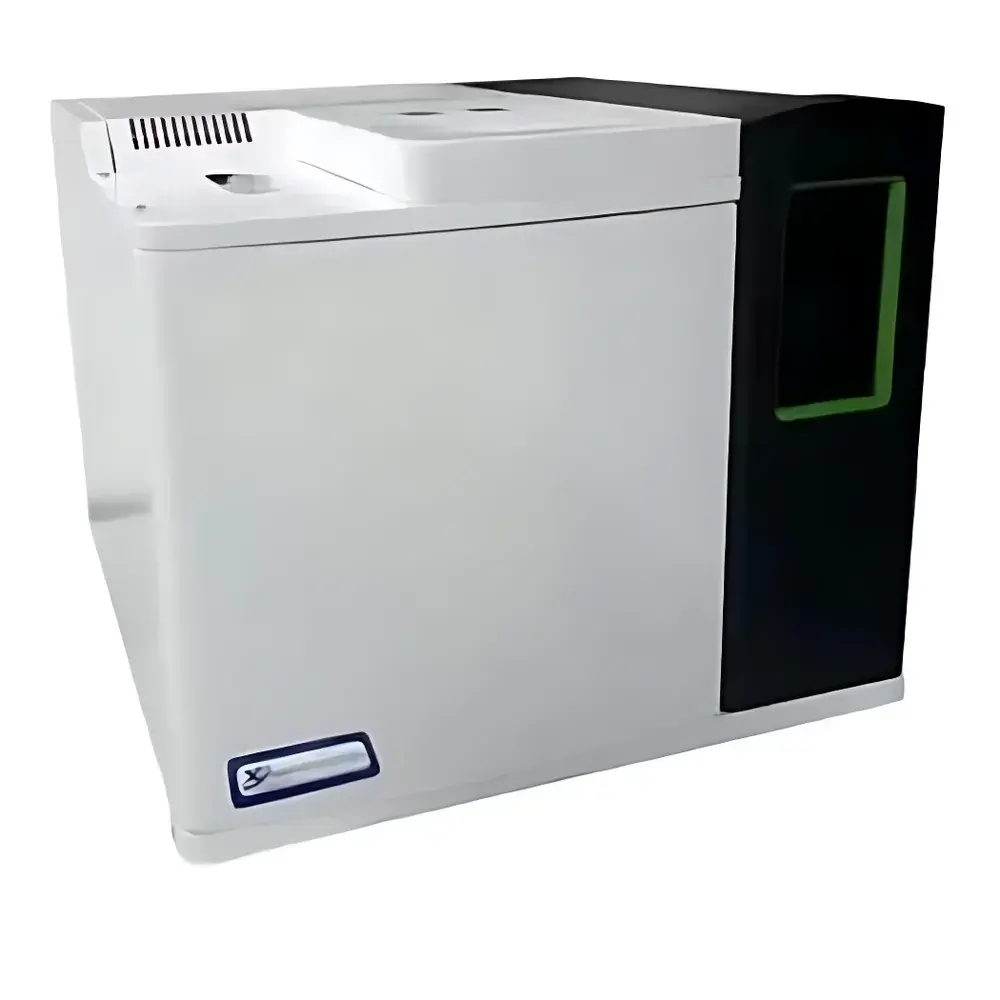
HuaShengPuXin HSPX GC-6000 Solvent Residue Analyzer for Edible Oil
| Brand | HuaShengPuXin (HSPX) |
|---|---|
| Origin | Beijing, China |
| Manufacturer Type | Direct Manufacturer |
| Instrument Type | Laboratory Gas Chromatograph |
| Application Field | Food Industry Dedicated |
| Column Oven Temperature Range | Ambient + 5°C to 400°C |
| Ramp Rate | 0.1–40°C/min |
| Cool-down Rate | 400°C to 50°C in ~6 min |
| Carrier Gas Flow Range & Control | 0–1000 mL/min |
| Carrier Gas Pressure Range & Control | 0–970 kPa |
| Injector Max Operating Temperature | 400°C |
| Injector Pressure Setting Range | 0–970 kPa |
| Injector Total Flow Setting Range | 0–1000 mL/min |
Overview
The HuaShengPuXin HSPX GC-6000 Solvent Residue Analyzer for Edible Oil is a dedicated laboratory gas chromatograph engineered for precise quantification of residual hydrocarbon solvents—primarily n-hexane and heptane, with trace levels of benzene, toluene, and other volatile aromatic compounds—in refined vegetable oils. These solvents are widely used in industrial oil extraction processes; however, their persistence beyond regulatory thresholds poses documented neurotoxic and hematotoxic risks. The instrument employs capillary gas chromatography with flame ionization detection (FID) as the primary analytical method, compliant with internationally recognized protocols including ISO 5508:1990 (Animal and vegetable fats and oils — Determination of solvent residues), AOAC Official Method 992.13, and China’s GB 5009.262–2016 (National Food Safety Standard — Determination of residual solvents in edible vegetable oils). Its thermally stable column oven, dual independent air-cooled back doors, and high-fidelity temperature ramping architecture ensure reproducible retention time alignment and baseline stability across multi-batch analyses under routine QC conditions.
Key Features
- Six-zone independent temperature control system—including column oven, dual injectors, dual detectors, and auxiliary heating zones—enables simultaneous optimization of separation efficiency, peak shape, and detector response.
- Five-stage programmable temperature ramping (0.1–39.9°C/min) supports resolution of complex solvent mixtures spanning wide boiling point ranges (35–150°C).
- Intelligent dual rear-door cooling system achieves rapid thermal equilibration: 400°C → 50°C in ≤6 minutes, with dynamic airflow modulation enabling near-ambient operation without mechanical refrigeration.
- Capillary split/splitless injector with septum purge and make-up gas (tail-blown) capability ensures quantitative transfer of low-volume oil headspace samples while minimizing carryover and active site adsorption.
- Modular detector configuration accommodates FID as standard; optional TCD, ECD, FPD, or NPD detectors may be installed via field-upgradable hardware interfaces and firmware calibration modules.
- Integrated power protection suite includes brownout immunity, uninterruptible parameter memory (EEPROM-based), real-time gas pressure/flow fault detection, and automatic TCD filament safeguard upon carrier gas interruption.
- Self-diagnostic subsystem reports error codes in English on the 320×240 LCD display, accompanied by audible alert and visual indicator—facilitating rapid troubleshooting without service engineer intervention.
Sample Compatibility & Compliance
The GC-6000 is validated for direct analysis of headspace vapor from heated vegetable oil samples (e.g., soybean, rapeseed, sunflower, peanut oils) following standardized static or dynamic headspace extraction per GB/T 5009.37–2003 and ISO 15709:2001. It meets essential performance criteria for food safety laboratories operating under GLP and GMP frameworks. Data integrity is supported through audit-trail-enabled chromatography data system (CDS) software compliant with FDA 21 CFR Part 11 requirements—including electronic signatures, user access controls, and immutable raw data archiving. All thermal and flow parameters adhere to ISO/IEC 17025:2017 metrological traceability standards when calibrated using NIST-traceable reference standards.
Software & Data Management
Bundled HSPX ChromaLab CDS v3.2 provides full instrument control, sequence scheduling, peak integration (with customizable baseline algorithms), calibration curve generation (linear, quadratic, or weighted), and report export in PDF, CSV, and XML formats. The software implements role-based user permissions, session logging, and electronic signature workflows aligned with ALCOA+ principles (Attributable, Legible, Contemporaneous, Original, Accurate, Complete, Consistent, Enduring, Available). Raw acquisition files (.hsp) are digitally signed and timestamped at acquisition; metadata includes instrument ID, operator login, method version, and environmental sensor readings (ambient temperature/humidity).
Applications
- Quantitative determination of n-hexane (CAS 110-54-3) and total volatile hydrocarbons in edible oils per national and regional maximum residue limits (e.g., China’s 10 mg/kg, EU’s 1 mg/kg).
- Method validation studies including specificity, linearity (0.1–100 mg/kg), LOD/LOQ (≤0.02 / ≤0.05 mg/kg), precision (RSD < 3.5% intra-day), and recovery (92–103%).
- Batch release testing in oil refining facilities and third-party food safety laboratories.
- Support for regulatory submissions to SAMR (State Administration for Market Regulation), CNCA (China National Certification and Accreditation Administration), and international import authorities requiring ISO/IEC 17025-accredited test reports.
FAQ
What solvents does this system specifically target in edible oil matrices?
It is optimized for n-hexane, heptane, and related aliphatic hydrocarbons, with validated sensitivity for benzene and toluene at sub-ppm levels.
Is the instrument compatible with automated headspace samplers?
Yes—standardized 1/8″ male VCR fittings and analog/digital I/O ports support integration with commercial HS-20/HS-40 and PAL-type autosamplers.
Does the system include validation documentation for laboratory accreditation?
Factory-installed IQ/OQ protocols, along with a full set of NIST-traceable calibration certificates and system suitability test (SST) templates, are provided upon delivery.
Can the GC-6000 operate under ambient temperatures below 15°C?
The column oven maintains specified accuracy down to ambient +5°C; however, stable operation below 15°C requires climate-controlled laboratory environments per ISO/IEC 17025 Clause 6.3.3.
What maintenance intervals are recommended for routine FID operation?
FID nozzle cleaning every 200 injections; ceramic igniter inspection every 6 months; and annual full system performance verification using certified hexane reference standards.






