
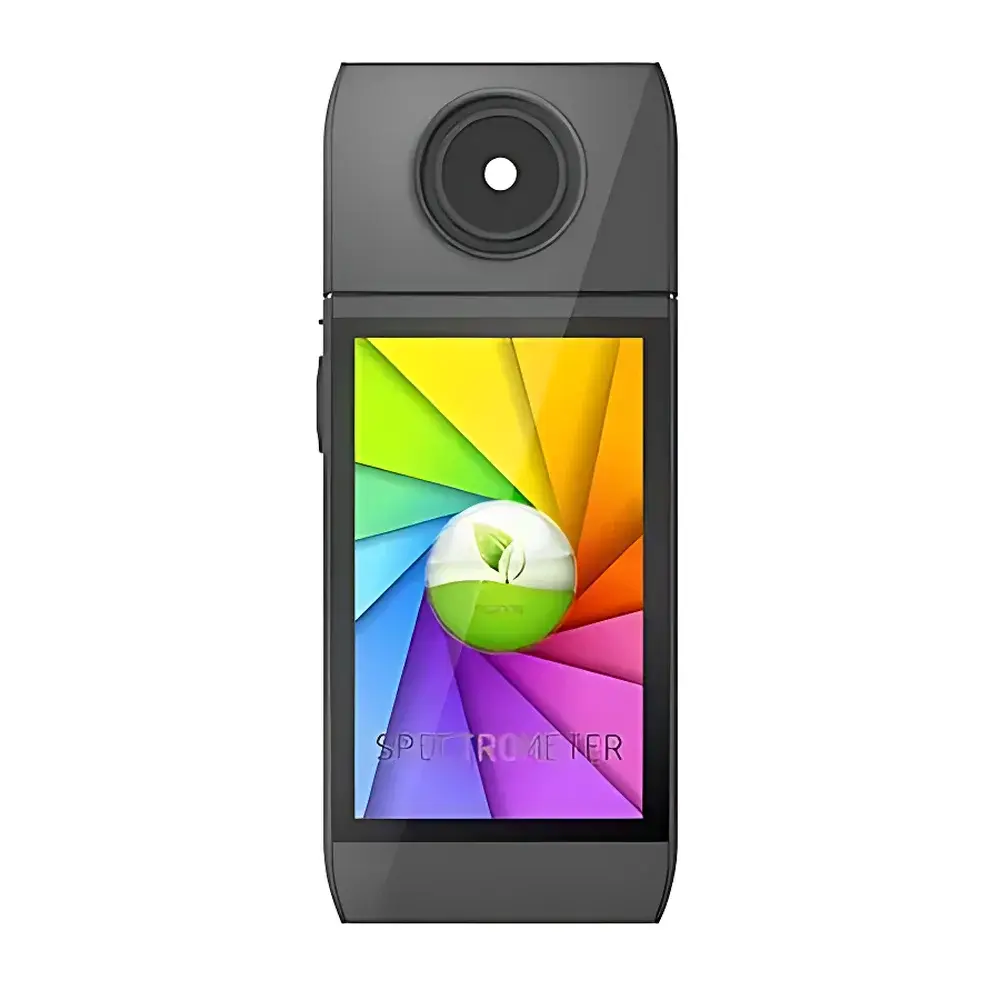
UPRtek PG200N Handheld PAR Meter for Horticultural Lighting
| Brand | CLEAN |
|---|---|
| Origin | Taiwan |
| Manufacturer Type | Authorized Distributor |
| Regional Category | Asia-Pacific Manufactured |
| Model | PG200N |
| Price Range | USD 700–1,400 |
| Instrument Type | Silicon Photodiode-Based Spectroradiometer with PAR-Optimized CMOS Linear Sensor |
| Spectral Range | 350–800 nm |
| Wavelength Resolution | 1 nm |
| FWHM | ~12 nm |
| Cosine Correction | CIE 1990 Compliant |
| Accuracy (Illuminance) | ±5% @ Standard Illuminant A (2856 K, 20,000 lx) |
| PPFD Range | 1–3,000 µmol/(m²·s) |
| Irradiance Range | 0.5–1,000 W/m² |
| Lux Range | 70–150,000 lx |
| Repeatability (2σ) | 0.2% |
| Colorimetric Accuracy | ±0.0025 in CIE 1931 x,y |
| CCT Accuracy | ±2% |
| CRI Accuracy | ±1.5% |
| IP Rating | IP66 |
| Display | 4.3" capacitive touch LCD (800×480) |
| Battery Life | Up to 5 hours (2500 mAh Li-ion) |
| Data Storage | ~68,000 records on 8 GB microSD |
| Connectivity | USB-C, Bluetooth 5.0, microSD |
| Operating Temp | 0–35 °C, ≤70% RH (non-condensing) |
| Weight | 280 g ±10 g |
| Compliance | JIS C 1609-1:2006 Class AA, DIN 5032-7 Class B |
Overview
The UPRtek PG200N Handheld PAR Meter is a field-deployable, spectrally resolved horticultural light measurement instrument engineered for quantitative assessment of photosynthetically active radiation (PAR) and spectral irradiance across the biologically relevant 350–800 nm range. Unlike conventional photometric lux meters or single-channel quantum sensors, the PG200N employs a high-fidelity CMOS linear sensor with 1 nm spectral sampling resolution and CIE 1990-compliant cosine correction—ensuring accurate angular response under diffuse, directional, and mixed-light conditions typical in vertical farms, greenhouse environments, and controlled-environment agriculture (CEA) facilities. Its core measurement principle is based on absolute spectral radiometry: incident photons are dispersed via a precision optical grating, detected across 451 discrete wavelength channels, and converted into calibrated spectral power distribution (SPD) data. This enables traceable calculation of photosynthetic photon flux density (PPFD), spectral photon flux (PFD) sub-bands (e.g., UV-A, blue, green, red, far-red), and photobiologically weighted metrics aligned with plant photoreceptor action spectra—including chlorophyll a, chlorophyll b, β-carotene, and phytochrome Pr/Pfr absorption profiles.
Key Features
- Integrated 3-axis gravity sensor (G-sensor) enabling real-time tilt-angle feedback and dynamic horizontal alignment—critical for minimizing cosine error during multi-point canopy mapping.
- IP66-rated detachable sensor head with dual-side measurement capability, permitting rapid repositioning without recalibration in humid, dusty, or outdoor field conditions.
- On-device PAR reference spectrum overlay (chlorophyll a/b, β-carotene, phytochrome Pr/Pfr) for immediate visual comparison between emitted SPD and plant photoreceptor absorption peaks.
- Configurable spectral integration: user-selectable wavelength ranges (e.g., 350–400 nm UV-A, 400–700 nm PAR, 700–800 nm FR) for targeted PFD quantification per ISO 21348 and ASTM E2917 definitions.
- Multi-mode operation: standalone handheld use, Bluetooth 5.0 wireless remote control (iOS/Android), or USB-C tethered acquisition with uSpectrum PC software for batch analysis and GLP-compliant reporting.
- Automated dark-current compensation and adaptive integration time (2–2000 ms) ensuring stable low-light sensitivity and saturation resistance under high-intensity LED arrays.
Sample Compatibility & Compliance
The PG200N is validated for use with all major horticultural light sources—including narrowband LEDs (e.g., 450 nm blue, 660 nm red, 730 nm far-red), broad-spectrum white LEDs, fluorescent tubes, and supplemental HID lamps. Its optical design adheres to CIE Publication 191:2010 for PAR instrumentation and satisfies metrological requirements specified in JIS C 1609-1:2006 Class AA and DIN 5032-7 Class B for illuminance and irradiance measurement. The device supports audit-ready data capture compliant with Good Laboratory Practice (GLP) frameworks; timestamped spectral records include metadata such as GPS coordinates (via paired smartphone), sensor tilt angle, integration time, and calibration traceability ID. While not FDA 21 CFR Part 11-certified out-of-the-box, raw data exports (Excel, JPG, CSV) facilitate integration into validated LIMS or ELN systems requiring electronic signature and audit trail capabilities.
Software & Data Management
The uSpectrum desktop application provides advanced spectral analytics including spectral comparison overlays, custom PAR weighting curve definition, time-series accumulation mode, and automated report generation (PDF/Excel). Users may build proprietary lighting recipes by correlating spectral signatures with crop-specific growth responses—enabling empirical optimization of R:FR, B:G, and UV-B dose ratios. All measurements are stored locally on an 8 GB microSD card with embedded EXIF-like metadata (date/time, GPS, tilt, battery level). Firmware updates and spectral calibration files are distributed via UPRtek’s secure customer portal, ensuring long-term measurement consistency across instrument fleets. Export formats comply with ISO/IEC 17025 documentation requirements for accredited testing laboratories.
Applications
- Vertical farm lighting layout validation and uniformity mapping (per ASABE S640.3)
- LED fixture spectral binning verification during manufacturing QA
- Greenhouse supplemental lighting efficacy studies under variable skylight conditions
- Phytochrome-mediated photomorphogenesis research (e.g., shade avoidance, flowering induction)
- Academic and commercial photobiology labs conducting PAR-driven growth trials
- Regulatory support for energy efficiency certification (e.g., DLC Horticultural Program)
FAQ
Does the PG200N require annual factory recalibration?
Yes—UPRtek recommends traceable recalibration every 12 months against NIST-traceable standards to maintain JIS AA/DIN B compliance. Calibration certificates include uncertainty budgets per ISO/IEC 17025.
Can the device measure pulsed or modulated LED lighting?
Yes—the 2 ms minimum integration time and hardware-level synchronization enable accurate averaging of flickering or PWM-driven sources when configured in continuous acquisition mode.
Is spectral data export compatible with MATLAB or Python?
Yes—CSV exports contain wavelength (nm) and irradiance (µW/cm²/nm) columns, fully importable into NumPy, Pandas, or spectroscopic toolboxes without proprietary dependencies.
How does the G-sensor improve measurement reproducibility?
By providing real-time pitch/yaw feedback, it reduces operator-induced cosine error—particularly critical when measuring at oblique angles above or below plant canopies, where deviations >5° significantly impact PPFD accuracy.
Does the IP66 rating apply to the full unit or only the sensor head?
The IP66 rating applies exclusively to the removable sensor head; the main body is rated IP54 and must be shielded from direct water exposure during outdoor use.



