
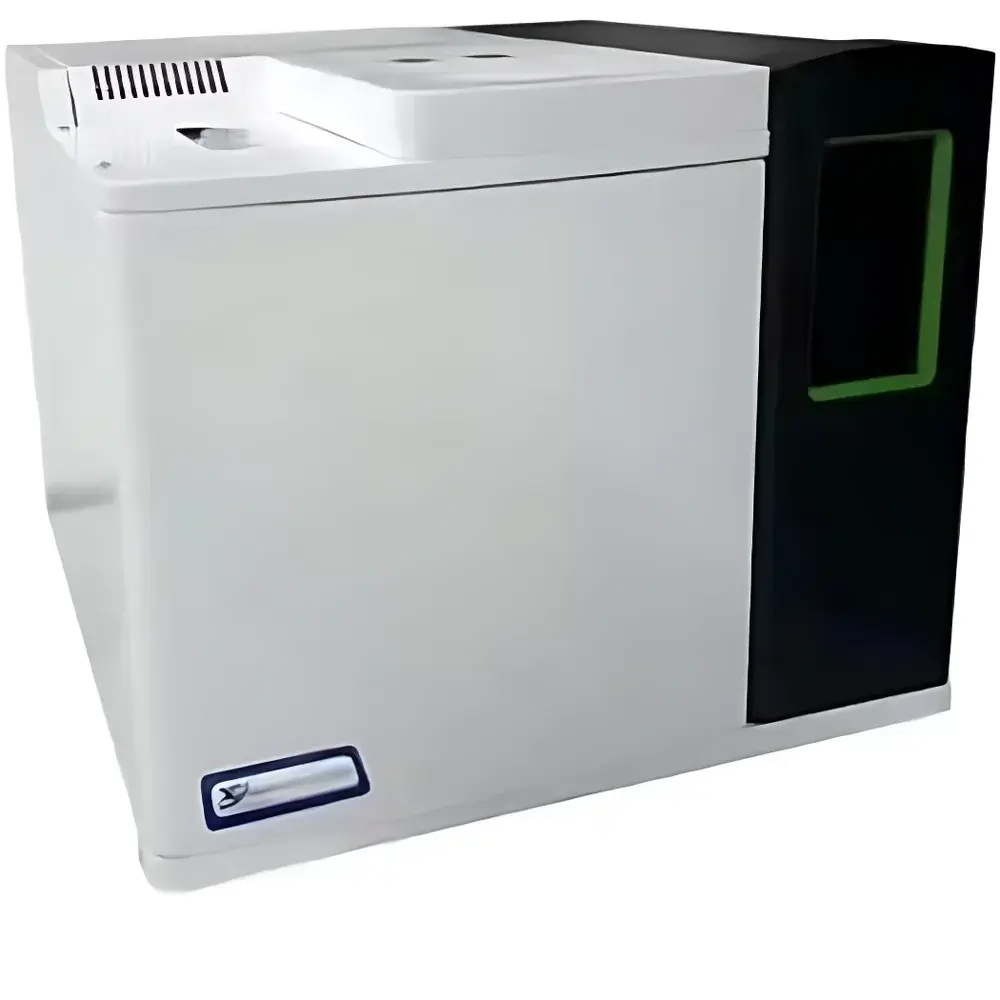
HuaShengPuXin HSPX Baijiu-Specific Gas Chromatograph
| Brand | HuaShengPuXin (HSPX) |
|---|---|
| Origin | Beijing, China |
| Manufacturer Type | Direct Manufacturer |
| Instrument Type | Laboratory Gas Chromatograph |
| Application Field | Baijiu (Chinese Liquor) Analysis |
| Temperature Control Range | 20 °C to 450 °C |
| Temperature Ramp Rate | 0.1–80 °C/min |
| Cooling Rate | Up to 39.9 °C/min |
| Carrier Gas Flow Range & Control | 0–1200 mL/min |
| Carrier Gas Pressure Range & Control | 0–0.6 MPa |
| Injector Maximum Operating Temperature | 400 °C |
| Injector Pressure Setting Range | 0–0.6 MPa |
| Injector Total Flow Setting Range | 0–1200 mL/min |
| Temperature Zones | 8 independently controlled zones |
| Temperature Accuracy | ±0.01 °C |
| Minimum Temperature Increment | 1 °C |
| Programmable Temperature Program | Multi-step (≥8 stages) |
| External Event Inputs | 6 channels |
| Auxiliary Outputs | 2 channels |
| Injector Options | Packed column, capillary column, 6-port gas valve, automatic thermal desorption, purge-and-trap, and headspace sampling |
| Detector Capacity | Up to 3 detectors simultaneously |
| Detector Options | FID, TCD, ECD, FPD, NPD |
Overview
The HuaShengPuXin HSPX Baijiu-Specific Gas Chromatograph is a purpose-engineered laboratory gas chromatograph designed explicitly for the quantitative and qualitative analysis of volatile congeners, esters, alcohols, aldehydes, and organic acids in baijiu—a traditional Chinese distilled spirit with complex matrix composition and strict national quality standards (GB/T 10781 series). Built on robust gas chromatographic principles, the system separates analytes based on differential partitioning between a mobile phase (high-purity carrier gas) and a stationary phase (capillary or packed column), enabling high-resolution profiling of trace-level flavor compounds at sub-ppb detection limits when coupled with flame ionization detection (FID) or electron capture detection (ECD). Its architecture complies with fundamental requirements for regulated QC environments, including stable temperature control, reproducible injection, and retention time locking—essential for method transfer across laboratories and long-term batch consistency monitoring in distillery QA/QC workflows.
Key Features
- Eight independently programmable temperature-controlled zones—including oven, injector(s), detector(s), and auxiliary modules—ensuring precise thermal management for multi-detector configurations and complex method development.
- High-precision oven temperature control (±0.01 °C) over a wide range (20 °C to 450 °C), supporting both standard and high-temperature applications such as fatty acid ethyl ester (FAEE) profiling and aging marker analysis.
- Flexible ramp rate capability (0.1–80 °C/min), optimized for rapid method screening or high-resolution separation of co-eluting congeners common in baijiu matrices (e.g., ethyl acetate vs. isoamyl alcohol).
- Modular hardware design enables field-upgradable detector configurations and seamless integration of auxiliary sampling devices—including auto-samplers, thermal desorbers, purge-and-trap concentrators, and headspace autosamplers—without hardware modification.
- Electronic pressure and flow control (EPC) option provides digital regulation of carrier gas pressure (0–0.6 MPa) and total flow (0–1200 mL/min), enhancing retention time stability and method robustness across ambient fluctuations.
- Integrated safety logic includes automatic flame re-ignition after extinguishment, carrier gas leak detection, and fail-safe shutdown protocols—meeting essential operational safety expectations in ISO/IEC 17025-accredited laboratories.
- Dual-language firmware (English and Simplified Chinese) with industrial-grade color LCD interface and PC-based remote control software compliant with Windows OS environments.
Sample Compatibility & Compliance
The HSPX system supports diverse sample introduction modes required for baijiu analysis: direct liquid injection (via split/splitless injectors), gas-phase analysis using 6-port valves, and automated headspace sampling for volatile compound enrichment. It is routinely deployed in accordance with GB/T 10345–2007 (Method for Analysis of Volatile Flavor Substances in Baijiu) and aligned with broader chromatographic validation frameworks per ICH Q2(R2) and USP . While not pre-certified for FDA 21 CFR Part 11, its software architecture supports audit trail logging, user access control, and electronic signature readiness—facilitating GxP-aligned deployment where local regulatory interpretation permits.
Software & Data Management
Built-in acquisition and processing software delivers real-time chromatogram visualization, peak integration using valley-to-valley or tangent skim algorithms, retention time alignment, and customizable report templates exportable to PDF, CSV, or Excel formats. The platform supports ASTM E168-compliant spectral library matching for unknown identification and allows method archiving with version control. All instrument parameters—including temperature programs, flow settings, and detector voltages—are stored as encrypted method files with timestamped metadata, ensuring full traceability for GLP/GMP documentation requirements.
Applications
- Quantification of major esters (ethyl acetate, ethyl lactate, ethyl hexanoate) and higher alcohols (isoamyl alcohol, propanol) per GB/T 10345.
- Detection and quantification of methanol and fusel oils for safety compliance.
- Profiling of trace sulfur compounds (e.g., dimethyl sulfide) contributing to off-flavors.
- Authentication and origin verification via volatile fingerprinting combined with chemometric modeling (PCA, PLS-DA).
- Stability testing during storage and aging by tracking ester hydrolysis and aldehyde oxidation kinetics.
FAQ
Is this instrument validated for routine QC use in baijiu production facilities?
Yes—its temperature precision, retention time repeatability (<0.05% RSD), and compatibility with GB/T-standard methods make it suitable for daily QC release testing when operated under documented SOPs and periodic system suitability checks.
Can it be integrated into an existing LIMS environment?
The instrument supports ASCII-based data export and ODBC connectivity; custom API integration is possible via vendor-provided SDK upon request.
What maintenance intervals are recommended for FID and TCD detectors?
FID nozzle cleaning and jet inspection every 200 injections; TCD filament resistance monitoring and cell purging every 500 runs—per manufacturer’s preventive maintenance schedule.
Does the system support unattended overnight operation?
Yes—programmable start/stop sequences, auto-shutdown after run completion, and event-triggered restart functionality enable fully automated batch processing for up to 99 samples.






