
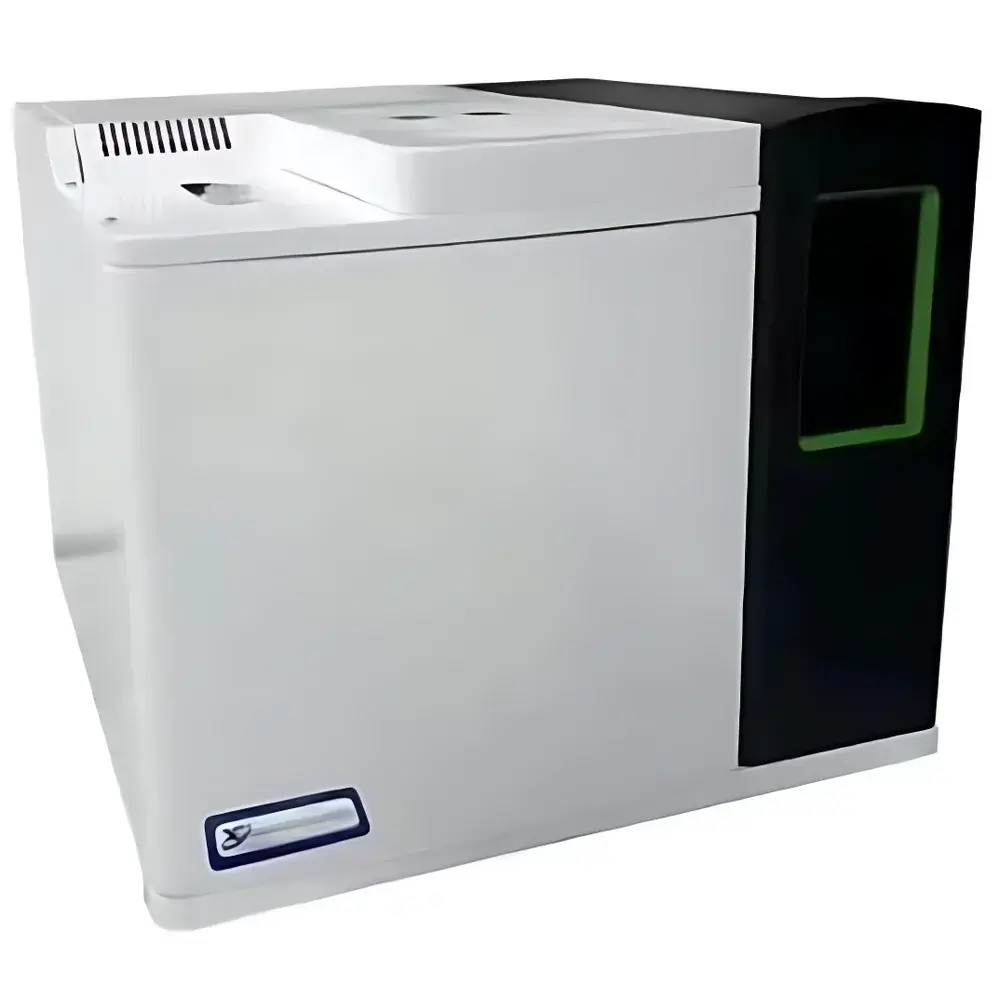
HuaShengPuXin HSPX Baijiu-Specific Gas Chromatograph
| Brand | HuaShengPuXin (HSPX) |
|---|---|
| Origin | Beijing, China |
| Manufacturer Type | Direct Manufacturer |
| Instrument Category | Domestic Lab-Scale Gas Chromatograph |
| Model | Baijiu-Specific |
| Temperature Control Range | Ambient to 400 °C |
| Oven Ramp Rate | 0.1–40 °C/min |
| Oven Cool-Down | 450 °C to 50 °C in ~6 min |
| Carrier Gas Flow Range & Control | 0–60 mL/min |
| Carrier Gas Pressure Range & Control | 0–0.6 MPa |
| Injector Max Operating Temperature | 400 °C |
| Injector Pressure Setting Range | 0–0.6 MPa |
| Injector Total Flow Setting Range | 0–1200 mL/min |
Overview
The HuaShengPuXin HSPX Baijiu-Specific Gas Chromatograph is a dedicated analytical system engineered for the precise qualitative and quantitative determination of volatile organic compounds in Chinese baijiu (distilled spirit). It operates on the principle of gas chromatography coupled with flame ionization detection (FID), a technique recognized for its high sensitivity, linear dynamic range, and robust response to hydrocarbons and oxygenated organics—including alcohols, aldehydes, esters, and organic acids. Designed explicitly for compliance with national standard methodologies, this instrument enables full-spectrum profiling of over 40 target analytes using capillary column configurations, or rapid screening of 10–15 key congeners via DNP-packed columns—both fully aligned with GB/T 10345.7–1989 and GB/T 10345.8–1989 for baijiu quality control and authenticity verification.
Key Features
- Dedicated hardware and method presets optimized for baijiu matrix complexity, including ethanol-rich samples with high volatility gradients and trace-level flavor congeners.
- Programmable temperature-controlled oven with ultra-stable thermal regulation (±0.1 °C) across ambient to 400 °C, supporting multi-step ramping and isothermal holds critical for compound resolution.
- FID detector with low-noise electronics, optimized hydrogen/air flow management, and linear response over 107 concentration range—ensuring reproducible quantification of methanol, ethyl acetate, isoamyl alcohol, ethyl lactate, and other regulated impurities.
- Flexible inlet configuration supporting both packed-column (DNP phase) and fused-silica capillary column operation, with independent pressure and flow control for split/splitless injection modes.
- Robust mechanical architecture with reinforced column oven insulation, vibration-dampened detector housing, and sealed electronics compartment for long-term stability in QC laboratory environments.
- Integrated carrier gas control module enabling precise, digitally regulated pressure (0–0.6 MPa) and mass flow (0–60 mL/min) delivery—compatible with nitrogen, helium, or hydrogen carriers per method requirements.
Sample Compatibility & Compliance
This GC system is validated for direct injection of diluted or headspace-derived baijiu samples without derivatization. It accommodates standard 1–2 µL liquid injections and supports automated headspace sampling when interfaced with third-party autosamplers. All operational parameters—including temperature programs, detector settings, and calibration protocols—are structured to satisfy the procedural rigor defined in GB/T 10345.7–1989 (determination of esters and alcohols) and GB/T 10345.8–1989 (determination of aldehydes and fusel oils). While not pre-certified to ISO/IEC 17025 or FDA 21 CFR Part 11 out-of-the-box, the platform’s deterministic signal acquisition, audit-ready method storage, and electronic logbook functionality support laboratory implementation of GLP/GMP-aligned data integrity practices.
Software & Data Management
Bundled chromatography data system (CDS) software provides method development tools, peak integration with baseline correction algorithms, retention time locking, and customizable reporting templates compliant with internal QA documentation standards. Raw data files are stored in vendor-neutral formats (e.g., .cdf) for long-term archival and third-party reprocessing. The software supports user-defined calibration curves (linear, quadratic, or multipoint weighted), limit-of-quantitation (LOQ) validation workflows, and batch processing for routine QC sample sets. Audit trail features record operator actions, parameter changes, and analysis timestamps—facilitating traceability during regulatory inspections or internal audits.
Applications
- Quantitative analysis of major and minor volatile congeners in baijiu production batches for consistency monitoring and sensory correlation.
- Authentication testing to detect adulteration (e.g., synthetic ethanol addition, dilution with neutral spirits).
- Regulatory compliance testing for methanol (≤0.6 g/L), ethyl carbamate, and higher alcohols per China’s Food Safety National Standards (GB 2757–2012).
- R&D support for fermentation optimization, aging studies, and distillation cut-point validation.
- Training and method transfer in regional food testing laboratories accredited under CNAS (China National Accreditation Service).
FAQ
Is this instrument compatible with capillary columns for expanded component profiling?
Yes—the system supports standard 0.25–0.53 mm ID fused-silica capillary columns up to 60 m length, enabling separation and quantification of over 40 volatile compounds including organic acids and lactates.
Does it meet international standards such as ISO or ASTM methods?
While designed primarily for GB-series national standards, method adaptation for ISO 17025-accredited labs is feasible through documented validation per ISO/IEC 17025:2017 Clause 7.2.2 and ASTM E260/E1691 guidelines.
Can the software generate reports compliant with regulatory submissions?
The CDS exports PDF and Excel reports with embedded metadata, integration results, calibration history, and analyst signatures—sufficient for internal QA records and preparatory documentation for CNAS or provincial food safety authority reviews.
What maintenance intervals are recommended for sustained FID performance?
FID jet cleaning and detector alignment are advised every 200–300 injections; ceramic igniter inspection and septum replacement should occur biweekly under continuous operation.
Is remote diagnostics or network connectivity supported?
The instrument includes Ethernet port and RS-232 interface for LAN-based instrument control and data export; optional VPN-enabled remote access modules are available for enterprise lab networks under IT security review.




