
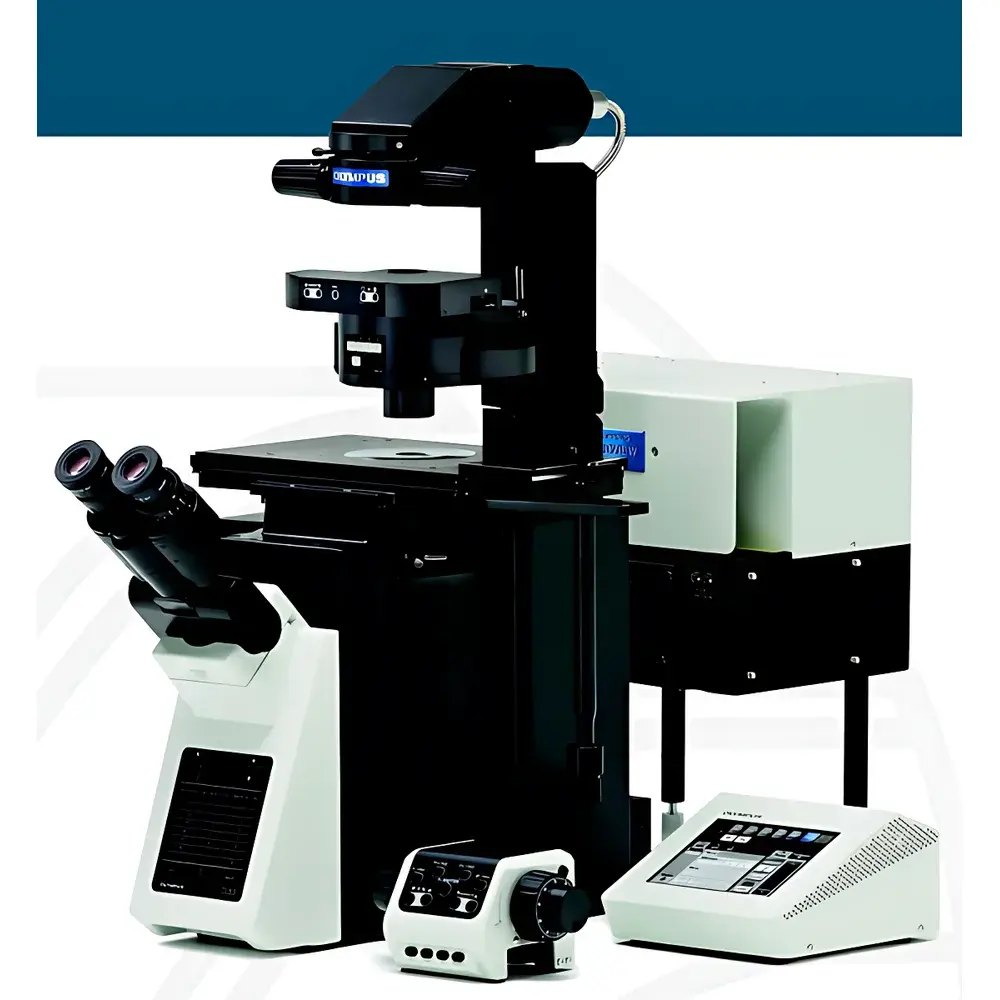
ISS SMT-3D Nanoimaging & Single-Molecule Tracking Kit
| Brand | ISS |
|---|---|
| Origin | USA |
| Model | SMT-3D Nanoimaging |
| Category | Upgraded Add-on for Olympus FV1000/FV1200 Laser Scanning Confocal Microscopes |
| Detection Principle | Modulation Tracking via Feedback-Controlled Circular Beam Oscillation |
| Lateral Resolution | 20–40 nm (±2 nm) |
| Axial Precision | 2 nm |
| XY Tracking | Galvo Mirror System |
| Z Tracking | Piezo-Driven Stage |
| Data Acquisition Rate | 32–256 kHz |
| Orbit Frequency | 2 kHz |
| Detector | Internal PMT of FV1000/FV1200 + ISS Photon Counting Unit |
| Software | SimFCS (Globals Unlimited) |
| Compliance | Designed for GLP/GMP-aligned workflows |
Overview
The ISS SMT-3D Nanoimaging & Single-Molecule Tracking Kit is an engineered add-on system designed to extend the functional capabilities of Olympus FV1000 and FV1200 laser scanning confocal microscopes into the nanoscale regime. Unlike conventional super-resolution techniques—such as STED, PALM, or STORM—that rely on stochastic activation and post-acquisition reconstruction, this system implements a deterministic, feedback-driven modulation tracking methodology. It operates by dynamically steering a focused excitation beam along a circular orbit around a target fluorophore while imposing controlled vertical oscillation of the beam relative to the sample surface. The resulting periodic modulation in fluorescence intensity—governed by the interplay between evanescent field decay, fluorophore quantum yield, and local concentration—is quantitatively analyzed to extract nanometer-scale axial distance information. Combined with high-speed galvo-based XY localization and piezo-stage Z-positioning, the system achieves real-time, volumetric single-molecule tracking with lateral resolution of 20–40 nm and axial precision of ±2 nm—enabling dynamic 3D structural mapping of subcellular architectures at sub-second temporal resolution.
Key Features
- Modulation Tracking Algorithm: Real-time feedback control adjusts beam trajectory based on instantaneous fluorescence response, eliminating reliance on sparse blinking or fixed-pattern scanning.
- Integrated Hardware Interface: Seamless coupling with Olympus FV1000/FV1200 via dedicated switching box—preserves native confocal functionality while enabling nanoimaging mode activation without hardware modification.
- High-Fidelity Signal Acquisition: ISS photon counting electronics synchronized with internal PMT detectors ensure low-noise, time-tagged photon streams at up to 256 kHz sampling rate.
- Multi-Axis Tracking Architecture: XY localization via high-bandwidth galvanometric mirrors; Z-axis tracking via closed-loop piezoelectric stage with sub-nanometer step resolution.
- Deterministic Orbital Scanning: 2 kHz circular orbit frequency with programmable radial oscillation (8–32 cycles/orbit), enabling robust distance calibration independent of fluorophore brightness heterogeneity.
- SimFCS Software Platform: Full-featured acquisition, correlation analysis, and 3D trajectory reconstruction—including FCS, FCCS, number & brightness (N&B), and raster image correlation spectroscopy (RICS)—all natively supported.
Sample Compatibility & Compliance
The SMT-3D Nanoimaging Kit is optimized for live-cell and fixed-sample applications using standard organic dyes (e.g., Alexa Fluor, Cy series), fluorescent proteins (e.g., mEos, Dronpa), and quantum dots compatible with 405–640 nm excitation. Its non-destructive, low-dose illumination strategy minimizes phototoxicity during prolonged acquisition—critical for monitoring membrane dynamics, cytoskeletal remodeling, or nuclear pore transport. From a regulatory standpoint, the system supports traceable, timestamped data capture aligned with GLP and GMP documentation practices. When operated on a validated computer platform with user access controls and electronic signatures enabled, SimFCS-generated datasets comply with FDA 21 CFR Part 11 requirements for audit trails, data integrity, and secure archiving.
Software & Data Management
Acquisition and analysis are fully integrated within SimFCS (Globals Unlimited), a MATLAB-based platform widely adopted in quantitative fluorescence laboratories. SimFCS provides native support for time-resolved photon stream processing, including burst analysis, autocorrelation, cross-correlation, and spatial moment analysis. All raw photon arrival times, orbital parameters, and stage position logs are stored in HDF5 format—ensuring long-term readability, metadata embedding, and compatibility with third-party analysis pipelines (e.g., Python-based TrackMate or custom MATLAB scripts). The software architecture permits batch processing of multi-condition experiments, automated ROI selection, and export of calibrated 3D trajectories in standard formats (e.g., CSV, Imaris .ims). Optional integration with laboratory information management systems (LIMS) is achievable via API extension.
Applications
- Real-time 3D diffusion mapping of membrane receptors and lipid raft-associated proteins
- Quantitative analysis of chromatin mobility and nuclear body assembly kinetics
- Intracellular vesicle trafficking with simultaneous size, brightness, and oligomeric state determination
- Dynamic characterization of protein-protein interactions via dual-color co-tracking and FCCS
- Nanoscale topography profiling of extracellular matrix components using surface-adherent probes
- Validation of CRISPR-edited cell lines through single-molecule stoichiometry and residence time measurements
FAQ
Is the SMT-3D Nanoimaging Kit compatible with microscopes other than Olympus FV1000/FV1200?
No—the system is specifically engineered for OEM-level integration with Olympus FV1000 and FV1200 platforms. Control signal routing, detector synchronization, and galvo driver interfacing are hardware-specific and not adaptable to other microscope chassis without custom engineering.
What fluorophores are recommended for optimal modulation tracking performance?
Fluorophores with high quantum yield (>0.5), moderate photostability, and emission maxima between 500–650 nm deliver strongest modulation contrast. Examples include Alexa Fluor 532, ATTO 565, and mNeonGreen. Avoid heavily quenched or aggregation-prone labels.
Does the system require specialized training for operation?
Yes—proficiency in SimFCS workflow configuration, orbital parameter optimization, and photophysical artifact recognition is essential. ISS provides on-site installation support and a two-day hands-on training course covering experimental design, calibration procedures, and troubleshooting.
Can the system perform simultaneous multicolor single-molecule tracking?
Yes—when combined with appropriate dichroic filters and spectral unmixing modules, dual-channel detection enables independent tracking of two spectrally distinct species. Cross-talk correction and spatiotemporal registration are handled within SimFCS.
Is maintenance covered under warranty?
The kit includes a 12-month parts-and-labor warranty. Extended service plans—including annual calibration verification, photon-counting electronics diagnostics, and software update support—are available upon request.




