
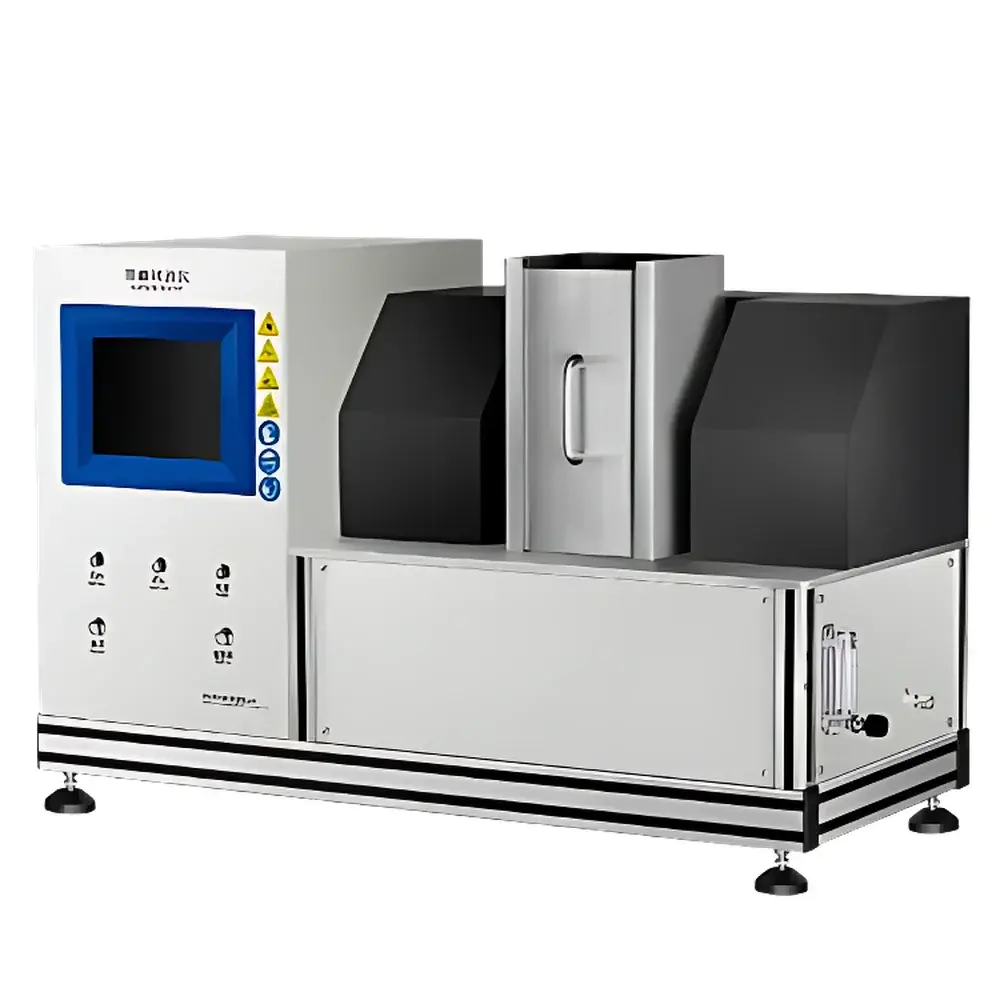
Young Instruments HWP20-10S Koenen Test Apparatus
| Brand | Young Instruments |
|---|---|
| Origin | Zhejiang, China |
| Manufacturer Type | Direct Manufacturer |
| Country of Origin | China |
| Model | HWP20-10S |
| Pricing | Available Upon Request |
Overview
The Young Instruments HWP20-10S Koenen Test Apparatus is a precision-engineered laboratory instrument designed to assess the thermal sensitivity of solid and liquid substances under highly confined conditions—specifically evaluating their propensity to undergo rapid exothermic decomposition or deflagration when subjected to controlled high-temperature heating. It operates in strict accordance with the fundamental principles of the Koenen test (UN Manual of Tests and Criteria, Section 11.5.1, Test 1(b)), which simulates worst-case thermal exposure scenarios for hazardous materials during transport and storage. The apparatus implements a standardized steel tube confinement geometry, where a defined sample mass is heated at a precisely regulated rate (3.3 ± 0.3 K/s) until onset of reaction is detected via thermocouple monitoring and visual/pressure-based observation. Its design prioritizes repeatability, traceable calibration, and mechanical robustness to support regulatory submissions and internal safety screening workflows.
Key Features
- Compliance-ready architecture aligned with UN ST/SG/AC.10/Rev.6, GB/T 21578–2008, GB/T 21848–2008, GB 5085.5, and NY/T 1860.6–2010—enabling direct use in GLP-compliant laboratories and regulatory testing facilities.
- High-fidelity temperature control system featuring a Class F2-certified load mass (80 N applied force) and calibrated K-type thermocouple with measurement range from −40 °C to 1000 °C, accuracy of ±1.5 °C or ≤±0.004|t|, and thermal response time ≤0.5 s.
- Interchangeable orifice plates (10 standard sizes: 1.0, 1.5, 2.0, 2.5, 3.0, 5.0, 6.0, 8.0, 12.0, and 20.0 mm diameter) to accommodate variable venting requirements across diverse material classes.
- Precision-machined steel test tube assembly: outer diameter 25 mm × height 75 mm, wall thickness 0.5 ± 0.05 mm, mass 26.5 ± 1.5 g—dimensionally certified to meet UN-specified tolerances.
- Environmental operating envelope: −5 °C to +45 °C ambient temperature, <95% relative humidity (non-condensing), supporting deployment in standard analytical labs without climate-controlled rooms.
Sample Compatibility & Compliance
The HWP20-10S accommodates both powdered solids and low-viscosity liquids within the prescribed mass and physical constraints of the Koenen test protocol. Sample preparation follows strict volumetric and compaction guidelines per GB/T 21578–2008, including use of standardized die sets and F2-grade reference weights. All mechanical components—including orifice plates, steel tubes, and pressure-loading fixtures—are manufactured to metrological standards traceable to national primary standards. The apparatus satisfies essential requirements for inclusion in ISO/IEC 17025-accredited testing laboratories and supports audit readiness for FDA 21 CFR Part 11 (when integrated with compliant data acquisition software), EU ADR, IATA DGR, and IMDG Code compliance programs.
Software & Data Management
While the base HWP20-10S operates as a standalone hardware platform, it is fully compatible with third-party data acquisition systems supporting IEEE 1451.2 or Modbus RTU protocols. Temperature-time profiles, event timestamps (e.g., ignition onset, flame propagation), and manual observation logs can be synchronized with LIMS or ELN platforms. When paired with validated acquisition software, full audit trails—including user identity, parameter changes, calibration history, and raw thermocouple output—are generated in accordance with ALCOA+ principles. Raw data export is supported in CSV and TDMS formats for post-test statistical analysis (e.g., Weibull modeling of thermal initiation probability).
Applications
- Determination of explosive hazard classification for new chemical entities under UN transport regulations.
- Reaction hazard screening during process safety lifecycle (PSL) assessments per CCPS Guidelines.
- Supporting SDS Section 9 (Physical and Chemical Properties) and Section 10 (Stability and Reactivity) authoring.
- Verification testing for waste characterization under RCRA and EPA Method 1110B equivalents.
- Formulation stability evaluation of energetic materials, propellants, and pyrotechnic compositions.
- Contract testing services for REACH registration dossiers requiring Koenen test data.
FAQ
What standards does the HWP20-10S directly support?
It is engineered to execute tests per UN Manual of Tests and Criteria 11.5.1 (Test 1(b)), GB/T 21578–2008, GB/T 21848–2008, GB 5085.5, and NY/T 1860.6–2010.
Is the steel tube assembly supplied with NIST-traceable certification?
Yes—each tube batch includes dimensional verification reports and mass calibration certificates issued by an accredited metrology lab.
Can the apparatus be integrated into an automated test station?
Yes; analog voltage outputs (0–5 V for temperature) and digital I/O triggers are available for synchronization with programmable logic controllers or SCADA systems.
What maintenance intervals are recommended for long-term reliability?
Thermocouple verification every 6 months; orifice plate inspection prior to each test series; steel tube replacement after 50 firings or visible deformation.
Does Young Instruments provide method validation documentation?
Upon request, users receive a comprehensive IQ/OQ protocol package aligned with ISO/IEC 17025 Annex A.3 and ASTM E2500-13 guidance.





