
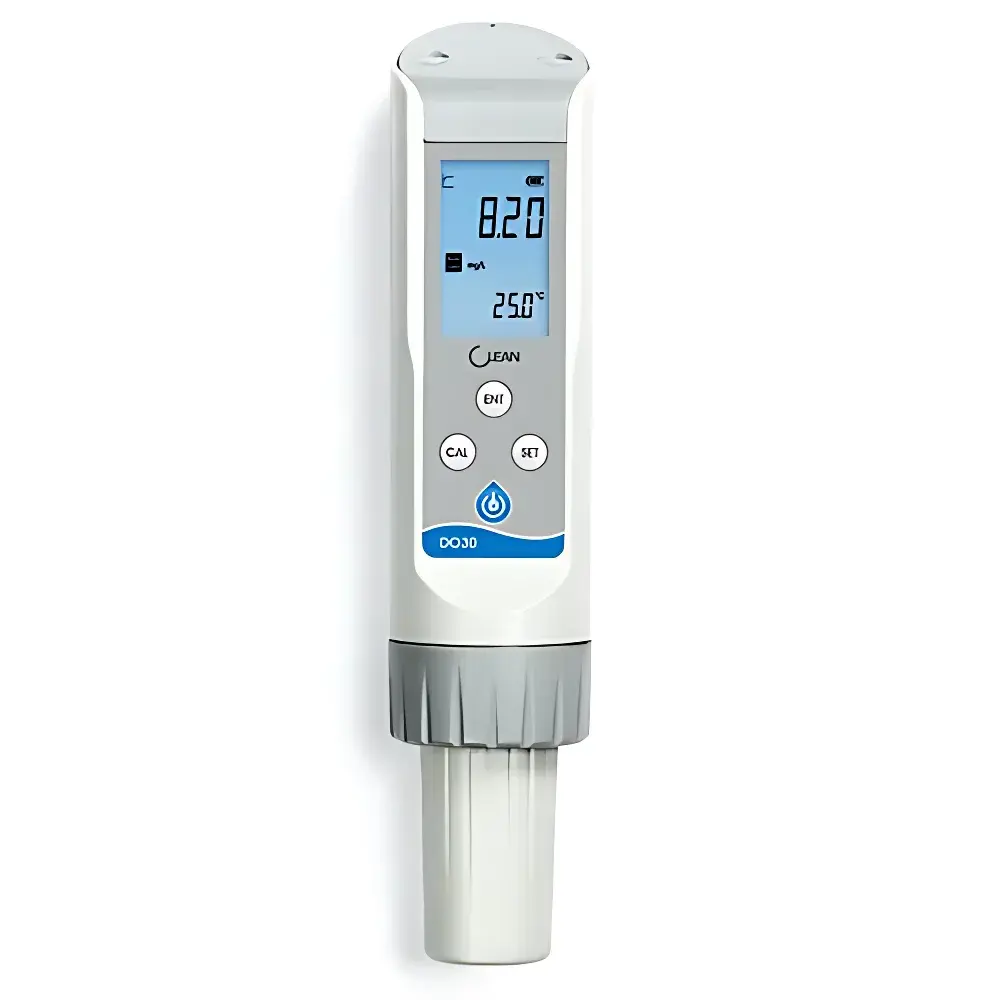
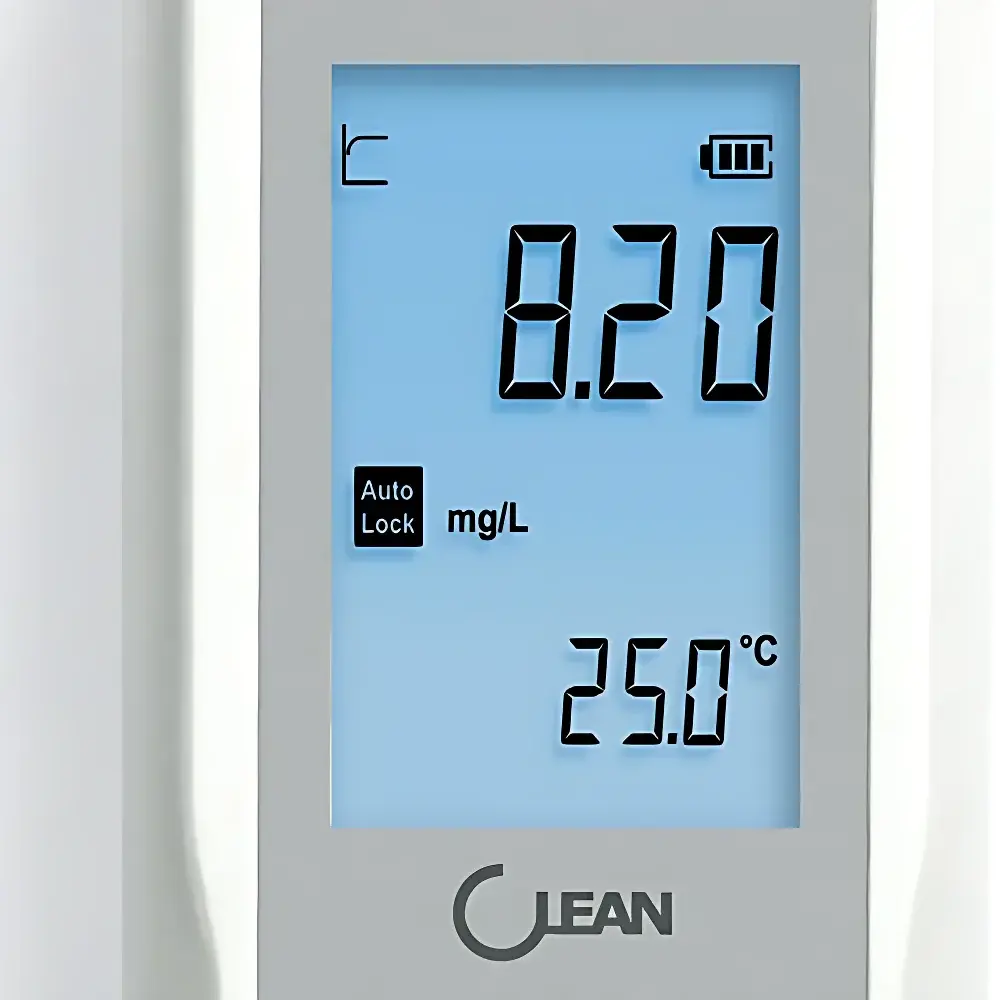
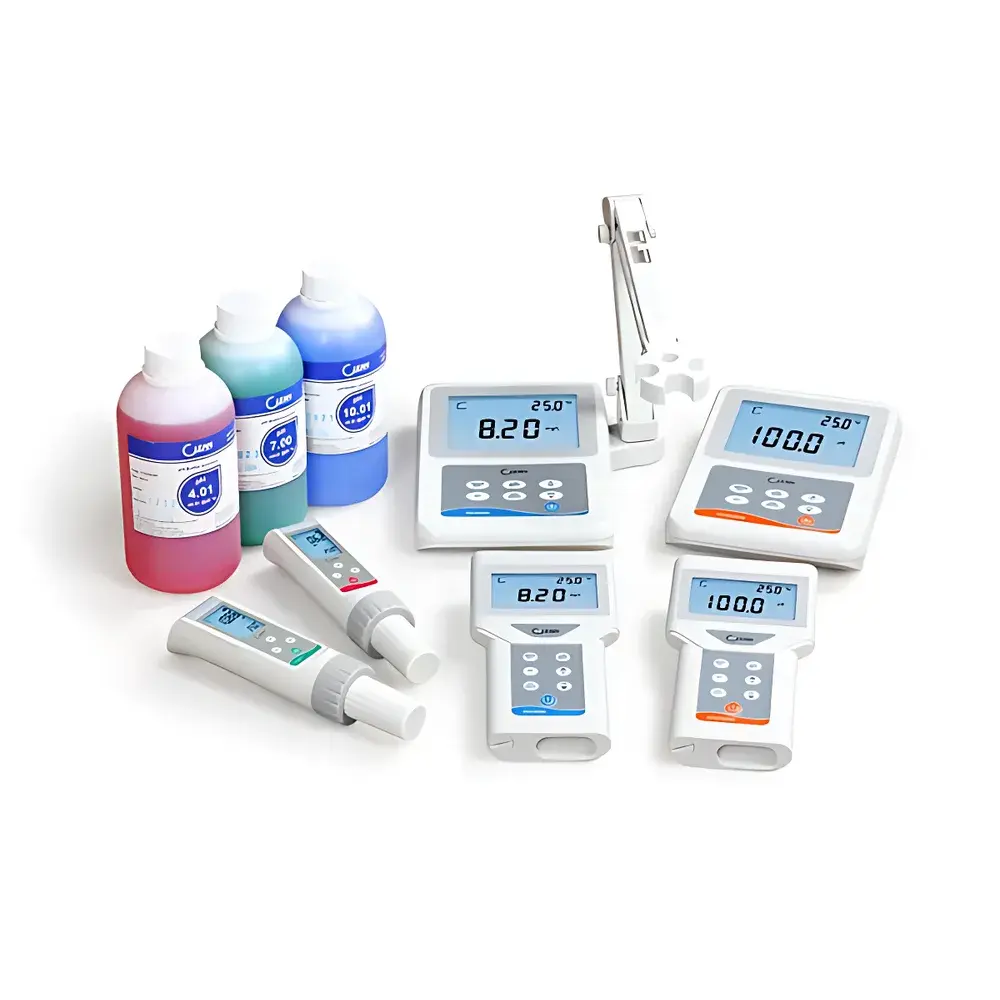
CLEAN DO30 Portable Dissolved Oxygen Meter
| Brand | CLEAN |
|---|---|
| Origin | USA |
| Model | DO30 |
| Instrument Type | Portable |
| Measurement Principle | Galvanic Cell Electrochemical Probe |
| Measurement Range | 0.00–40.00 mg/L (ppm) and 0.0–200.0% saturation |
| Accuracy | ±2% of full scale |
| Resolution | 0.01 mg/L, 0.1% saturation |
| Temperature Range | 0–100.0 °C (32–212 °F) |
| Temperature Compensation | Automatic (0–60 °C) |
| Salinity Compensation | 0.0–40.0 ppt |
| Atmospheric Pressure Compensation | 600–1100 mbar |
| Calibration | 1- or 2-point (zero-oxygen solution or air-saturated water) |
| Display | Multi-line LCD (21 × 34 mm), backlight enabled |
| IP Rating | IP67 |
| Power | 1 × 1.5 V AAA battery |
| Dimensions (H×W×D) | 185 × 40 × 48 mm |
| Weight | 95 g |
| Auto-off | 5 minutes of inactivity |
| Electrode Replaceability | User-serviceable galvanic probe with replaceable membrane cap (CS49303H1L) |
Overview
The CLEAN DO30 Portable Dissolved Oxygen Meter is an engineered field-deployable instrument designed for reliable, on-site measurement of dissolved oxygen (DO) concentration and saturation in natural waters, wastewater, aquaculture systems, and environmental monitoring applications. It employs a self-powered galvanic cell electrochemical sensor—eliminating the need for external polarization voltage—and delivers stable, low-drift readings across a broad operational temperature range. Unlike polarographic sensors requiring warm-up and frequent maintenance, the DO30’s galvanic probe provides immediate response upon immersion, with inherent stability over extended deployment intervals. Its measurement architecture complies with standard electrochemical DO methodologies referenced in ASTM D888 and ISO 5814, ensuring traceable performance for routine compliance checks and trend analysis in non-regulated or pre-screening contexts.
Key Features
- IP67-rated rugged housing ensures full dust ingress protection and submersion resistance up to 1 meter for 30 minutes—validated for field use in rain, splashing, or accidental immersion.
- Float-capable ergonomic design enables direct surface-water deployment; auto-hold function freezes reading upon stabilization for accurate retrieval from moving or turbulent water bodies.
- Multi-parameter display simultaneously shows DO concentration (mg/L or ppm), % saturation, temperature (°C/°F), and real-time electrode health status—no mode cycling required.
- Integrated automatic temperature compensation (ATC) with user-input salinity and barometric pressure correction algorithms improves accuracy in estuarine, high-altitude, or saline environments.
- Tool-free modular electrode system allows field replacement of the galvanic probe and membrane cap (part no. CS49303H1L) without calibration loss—minimizing downtime and service dependency.
- Energy-efficient design supports >1,000 hours of continuous operation on a single AAA alkaline cell; auto-backlight activates for 30 seconds in low-light conditions, and auto-power-off engages after 5 minutes of inactivity.
Sample Compatibility & Compliance
The DO30 is validated for aqueous samples including freshwater, seawater (up to 40.0 ppt salinity), treated effluent, pond and aquaculture water, and groundwater. It does not require sample filtration for typical turbidities (<100 NTU) but should avoid exposure to sulfides, hydrogen sulfide, or high concentrations of heavy metals that may poison the galvanic anode. While not certified for GLP/GMP or FDA 21 CFR Part 11 environments, its calibration traceability (via air-saturation or zero-oxygen standards), documented repeatability (≤0.1% RSD), and consistent linearity support data integrity in field QA/QC programs aligned with EPA Method 360.1 and APHA Standard Methods 4500-O G. The device meets IEC 60529 for IP67 enclosure rating and conforms to RoHS Directive 2011/65/EU for hazardous substance restrictions.
Software & Data Management
The DO30 operates as a standalone, microprocessor-controlled instrument with no onboard data logging or PC connectivity. All configuration, calibration, and diagnostic functions are managed via intuitive front-panel controls. Calibration history is not stored; however, the unit retains user-selected units (mg/L or % saturation), temperature units (°C/°F), and compensation parameters until reset. For laboratories requiring audit trails, users are advised to record calibration dates, standard values used, and field measurements manually or via external LIMS integration using printed field logs. Firmware is fixed and non-upgradable—ensuring long-term operational consistency without version drift.
Applications
- Environmental field surveys: Stream, river, lake, and wetland DO profiling for ecological health assessment.
- Wastewater treatment plant monitoring: Aeration basin optimization, effluent compliance verification, and sludge respiration rate estimation.
- Aquaculture management: Real-time DO tracking in hatcheries, raceways, and recirculating aquaculture systems (RAS) to prevent hypoxia-related mortality.
- Educational laboratories: Undergraduate water chemistry experiments emphasizing sensor principles, calibration protocols, and environmental parameter interdependence.
- Drinking water distribution: Spot-checking residual DO in storage reservoirs and post-chlorination points where re-aeration may occur.
FAQ
What calibration standards are required for the DO30?
A zero-oxygen standard (e.g., sodium sulfite solution) and/or air-saturated water at known temperature, salinity, and barometric pressure. Two-point calibration is recommended for highest accuracy across the full 0–40 mg/L range.
Can the DO30 measure DO in highly viscous or oily water samples?
No. The galvanic probe requires free diffusion of oxygen through the membrane; samples with oil films, grease, or suspended solids >100 mg/L may impede response or cause fouling. Pre-filtration is advised for such matrices.
Is the electrode compatible with other CLEAN meters?
The CS49303H1L membrane cap and probe assembly is specific to the DO30 platform and not interchangeable with CLEAN’s pH, conductivity, or ORP sensors.
Does the DO30 meet US EPA or ISO certification requirements for regulatory reporting?
It is not EPA-certified or ISO 17025-accredited as a standalone instrument; however, its measurement methodology aligns with EPA Method 360.1 and ISO 5814, supporting defensible data when used within documented QA/QC procedures.
How often should the membrane cap be replaced?
Every 2–3 months under daily field use, or immediately if visual inspection reveals drying, cracking, or electrolyte leakage—regardless of usage frequency.







