
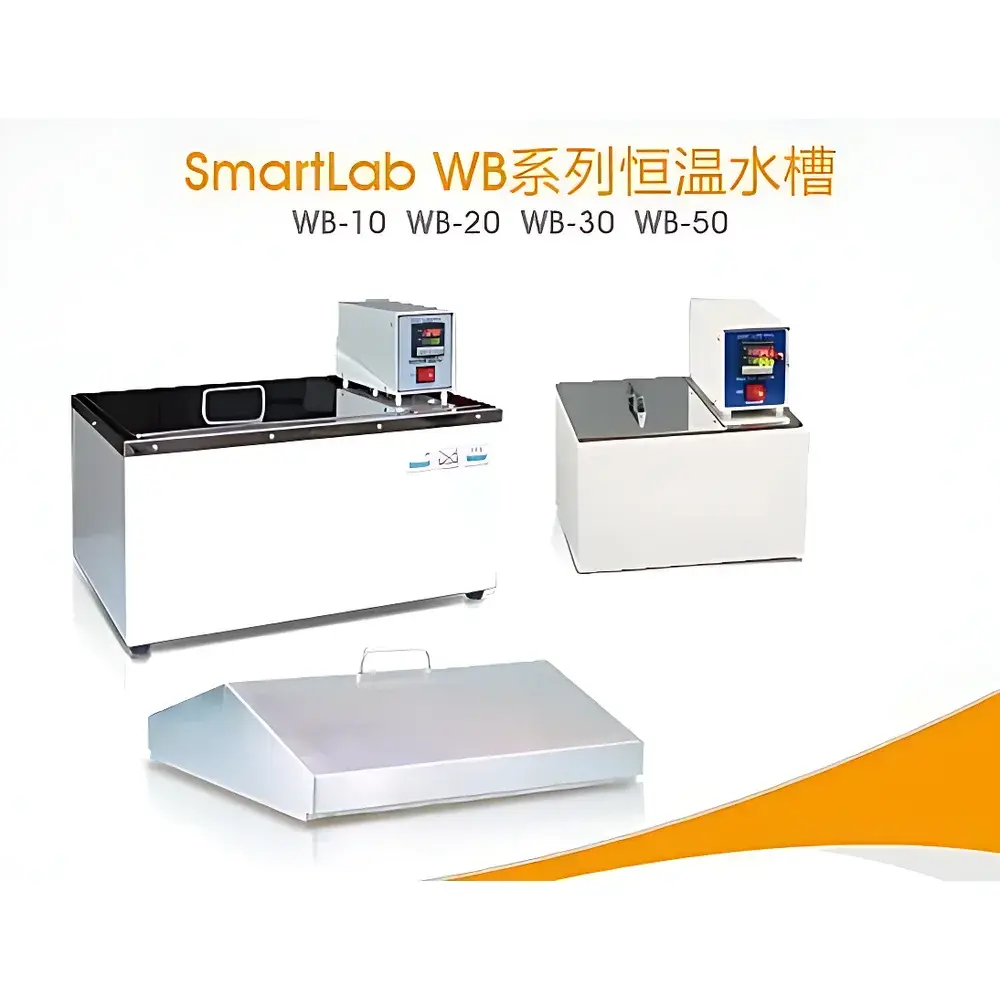
SmartLab WB-30 Precision Circulating Water Bath
| Origin | Taiwan |
|---|---|
| Manufacturer Type | Authorized Distributor |
| Regional Origin | China (Domestic Supply Chain) |
| Model | WB-30 |
| Price Range | USD 720–1,430 (FOB) |
| Instrument Category | Constant-Temperature Circulating Bath |
| Circulation Mode | Internal Recirculation Only |
| Temperature Range | Ambient +5°C to 100°C |
| Control System | Microprocessor-Based PID Controller with Touch Interface |
| Temperature Display | LED, 0.1°C Resolution |
| Temperature Accuracy | ±0.05°C |
| Sensor | Pt100 Platinum Resistance Thermometer |
| Heater | Stainless Steel Tubular Element |
| Circulation Pump | Stainless Steel Impeller Pump |
| Uniformity | ≤±0.1°C across Working Volume |
| Power Supply | 220 VAC, 50/60 Hz |
| Capacity | 30 L |
| Internal Dimensions (W×D×H) | 500 × 300 × 200 mm |
| External Dimensions (W×D×H) | 570 × 365 × 380 mm |
| Working Chamber Floor Area | 400 × 300 mm |
| Heating Power | 2000 W |
Overview
The SmartLab WB-30 Precision Circulating Water Bath is an engineered thermal management system designed for laboratory applications requiring stable, uniform, and repeatable temperature control within the range of ambient +5°C to 100°C. Built upon a robust stainless steel chassis and integrated internal recirculation architecture, it employs a high-stability Pt100 platinum resistance thermometer coupled with a microprocessor-driven PID control algorithm to deliver real-time thermal regulation with ±0.05°C accuracy and 0.1°C digital resolution. Unlike open-bath or static water baths, the WB-30 actively maintains spatial homogeneity—achieving ≤±0.1°C temperature deviation across its 30-liter working volume—through continuous circulation via a corrosion-resistant stainless steel impeller pump. This ensures consistent thermal transfer to immersed equipment such as viscometers, spectrophotometer cuvette holders, calibration standards, and reaction vessels. The unit complies with fundamental safety and electromagnetic compatibility requirements per IEC 61010-1 and is constructed to support long-term operation under GLP-aligned laboratory workflows.
Key Features
- Pt100 platinum RTD sensor with traceable calibration capability for metrological integrity
- Microprocessor-based PID controller with auto-tuning function and intuitive touch interface
- Stainless steel tubular heating element rated at 2000 W for rapid thermal response and durability
- Internally recirculating stainless steel pump ensuring uniform heat distribution without external plumbing
- LED digital display with 0.1°C resolution and real-time setpoint/actual temperature readout
- Thermal chamber constructed from 304 stainless steel interior and insulated cold-rolled steel exterior
- Working platform dimensions of 400 × 300 mm accommodate standard laboratory accessories and modular fixtures
Sample Compatibility & Compliance
The WB-30 supports immersion of glassware, metal probes, plastic tubing, and sealed sample containers up to 300 mm in height. Its open-top bath design allows direct insertion of analytical instruments requiring external temperature stabilization—including rotational rheometers, differential scanning calorimeters (DSC), and density meters. The unit meets general electrical safety requirements outlined in IEC 61010-1 for laboratory equipment and conforms to RoHS Directive 2011/65/EU regarding hazardous substance restrictions. While not certified for Class I Division 1 hazardous locations, it is suitable for use in ISO 17025-accredited testing laboratories where documented thermal stability and instrument calibration traceability are required. Optional third-party calibration certificates (NIST-traceable) are available upon request.
Software & Data Management
The WB-30 operates as a standalone analog-digital hybrid system with no built-in data logging or remote connectivity. All operational parameters—including setpoint, actual temperature, and status indicators—are displayed locally on the front-panel LED interface. For integration into regulated environments (e.g., pharmaceutical QC labs operating under FDA 21 CFR Part 11), users may connect external validated data loggers via the optional analog output port (0–5 V DC proportional to temperature). Audit trail generation, electronic signatures, and user access control must be implemented at the facility level using compliant third-party software platforms; the WB-30 itself does not store historical temperature records or support network authentication protocols.
Applications
- Temperature stabilization of viscometers, densitometers, and refractometers during routine QC testing
- Pre-conditioning of polymer samples prior to mechanical or rheological characterization
- Calibration of thermocouples, RTDs, and liquid-in-glass thermometers against reference standards
- Controlled incubation of enzyme assays and biochemical reaction mixtures requiring precise thermal profiles
- Supporting ASTM D445, ISO 3104, and USP viscosity measurement protocols through bath temperature compliance
- Thermal equilibration of reference materials used in inter-laboratory proficiency testing programs
FAQ
Does the WB-30 support external temperature probe input for dual-sensor verification?
No—the WB-30 uses only its integrated Pt100 sensor for feedback control and does not accept external probe inputs.
Is the circulation flow rate adjustable?
No—flow is fixed at approximately 12 L/min to ensure optimal thermal uniformity without cavitation or vibration-induced instability.
Can the WB-30 operate continuously at 100°C for extended periods?
Yes—it is rated for continuous duty at maximum temperature, provided ambient conditions remain below 30°C and ventilation clearance of ≥10 cm is maintained on all sides.
What maintenance is required for long-term reliability?
Annual inspection of pump seals, cleaning of heater surface deposits with citric acid solution, and verification of sensor drift using a calibrated reference thermometer are recommended.
Is deionized water mandatory for operation?
While not strictly required, use of deionized or distilled water significantly extends heater life and prevents scale buildup that compromises thermal transfer efficiency and sensor accuracy.



