
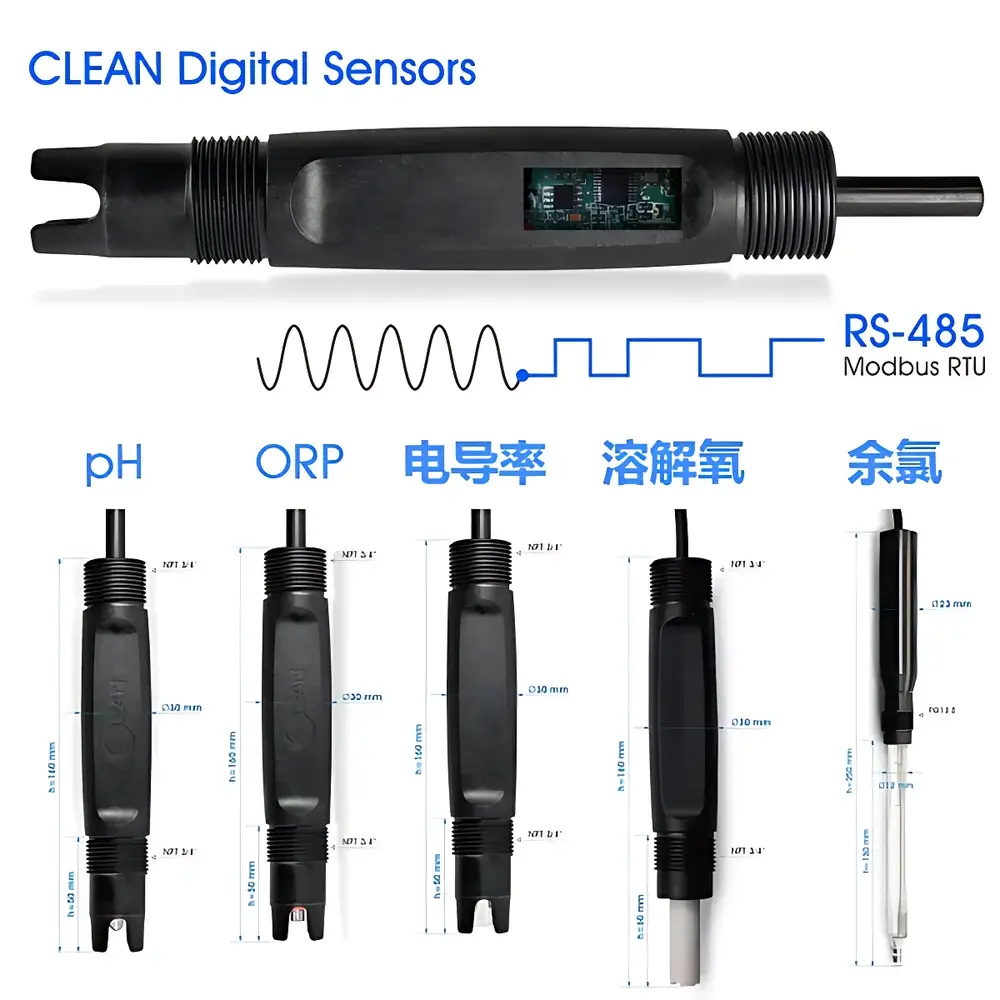
CLEAN CS3523D Digital Conductivity Electrode with RS-485 Output
| Brand | CLEAN |
|---|---|
| Origin | Taiwan |
| Model | CS3523D |
| Detection Parameter | Conductivity (single-parameter) |
| Form Factor | Pen-type |
| Conductivity Range | 0.00–20.00 µS/cm |
| TDS Range | 0–10.00 ppm |
| Resistivity Range | 0–10.00 MΩ·cm (inferred from low-conductivity context) |
| Salinity Range | 0.0–260.0 g/L |
| Temperature Range | −10.0–110.0 °C |
| Accuracy | ±0.5% FS |
| Minimum Resolution | 0.01 µS/cm |
| Electrode Constant | K = 0.01 cm⁻¹ |
| Reference Temperature | 15.0–35.0 °C |
| Temperature Coefficient | 0.00–10.00 %/°C |
| TDS Factor | 0.40–1.00 |
| Pressure Rating | 0 to −8 bar (vacuum-rated) |
| Housing Material | Polypropylene (PP) |
| Wetted Parts | Glass body, platinum electrodes |
| Connection | NPT 3/4″ |
| Cable Length | 5 m |
| Interface | RS-485 Modbus RTU |
| Power Supply | DC 12 V |
| Output Signals | Conductivity, TDS, Temperature |
| Ingress Protection | IP68 |
Overview
The CLEAN CS3523D is a high-precision, digital two-electrode conductivity sensor engineered for continuous, stable measurement in ultra-pure and low-conductivity water systems—including pharmaceutical-grade purified water (PW), water for injection (WFI), semiconductor rinse water, and laboratory-grade ultrapure water (UPW). Unlike analog sensors requiring external transmitters, the CS3523D integrates a calibrated signal conditioning circuit and embedded Modbus RTU protocol stack, enabling direct digital communication over RS-485 networks. Its K = 0.01 cm⁻¹ electrode geometry minimizes polarization effects and ensures linear response across the 0.00–20.00 µS/cm range—critical for applications where trace ionic contamination must be quantified with sub-µS/cm resolution. The sensor operates on a stable DC 12 V supply and features an IP68-rated polypropylene housing with glass-platinum wetted components, ensuring long-term chemical inertness in aggressive low-ionic-strength environments.
Key Features
- Digital RS-485 output with native Modbus RTU protocol—eliminates analog signal degradation and enables multi-drop network configuration (up to 32 nodes)
- Ultra-low-range optimized design: 0.00–20.00 µS/cm full scale with 0.01 µS/cm resolution and ±0.5% FS accuracy referenced to NIST-traceable calibration standards
- K = 0.01 cm⁻¹ two-electrode cell fabricated with precision-plated platinum electrodes and borosilicate glass insulation for minimal capacitance drift and thermal hysteresis
- Integrated Pt1000 temperature sensor with automatic temperature compensation (ATC); configurable temperature coefficient (0.00–10.00 %/°C) per ASTM D1125 and ISO 7888
- Vacuum-rated construction (0 to −8 bar) supports inline installation in recirculating UPW loops with negative-pressure headers
- NPT 3/4″ process connection and 5 m shielded, twisted-pair cable with tinned copper conductors for EMI resilience in industrial control cabinets
Sample Compatibility & Compliance
The CS3523D is validated for use in GMP-compliant water systems meeting USP , EP 2.2.38, and JP 2.07 specifications for conductivity testing of purified and water-for-injection. Its low K-value cell avoids concentration polarization during low-flow or static immersion conditions typical in validation skids and point-of-use monitoring. The PP housing and glass-platinum interface are compatible with deionized water, ozone-treated PW, and hydrogen-peroxide-sanitized distribution loops. All materials comply with FDA 21 CFR Part 177 for indirect food contact, and the sensor’s design supports GLP/GMP audit requirements—including electronic calibration logs, firmware version traceability, and Modbus register-level data integrity verification. No lubricants, adhesives, or elastomers contact the sample path, eliminating leachable organics that could compromise TOC or particle counts.
Software & Data Management
Modbus RTU register mapping includes dedicated holding registers for real-time conductivity (µS/cm), compensated TDS (ppm), salinity (g/L), and temperature (°C), each updated at 1 Hz default polling rate. Configuration registers allow user-defined TDS conversion factors (0.40–1.00), reference temperature (15.0–35.0 °C), and temperature compensation curves. When integrated with SCADA, DCS, or LIMS platforms (e.g., Siemens Desigo, Rockwell FactoryTalk, LabVantage), the sensor supports automated data timestamping, alarm thresholds (high/low limits per parameter), and audit-trail-ready event logging per FDA 21 CFR Part 11 requirements. Firmware updates are performed via Modbus function code 16 (Write Multiple Registers), preserving calibration coefficients and device identity across revisions.
Applications
- Continuous monitoring of ultrapure water resistivity (>18.2 MΩ·cm) in semiconductor fab UPW distribution systems
- In-line conductivity verification during pharmaceutical PW/WFI system sanitization cycles (e.g., hot water at 80 °C)
- Real-time detection of ionic breakthrough in mixed-bed ion exchange polishing units
- Validation of reverse osmosis membrane integrity in biotech process water generation skids
- Low-conductivity leak detection in double-tube heat exchangers used in clean steam generators
- Environmental monitoring of deionized rinse water in electroplating effluent treatment lines
FAQ
Does the CS3523D require a separate transmitter or controller to operate?
No. It is a fully digital sensor with built-in signal processing and Modbus RTU firmware—only a Modbus master (e.g., PLC, RTU, or gateway) and DC 12 V power are required.
Can this electrode be calibrated in situ without removal from the process line?
Yes. Calibration is performed using standard KCl solutions (e.g., 0.01 mol/kg) via Modbus register commands; no physical access to internal electronics is needed.
Is the sensor suitable for high-temperature applications such as hot water sanitization at 80 °C?
Yes. Its rated temperature range extends to 110.0 °C, and the Pt1000 sensor provides accurate ATC even during rapid thermal transients common in SIP cycles.
How is electrical isolation maintained in grounded industrial enclosures?
The RS-485 interface incorporates galvanic isolation (2.5 kV RMS), and the power input is opto-isolated—ensuring noise immunity in electrically noisy motor-control environments.
What documentation is provided for regulatory compliance?
Each unit ships with a factory calibration certificate (NIST-traceable), material compliance dossier (RoHS, REACH), and Modbus register map—fully aligned with Annex 11 and EU GMP Annex 11 expectations for digital instrumentation.



