
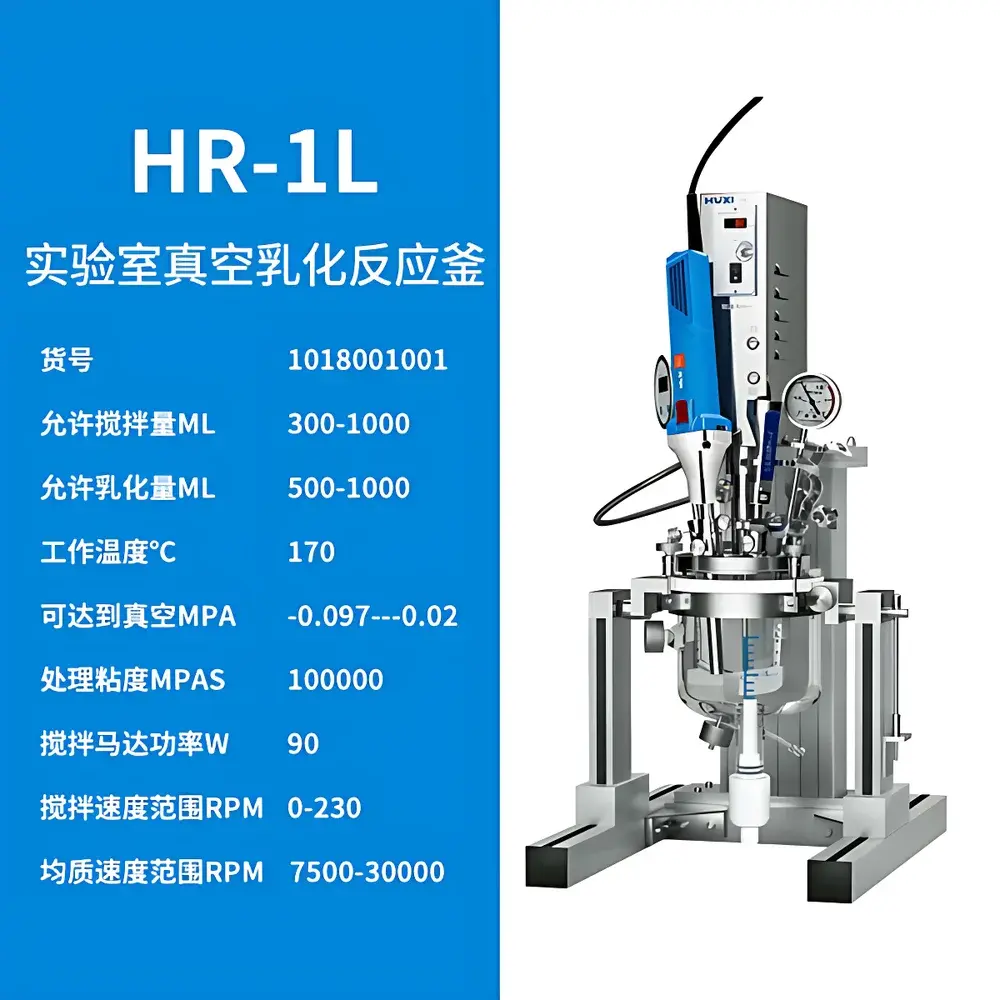
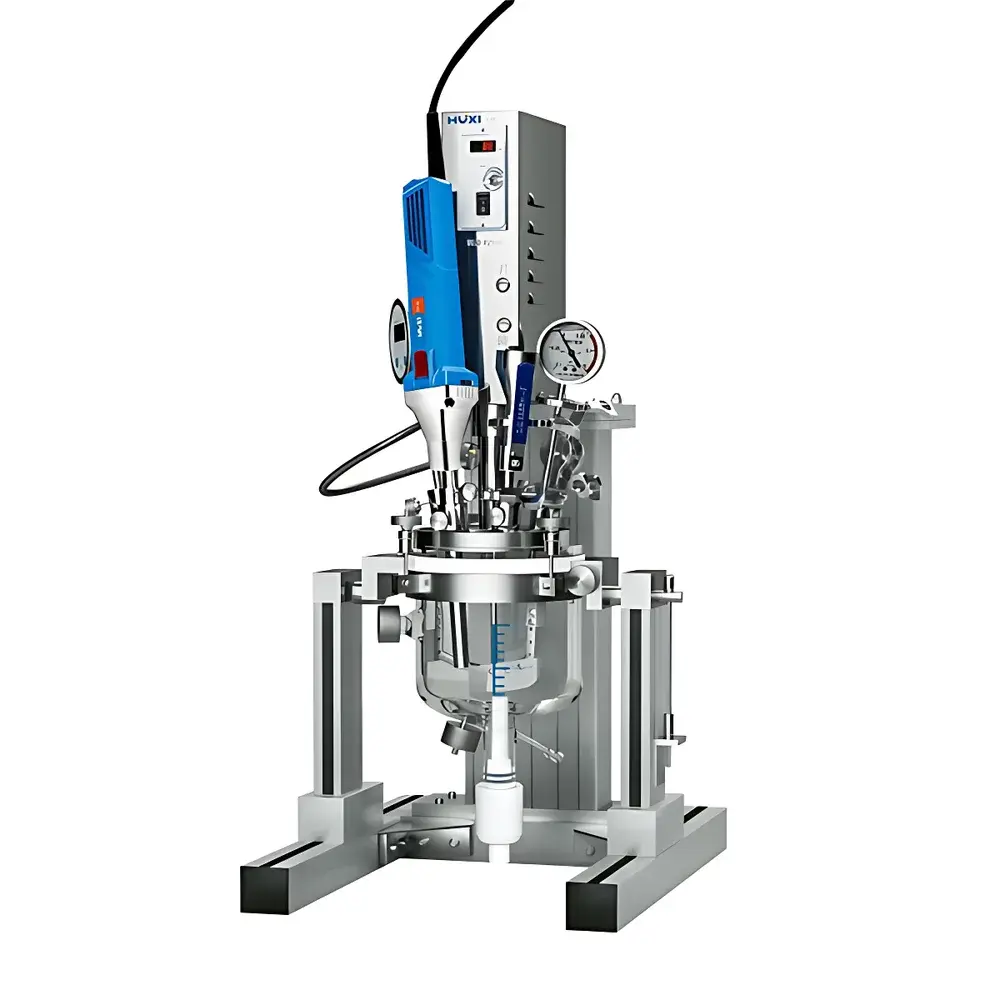
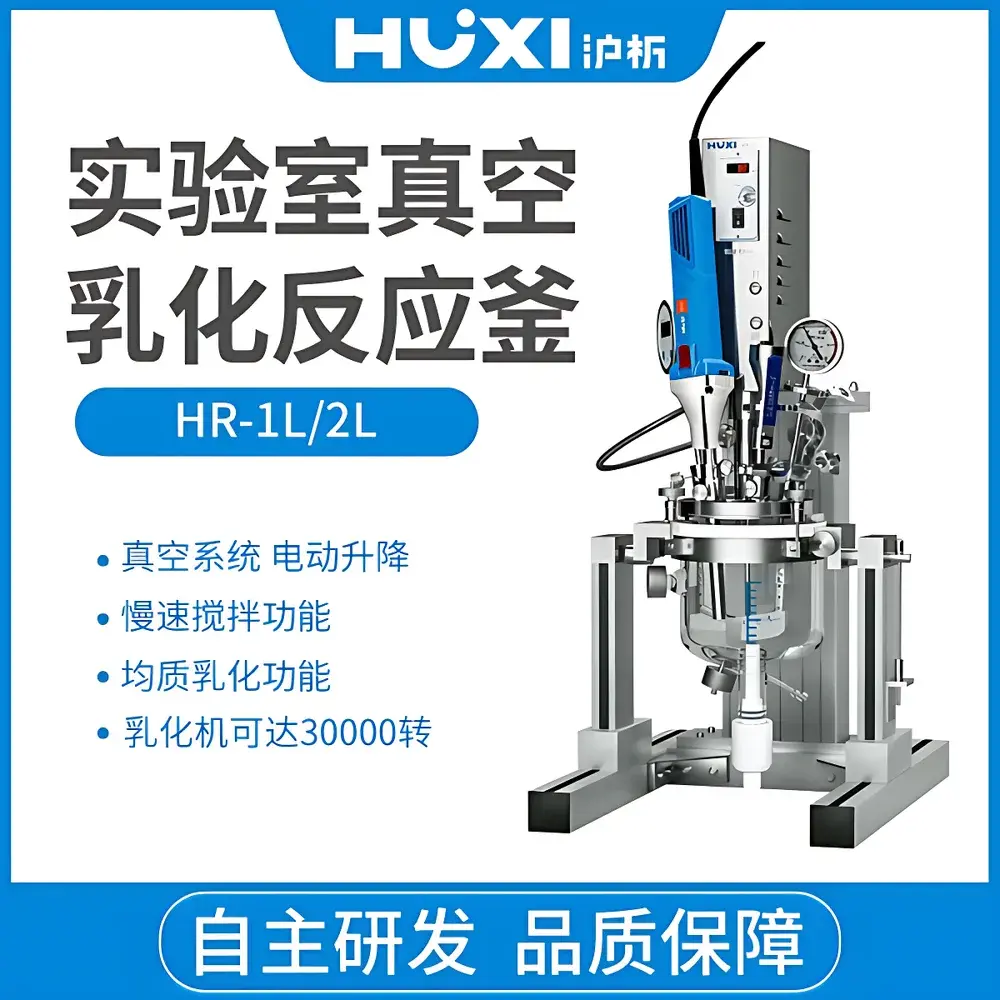
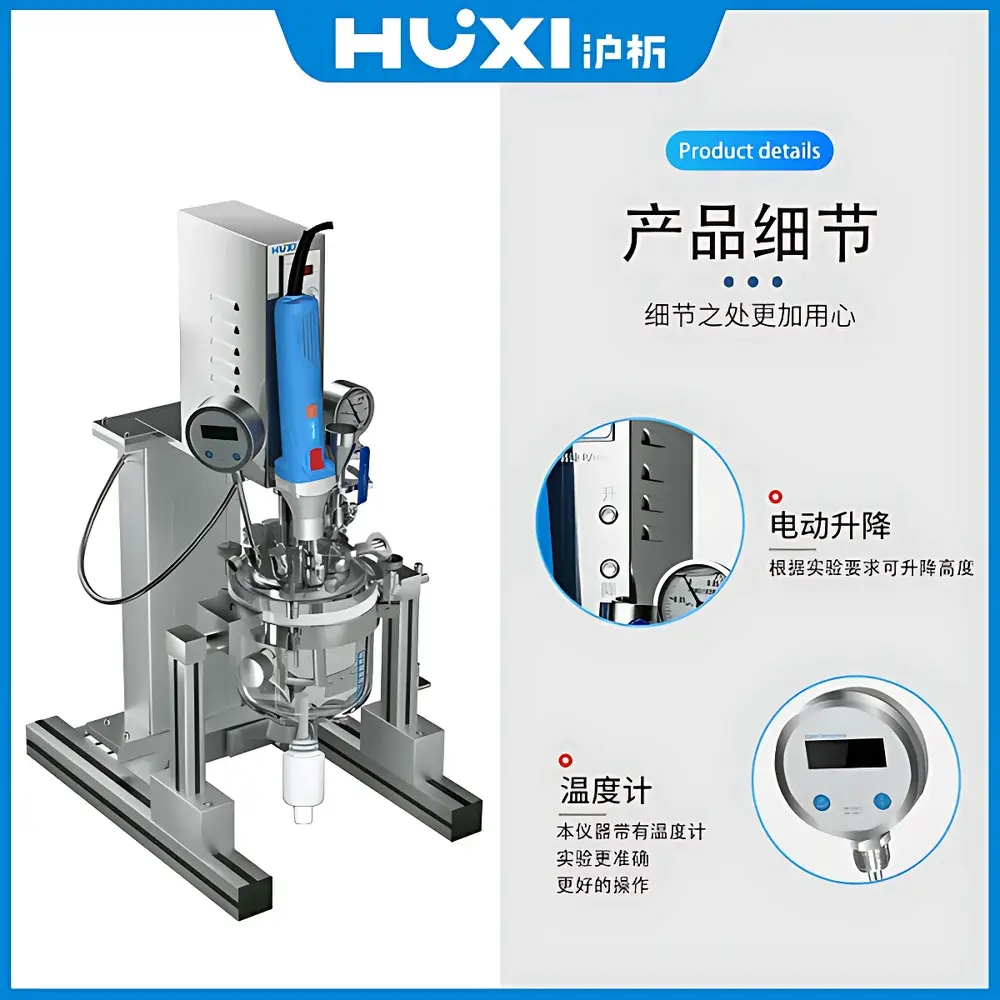
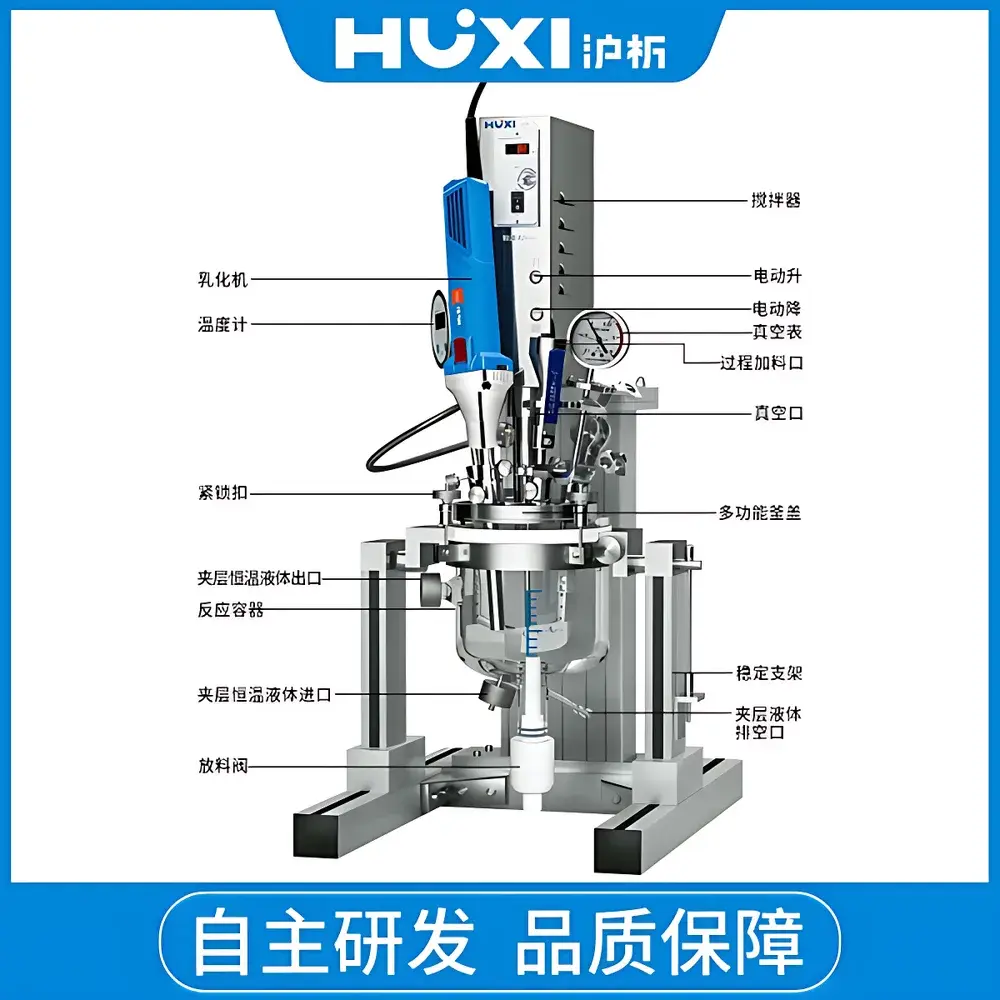
HUXI HR-1L Vacuum Emulsifying Mixer & Reaction Vessel
| Brand | HUXI |
|---|---|
| Origin | Shanghai, China |
| Manufacturer Type | Direct Manufacturer |
| Region Classification | Domestic (China) |
| Model | HR-1L |
| Price | ¥70,000 |
Overview
The HUXI HR-1L Vacuum Emulsifying Mixer & Reaction Vessel is a benchtop process-scale laboratory system engineered for controlled dispersion, emulsification, homogenization, and mixing under vacuum or positive pressure conditions. Based on Couette flow dynamics and high-shear rotor-stator interaction principles, the system integrates a jacketed glass or stainless steel reaction vessel (1 L nominal capacity), dual-drive agitation (macro-mixing + high-shear emulsification), hermetic vacuum sealing (down to ≤1 mbar), and precise thermal management via circulating fluid (−20 °C to +120 °C typical range). Designed for scalability from lab to pilot line, it replicates key unit operations found in pharmaceutical, cosmetic, battery electrolyte, and polymer synthesis workflows—enabling process parameter optimization, formulation development, and regulatory-compliant small-batch production under GLP-aligned conditions.
Key Features
- Dual-agitation architecture: Top-mounted anchor or paddle stirrer (0–200 rpm, torque-controlled) for bulk mixing and suspension of high-viscosity phases, paired with a bottom-inserted high-shear rotor-stator homogenizer (0–3500 rpm, adjustable shear intensity) for droplet size reduction and particle deagglomeration.
- Vacuum-compatible sealed vessel: Borosilicate glass (DIN 28740) or AISI 316L stainless steel construction; vacuum-rated mechanical seal with PTFE-graphite packing; integrated vacuum gauge and pressure relief valve compliant with PED 2014/68/EU for safe operation up to 0.6 MPa gauge pressure.
- Thermal control system: Double-jacketed vessel with external chiller/heater circulation; Pt100 RTD sensor (±0.2 °C accuracy) embedded in vessel wall; programmable temperature ramping and hold profiles via PID controller.
- Real-time process monitoring: Integrated digital sensors for temperature (vessel wall and medium), absolute pressure (capacitive transducer), and motor load/torque (for viscosity trend estimation); all signals logged at 1 Hz resolution.
- Modular design: Quick-release clamps for vessel access; standardized DIN 2817 ports for optional add-ons including pH probe, conductivity cell, reflux condenser, or feed syringe pump interface.
Sample Compatibility & Compliance
The HR-1L accommodates aqueous, solvent-based, and highly viscous systems—including o/w and w/o emulsions, polymer melts (up to 500,000 mPa·s), ceramic slurries, electrode slurry formulations (e.g., NMC cathode dispersions), and heat-sensitive actives (e.g., peptides, retinoids). It supports ASTM D4315 (emulsion stability), ISO 1628-1 (polymer solution viscosity), and USP (droplet size distribution in injectables) method development. All wetted parts comply with USP Class VI biocompatibility; vacuum and pressure components meet ASME BPE-2022 surface finish requirements (Ra ≤ 0.8 µm for stainless steel variants). Full audit trail capability (user logins, parameter changes, event timestamps) satisfies FDA 21 CFR Part 11 readiness when paired with optional HUXI LabSuite software.
Software & Data Management
The system operates via an embedded industrial touchscreen HMI (10.1″ capacitive, IP65-rated) with intuitive workflow navigation. Process recipes—including agitation speed profiles, vacuum ramp rates, temperature setpoints, and hold durations—are stored locally with version control and user-level permissions (admin/operator/viewer). Raw sensor data (CSV export) and event logs are timestamped and signed; optional Ethernet/Wi-Fi connectivity enables integration into LIMS or MES platforms via Modbus TCP or OPC UA protocols. For advanced analysis, HUXI LabSuite (Windows-based, optional license) provides real-time viscosity modeling (using power-law correlation), droplet size prediction algorithms (based on Weber number and capillary number), and automated report generation compliant with ISO/IEC 17025 documentation standards.
Applications
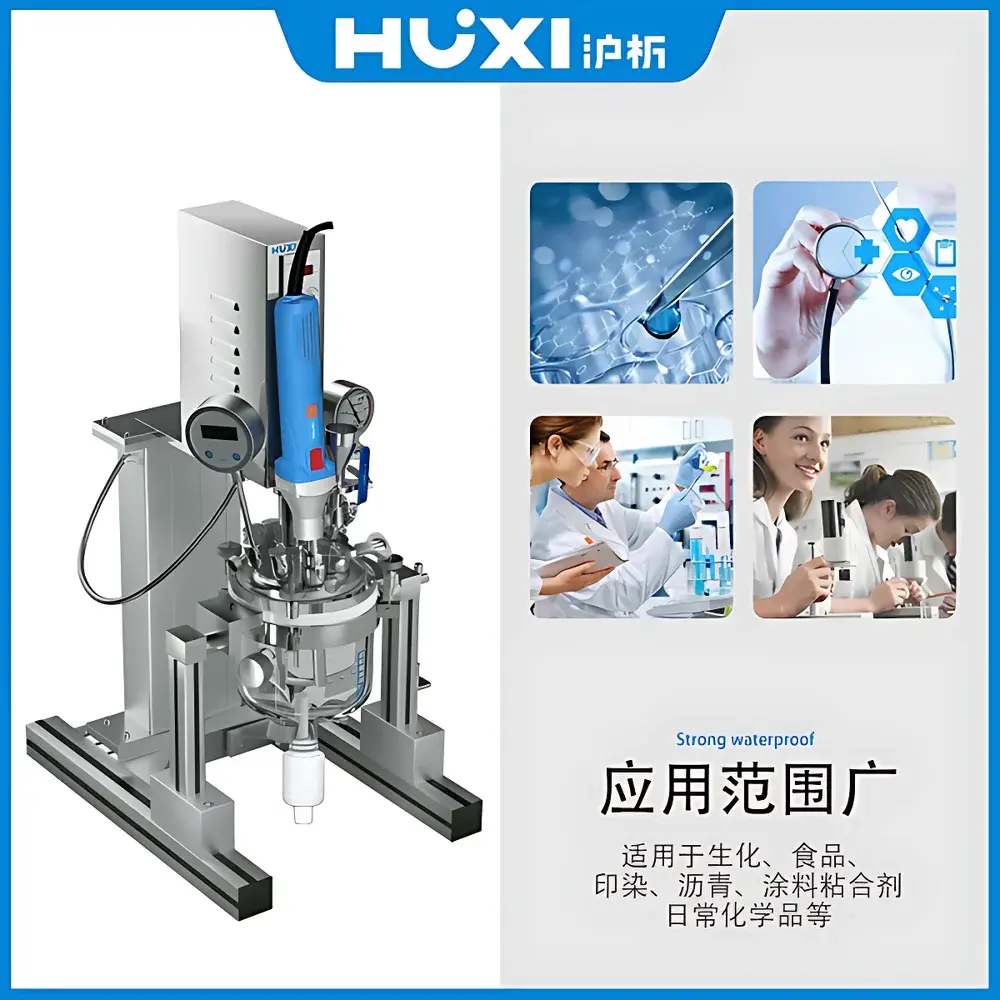
- Pharmaceutical R&D: Development of topical emulsions (creams, gels), nanostructured lipid carriers (NLCs), and sterile ophthalmic suspensions under inert gas/vacuum to prevent oxidation.
- Personal care formulation: High-solids pigment dispersion in sunscreen lotions; cold-process emulsification of heat-labile botanical extracts; rheology modifier activation in thickened surfactant systems.
- Battery materials: Homogeneous dispersion of conductive carbon black and LiCoO₂ in PVDF/NMP solutions; shear-controlled slurry deaeration prior to coating trials.
- Polymer synthesis: In-situ monitoring of viscosity rise during free-radical or condensation polymerization; controlled monomer addition under vacuum to suppress side reactions.
- Food science: Model system development for fat crystal network formation in dairy analogs; enzymatic transesterification under reduced oxygen partial pressure.
FAQ
What is the maximum operating temperature and pressure for the glass vessel variant?
The standard borosilicate glass vessel is rated for continuous operation up to 100 °C and −0.095 MPa (95 mbar abs) vacuum; pressure operation is not permitted with glass due to safety certification limits.
Can the system be validated for GMP manufacturing use?
Yes—the stainless steel HR-1L configuration supports IQ/OQ documentation packages, including calibration certificates for all sensors, leak test reports (helium mass spectrometry), and material traceability (EN 10204 3.1). Validation support is available through HUXI’s certified service engineers.
Is remote monitoring supported out of the box?
Basic remote status viewing (temperature, speed, vacuum level) is enabled via built-in web server; full remote control and data streaming require HUXI LabSuite with enterprise license and firewall-configured network access.
What maintenance intervals are recommended for the mechanical seal and homogenizer rotor?
Under normal operation (≤4 hrs/day, non-abrasive media), inspect the mechanical seal every 500 operating hours and replace the rotor-stator assembly every 1500 hours or after processing >200 batches of abrasive slurries.
Does the system meet explosion-proof requirements for solvent-based processes?
The base model is not ATEX-certified; however, HUXI offers optional Ex d IIB T4 explosion-proof motor enclosures and intrinsically safe sensor variants upon request—subject to site-specific hazardous area classification assessment.



