
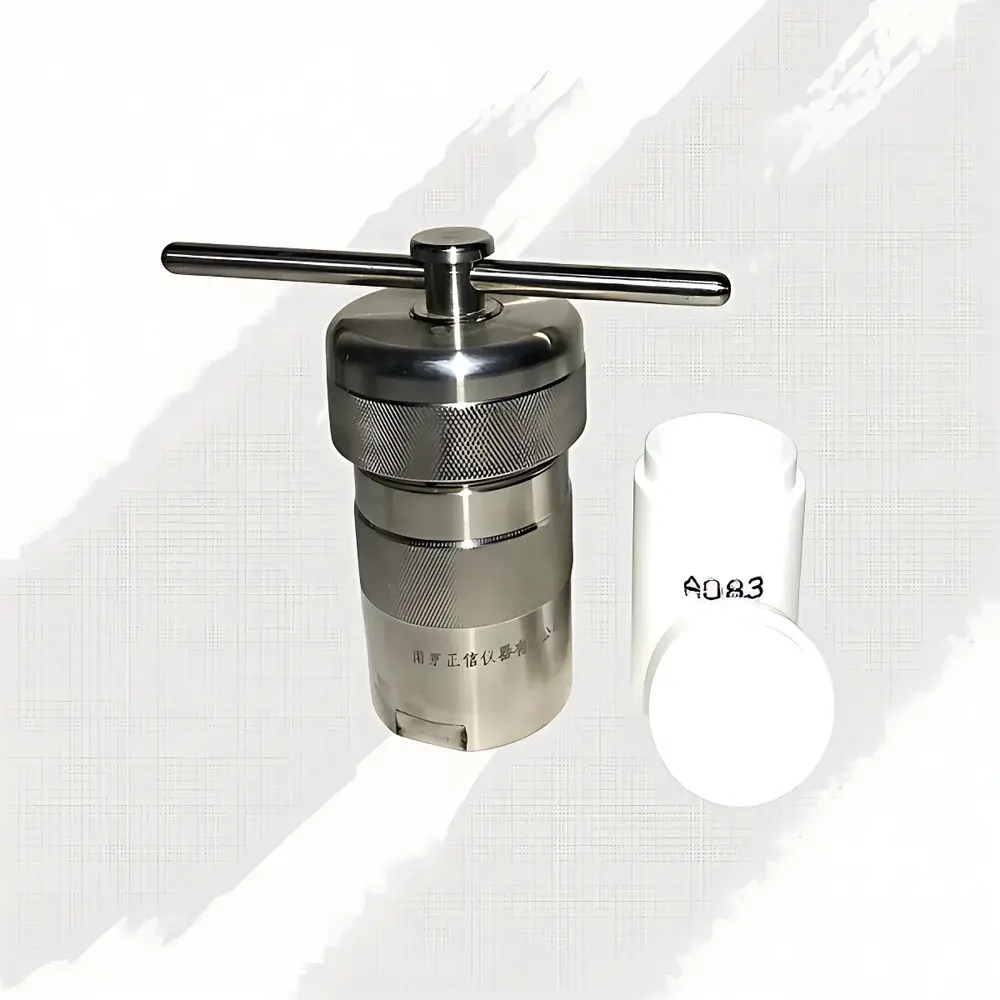
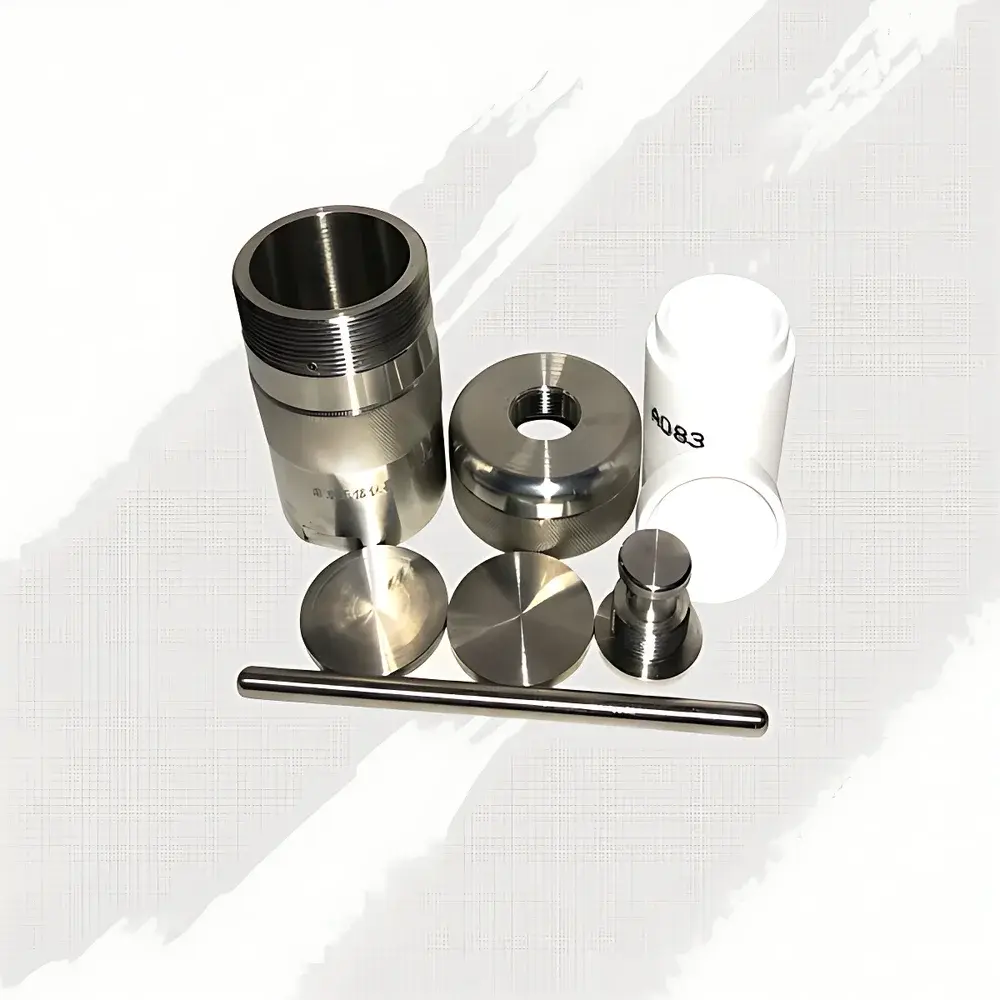
Zhengxin PF2-100ML Hydrothermal Synthesis Reactor
| Brand | Zhengxin Instrument Factory |
|---|---|
| Origin | Jiangsu, China |
| Manufacturer Type | Authorized Distributor |
| Country of Origin | China |
| Model | PF2-100ML |
| Capacity | 100 mL |
| Vessel Material | Forged 304 Stainless Steel |
| Liner Material | PTFE (F4) or PPL |
| Maximum Operating Pressure | ≤6 MPa |
| Maximum Temperature (PTFE liner) | 240 °C |
| Maximum Temperature (PPL liner) | 280 °C |
| Sealing Type | Circular Tenon-Groove + Manual Spiral Tightening |
| Safety Features | Integrated Burst Disc / Pressure Relief Port |
| Vacuum Capability | Up to –0.1 MPa (gauge) |
| Acid/Alkali Resistance | Excellent (PTFE/PPL liners) |
| Metal Blank Values | Pb < 1×10⁻¹¹ g/mL, U < 1×10⁻¹² g/mL |
Overview
The Zhengxin PF2-100ML Hydrothermal Synthesis Reactor is a precision-engineered, benchtop pressure vessel designed for controlled high-temperature, high-pressure chemical synthesis and sample digestion under inert or reactive atmospheres. Based on the principles of hydrothermal chemistry—where elevated temperature and autogenous pressure facilitate accelerated reaction kinetics and enhanced solubility—the reactor enables complete decomposition of refractory matrices including silicates, oxides, biological tissues, and organometallic compounds. Its core architecture integrates a forged 304 stainless steel outer body with a chemically inert liner (PTFE or PPL), ensuring compatibility with aggressive reagents such as hydrofluoric acid, aqua regia, and concentrated alkalis while maintaining ultra-low elemental blank levels critical for trace-metal analysis (e.g., ICP-MS, AAS). The reactor operates within a defined safety envelope: ≤6 MPa maximum pressure and up to 240 °C (PTFE) or 280 °C (PPL), making it suitable for applications ranging from nanomaterial crystallization to EPA Method 3052-compliant digestion of environmental and food samples.
Key Features
- Forged 304 stainless steel construction with precision-machined circular tenon-groove sealing interface, delivering repeatable leak-tight performance and mechanical durability across repeated thermal cycles.
- Interchangeable liners: Chemically inert PTFE (F4) liner rated to 240 °C and ≥6 MPa; optional PPL (polyphenylene sulfide) liner rated to 280 °C with superior creep resistance and enhanced stability in strong oxidizing media.
- Integrated passive overpressure protection: Pre-calibrated burst disc and dedicated relief port engineered to vent safely at pressures exceeding design limits—no external valves or active controls required.
- Ultra-low metal blank specification: Pb < 1×10⁻¹¹ g/mL and U < 1×10⁻¹² g/mL (measured per ASTM D5688 and ISO 17294-2 protocols), validated for trace-element quantification in high-purity alumina, geological standards, and clinical biosamples.
- Optimized thermal mass and uniform wall thickness ensure consistent heat transfer during oven-based ramping, minimizing thermal gradients and reducing risk of liner deformation or seal failure.
- Manual spiral tightening mechanism with torque-limiting design prevents over-torquing and preserves thread integrity over >500 operational cycles.
Sample Compatibility & Compliance
The PF2-100ML supports digestion and synthesis of diverse sample types—including soils, sediments, plant tissues, seafood, pharmaceutical excipients, rare-earth oxides, and ceramic precursors—without cross-contamination or analyte loss. It complies with key methodological frameworks: EPA Method 3052 (microwave-assisted acid digestion), ASTM D5688 (trace metal analysis in water), and ISO 17294-2 (ICP-MS sample preparation). When used with documented SOPs, the reactor meets GLP requirements for auditability, including batch-specific calibration logs, liner replacement records, and pressure/temperature exposure history. Its PTFE liner conforms to USP Class VI biocompatibility standards, supporting applications in biomedical material synthesis where leachable ion control is mandatory.
Software & Data Management
As a standalone passive reactor, the PF2-100ML does not incorporate embedded electronics or firmware. However, it is fully compatible with external process monitoring systems: thermocouple probes (K-type or T-type) can be inserted through the vent port for real-time temperature logging; pressure transducers (0–10 MPa range) may be mounted externally for validation studies. All usage data—including batch ID, liner lot number, heating profile, and post-digestion inspection notes—should be recorded manually or via LIMS-integrated electronic lab notebooks (ELN) to satisfy FDA 21 CFR Part 11 requirements for electronic records and signatures in regulated environments.
Applications
- Trace elemental analysis of environmental matrices (sludge, sediment, fly ash) per EPA SW-846 methods.
- Synthesis of metal–organic frameworks (MOFs), perovskites, and quantum dot precursors under controlled hydrothermal conditions.
- Digestion of high-purity Al₂O₃ and SiO₂ powders for ultratrace Cr, Fe, Ni, and Cu quantification by HR-ICP-MS.
- Extraction of heavy metals (Pb, Cd, As, Hg) from food and feed samples prior to GFAAS or ICP-OES measurement.
- Preparation of certified reference materials (CRMs) requiring minimal reagent blanks and reproducible dissolution yields.
- Routine QC/QA in semiconductor-grade chemical manufacturing, where metallic impurity thresholds are sub-ppt.
FAQ
What is the recommended fill volume for safe operation?
The liner should be loaded to no more than 60–70% of its nominal capacity (i.e., ≤70 mL for the 100 mL model) to accommodate thermal expansion and prevent mechanical stress on the seal interface.
Can the reactor be used in microwave digestion systems?
No—this is a convection-heated (oven/muffle furnace) reactor only. It is not microwave-transparent and must never be placed inside a microwave cavity.
How often should the PTFE liner be replaced?
Replace after 20–30 digestions involving HF or hot concentrated HNO₃/H₂SO₄, or immediately upon observing discoloration, surface pitting, or dimensional warping.
Is validation documentation available for regulatory submissions?
Yes—material certifications (304 SS mill test reports), liner compliance statements (USP Class VI, RoHS), and blank value test reports (per ISO/IEC 17025-accredited labs) are provided upon request.
Does the reactor support inert gas purging?
Yes—via the vent port using standard Swagelok fittings; recommended for oxygen-sensitive syntheses (e.g., FeS₂ nanoparticle growth) and reduction reactions.



