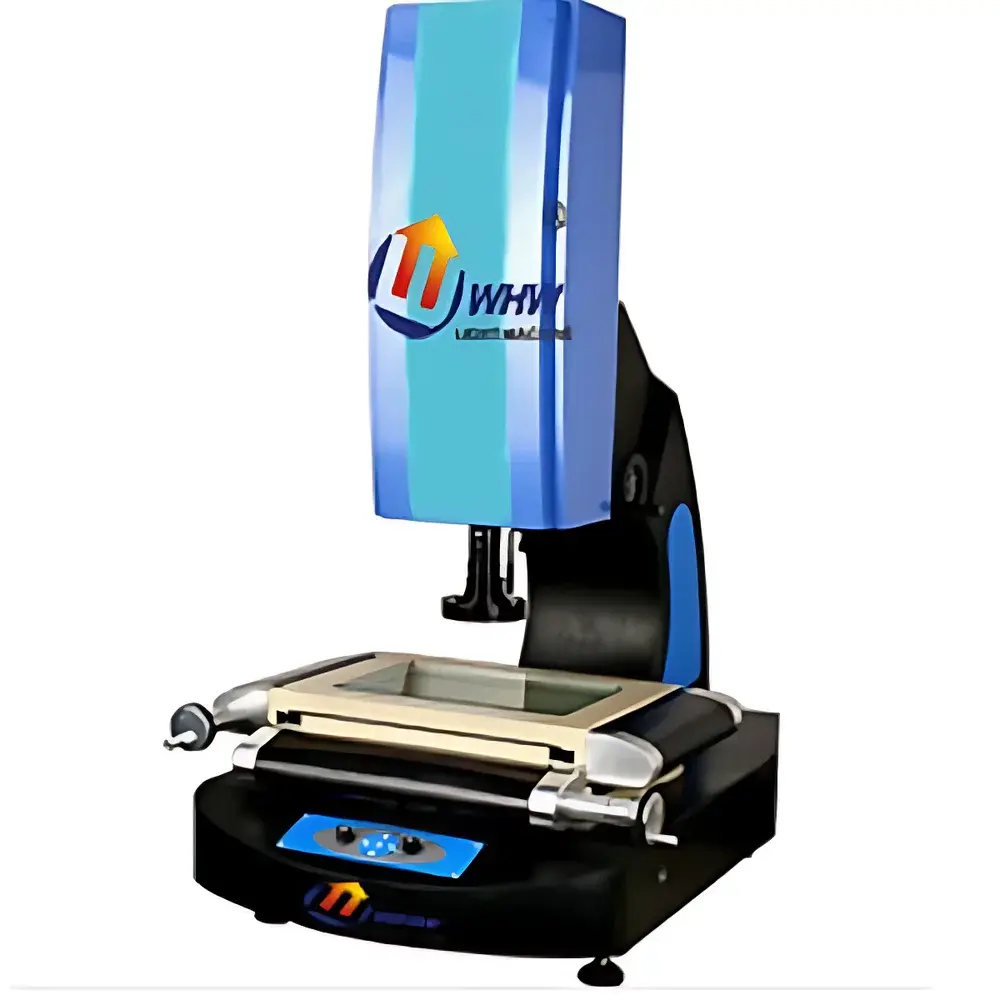
YANRUN YR-D2515 Non-Contact Vision Measuring Machine
| Brand | YANRUN |
|---|---|
| Origin | Shanghai, China |
| Manufacturer Type | Direct Manufacturer |
| Model | YR-D2515 |
| Table Surface (Metal) | 408 × 308 mm |
| Glass Stage Size | 306 × 196 mm |
| Motion Travel (X×Y) | 250 × 150 mm |
| Overall Dimensions | 929 × 612 × 1082 mm |
| Load Capacity | ≥450 kg |
| Base Platform Dimensions | 1120 × 730 × 780 mm |
| Drive Mechanism | Linear Guide Rods (X/Y), Precision Lead Screw (Z) |
| Z-Axis Stroke | 250 mm |
| Digital Readout Resolution (X/Y/Z) | 0.0005 mm |
| Positioning Accuracy (X/Y) | ≤(3 + L/200) µm |
| Imaging System | High-Resolution Color CCD Camera |
| Total Video Magnification | 30–230× (up to 440× with 2× Auxiliary Objective) |
| Illumination | Quadrant-Independent Adjustable LED Lighting |
| Power Supply | AC 220 V ±10%, 50 Hz |
| Operating Environment | 20 °C ±3 °C, 45–75% RH |
Overview
The YANRUN YR-D2515 Non-Contact Vision Measuring Machine is a high-precision coordinate metrology system engineered for dimensional inspection of small-to-medium mechanical parts, stamped components, PCB assemblies, and precision machined features. It operates on the principle of optical triangulation and digital image correlation, utilizing calibrated video magnification and sub-pixel edge detection algorithms to determine geometric attributes—including length, angle, radius, parallelism, perpendicularity, and positional tolerance—without physical probe contact. Designed for integration into quality control laboratories and production floor metrology stations, the YR-D2515 conforms to fundamental metrological traceability requirements aligned with ISO 10360-7 (coordinate measuring machines) and supports compliance with ISO/IEC 17025 calibration management frameworks when operated under controlled environmental conditions (20 °C ±3 °C, 45–75% RH).
Key Features
- Stable granite-based mechanical architecture with reinforced steel base platform (1120 × 730 × 780 mm) supporting ≥450 kg load capacity—ensuring thermal and mechanical stability during extended measurement cycles.
- Dual-stage optical measurement surface: precision-ground metal table (408 × 308 mm) for rigid part fixation and optically transparent glass stage (306 × 196 mm) enabling backlit silhouette imaging for contour and hole profile analysis.
- High-resolution imaging subsystem comprising a progressive-scan color CCD sensor coupled with a motorized 0.7–4.5× zoom lens; total magnification range extends from 30× to 230×, expandable to 440× using optional 2× auxiliary objective—enabling reliable detection of features down to ~10 µm in nominal size.
- Quadrant-controlled LED illumination system allows independent intensity adjustment across four directional zones (top, bottom, left, right), facilitating optimal contrast enhancement for diverse material surfaces—including anodized aluminum, electroplated metals, and translucent polymers.
- Precision motion system featuring linear guide rod drives on X/Y axes and a ground-lead-screw mechanism on Z-axis, delivering smooth vertical positioning over 250 mm stroke while maintaining repeatability within ±0.001 mm per axis.
- Sub-micron digital readout resolution of 0.0005 mm across all three axes, with certified 2D coordinate accuracy satisfying ≤(3 + L/200) µm (L in mm), consistent with Class II performance criteria for vision-based CMMs per VDI/VDE 2634 Part 3.
Sample Compatibility & Compliance
The YR-D2515 accommodates parts up to 250 mm × 150 mm × 250 mm (X×Y×Z travel limits), with maximum weight support exceeding 450 kg on its integrated foundation platform. It is routinely deployed for first-article inspection (FAI), GD&T verification (per ASME Y14.5), and supplier conformance testing in automotive Tier-1 suppliers, medical device contract manufacturers, and aerospace subcontractors. The system supports documentation workflows compliant with ISO 9001:2015 clause 7.1.5.2 (monitoring and measuring resources) and provides audit-ready measurement reports compatible with internal GLP/GMP record retention protocols. Environmental operation parameters meet ASTM E1250 and ISO 22476-1 recommendations for stable metrology environments.
Software & Data Management
Equipped with proprietary YANRUN VisionMetro Pro software, the YR-D2515 delivers full geometric feature recognition (lines, circles, arcs, slots, polygons), automatic edge extraction using Sobel and Canny operators, and batch measurement scripting via built-in macro language. Measurement data exports natively to CSV, DXF, and XML formats; PDF report generation includes annotated images, statistical summaries (Cp/Cpk), and traceable operator/timestamp metadata. Optional software modules support FDA 21 CFR Part 11 compliance—including electronic signatures, audit trails, and role-based access control—for regulated industries requiring documented evidence of measurement integrity.
Applications
- Dimensional validation of injection-molded plastic housings and connectors
- GD&T evaluation of machined flanges, brackets, and hydraulic valve bodies
- PCB solder paste deposit height and stencil aperture alignment verification
- Tooling wear assessment through periodic comparison of die cavity profiles
- Calibration artifact verification (e.g., step gauges, ring/plate gages) in secondary metrology labs
- Reverse engineering of legacy components lacking CAD models via point-cloud reconstruction from multi-angle image stacks
FAQ
What is the maximum part height that can be measured with full Z-axis travel?
The Z-axis provides 250 mm of vertical clearance between the lens focal plane and the glass stage surface, accommodating parts up to approximately 220 mm in height when accounting for lens working distance and fixture thickness.
Does the system support automated measurement routines for repetitive parts?
Yes—VisionMetro Pro includes template-based programming, allowing users to define measurement sequences once and deploy them across identical parts with auto-alignment via fiducial recognition.
Is NIST-traceable calibration available for this model?
YANRUN provides factory calibration certificates traceable to national standards (via CNAS-accredited partners); end-users may also perform in-house verification using certified step gages or ball bars per ISO 10360-2 guidelines.
Can the YR-D2515 integrate with MES or QMS platforms?
Through OPC UA and RESTful API interfaces (available as optional add-ons), the system supports bidirectional data exchange with major manufacturing execution systems and quality management software suites.
What maintenance is required to sustain long-term measurement accuracy?
Recommended quarterly verification of lens calibration and lighting uniformity; annual recertification of encoder linearity and axis orthogonality is advised under ISO/IEC 17025-aligned quality programs.