
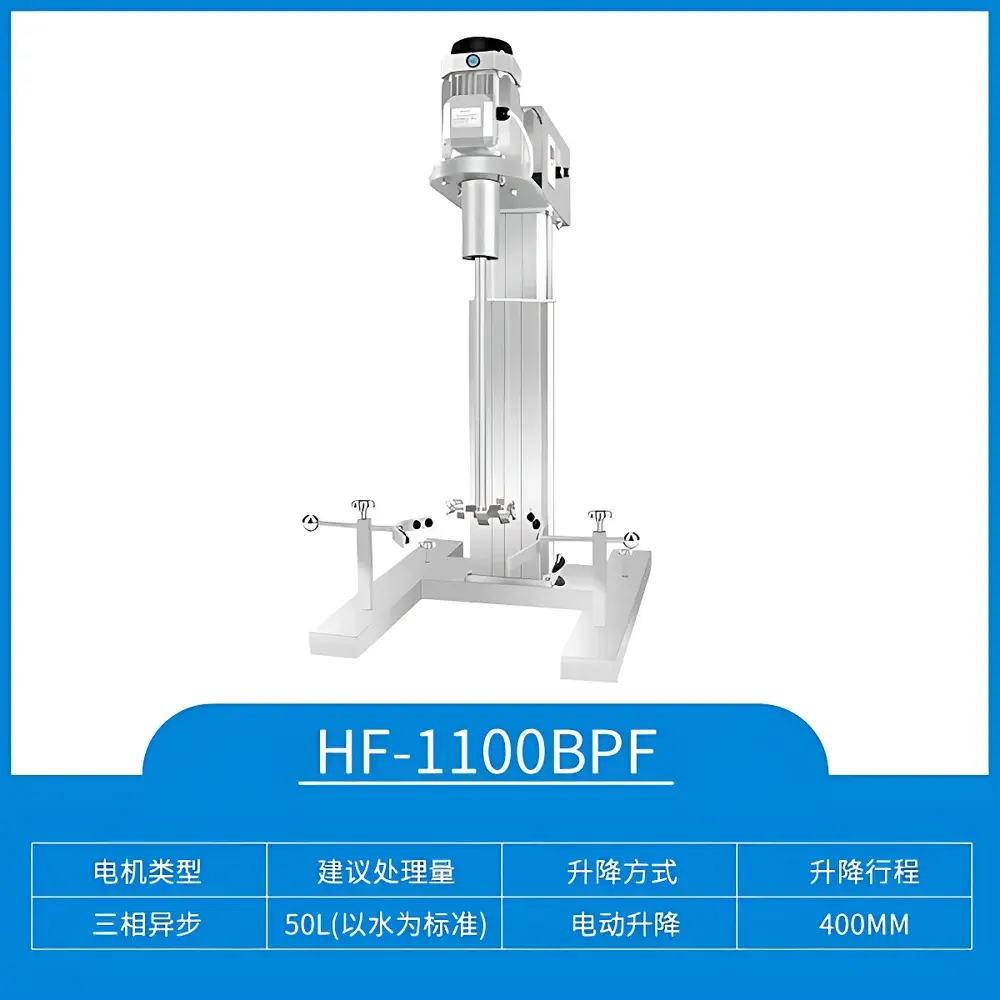
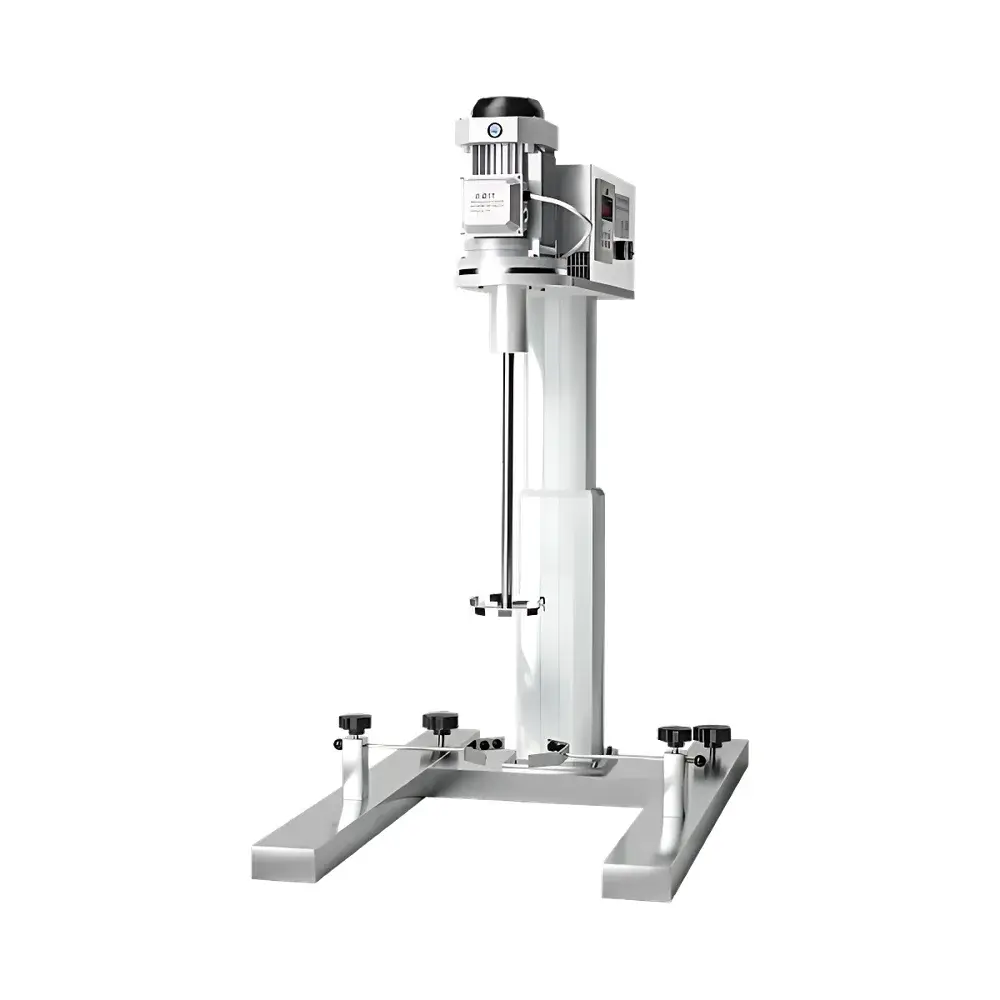
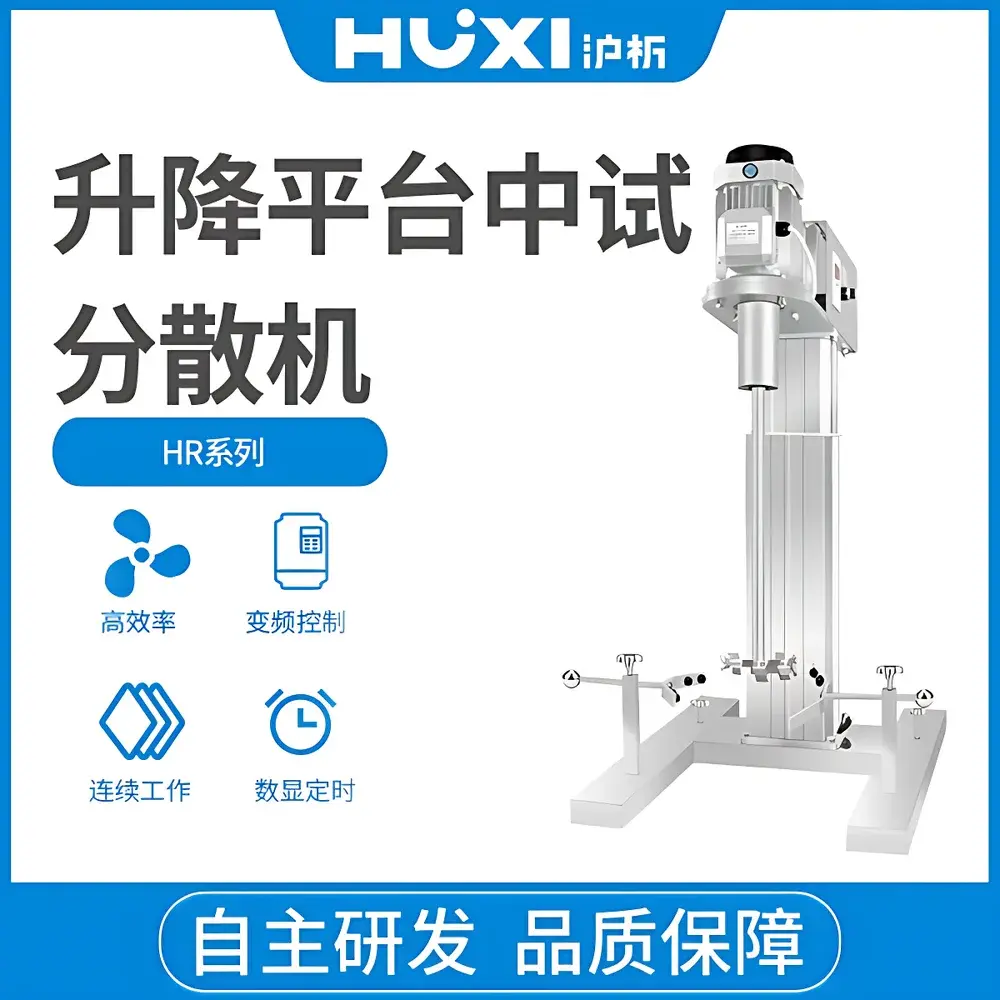
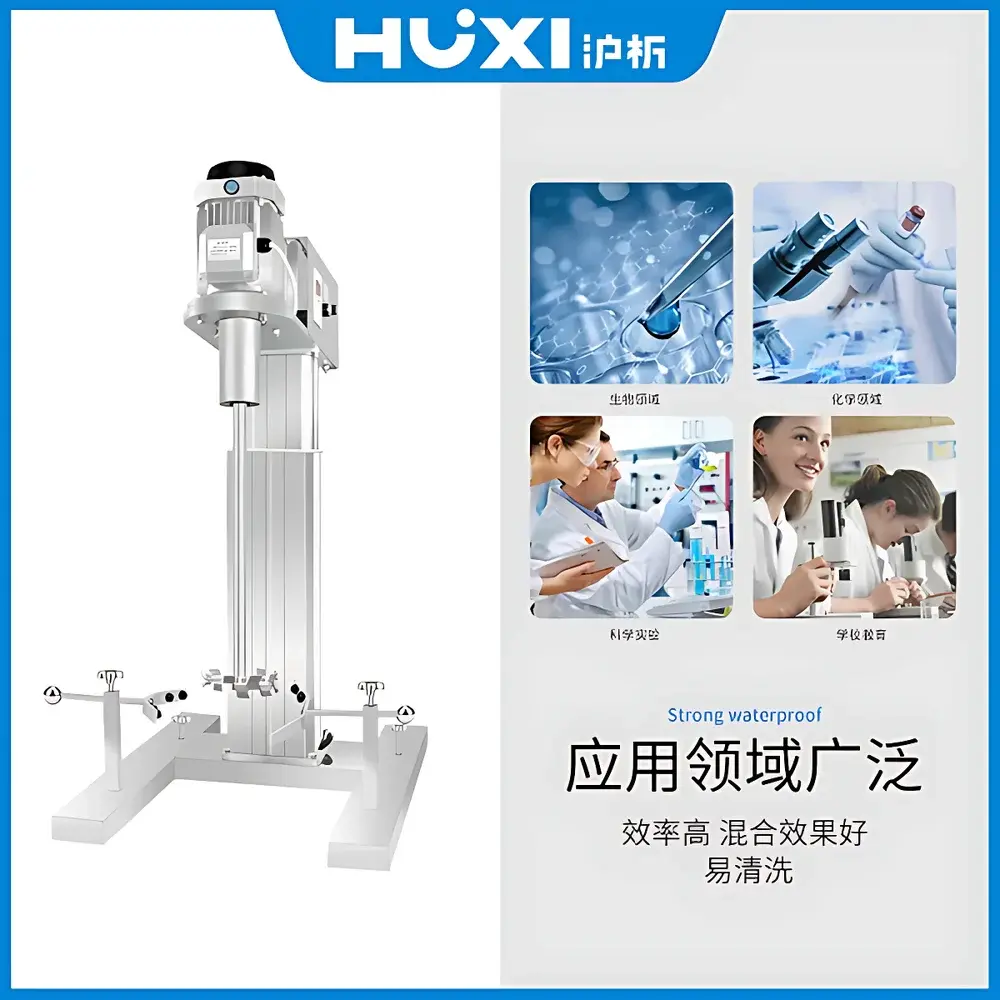
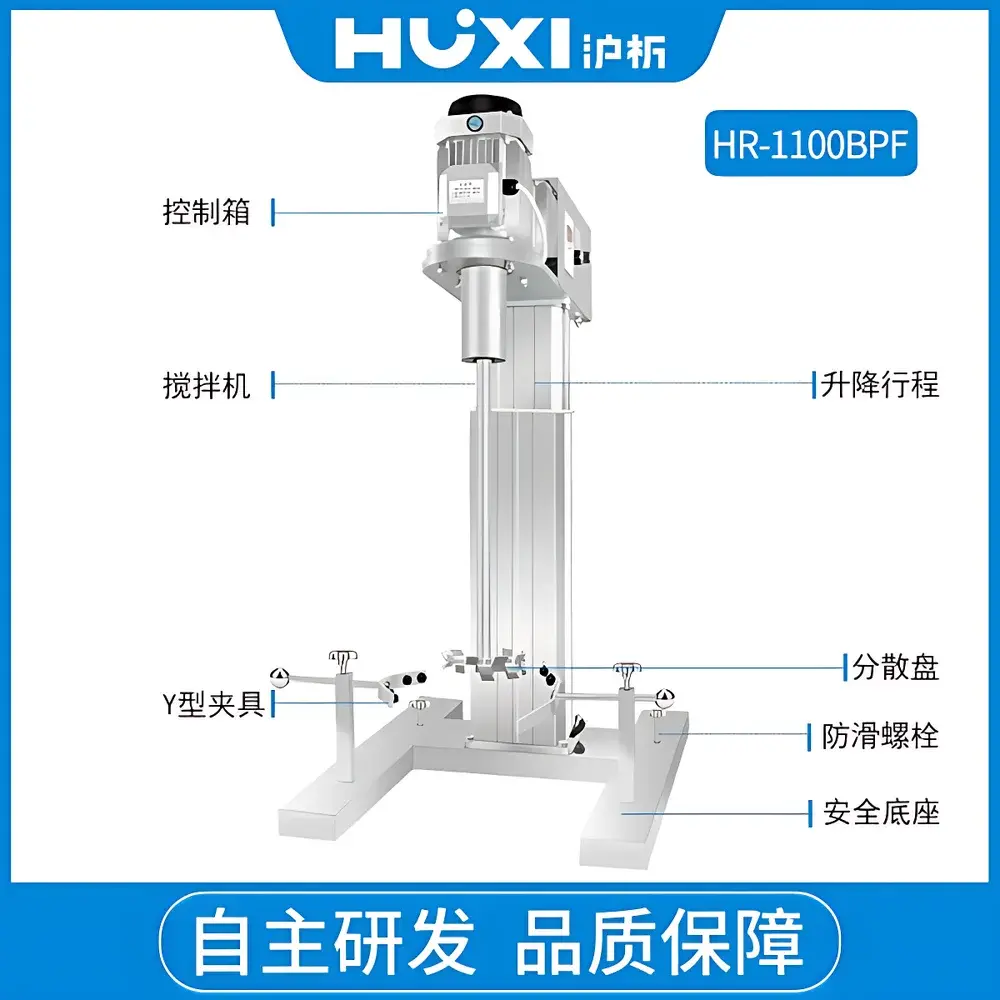
HUXI HR-1100BPF Pilot-Scale High-Shear Dispersion Homogenizer
| Brand | HUXI |
|---|---|
| Origin | Shanghai, China |
| Manufacturer Type | Direct Manufacturer |
| Country of Origin | China |
| Model | HR-1100BPF |
| Instrument Type | Probe-Type Rotor-Stator Homogenizer |
| Dimensions (W×D×H) | 1050×700×600 mm |
| Recommended Processing Volume | 50 L |
| Motor Type | Three-Phase Asynchronous Motor |
| Voltage | 220 V / 380 V |
| Power | 1100 W |
| Speed Range | 0–3000 rpm |
| Maximum Viscosity Handling | 20,000 cP |
| Lifting Mechanism | Electric Vertical Lift Platform |
| Lift Stroke | 400 mm |
| Shaft Length | 430 mm |
| Shaft Diameter | 28 mm |
| Shaft-to-Column Distance | 220 mm |
| Dispersion Disc Height Above Floor | 80 mm |
| Base Footprint | 395×420 mm |
| Drive System | Brushless Inverter-Controlled Motor |
| Material | Stainless Steel (Dispersion Disc & Shaft Assembly) |
| Mounting | Hex Socket Cap Screw Interface |
Overview
The HUXI HR-1100BPF is a pilot-scale high-shear dispersion homogenizer engineered for reproducible, scalable mixing and particle size reduction in laboratory and pre-production environments. It operates on the rotor-stator principle—where a high-speed rotating impeller (rotor) shears fluid against a stationary annular element (stator)—generating intense hydrodynamic forces including cavitation, turbulent flow, and extensional stress. This mechanism enables efficient deagglomeration, emulsification, suspension stabilization, and nanoscale dispersion of solid particles in liquid media. Designed for transition from benchtop formulation to process validation, the HR-1100BPF supports consistent batch processing up to 50 L (water-equivalent), making it suitable for applications requiring regulatory traceability, such as pharmaceutical suspension development, battery slurry preparation, or functional food ingredient dispersion.
Key Features
- Brushless inverter-driven three-phase asynchronous motor delivering precise, stepless speed control from 0 to 3000 rpm with high torque retention across the operating range.
- Electric vertical lift platform with 400 mm stroke and position-locking capability, enabling repeatable immersion depth adjustment and operator-safe height positioning.
- Stainless steel rotor-stator assembly (AISI 304 or equivalent) featuring corrosion-resistant construction, precision-machined clearance tolerances, and hex socket cap screw mounting for rapid, tool-assisted disc exchange.
- Robust column-and-base architecture with 395 × 420 mm footprint and reinforced load-bearing frame, ensuring mechanical stability during high-torque operation at elevated viscosities (up to 20,000 cP).
- Integrated thermal protection, overload current monitoring, and emergency stop circuitry compliant with IEC 61000-6-2/6-4 electromagnetic compatibility standards.
- No-spark, dust-free motor enclosure rated IP54, suitable for non-hazardous classified laboratories under ISO 14644-1 Class 8 cleanroom conditions.
Sample Compatibility & Compliance
The HR-1100BPF accommodates a broad spectrum of sample types—including aqueous and organic suspensions, polymer melts (below thermal degradation threshold), ceramic slurries, lithium-ion battery cathode/anode pastes, and oil-in-water emulsions—provided viscosity remains within specified operational limits. Its stainless steel wetted parts meet FDA 21 CFR Part 117 (Current Good Manufacturing Practice) requirements for indirect food contact surfaces. While not certified for GMP production use out-of-the-box, the system supports GLP-compliant documentation when paired with external data loggers and validated SOPs. All electrical components conform to CE marking directives (2014/30/EU EMC, 2014/35/EU LVD), and mechanical design follows ISO 12100:2012 principles for risk assessment and safety integration.
Software & Data Management
The HR-1100BPF operates via an integrated digital controller with real-time RPM display, preset memory slots (up to 5 user-defined protocols), and analog output (0–10 V) for external SCADA or PLC interfacing. Optional RS-485 Modbus RTU communication enables integration into centralized lab automation systems for audit-trail-capable parameter logging. When used with third-party software platforms supporting FDA 21 CFR Part 11 compliance (e.g., LabArchives ELN or DeltaV DCS), full electronic record integrity—including operator ID, timestamped speed/position logs, and session duration—is achievable through external configuration. No proprietary cloud service or vendor-hosted software is required or embedded.
Applications
- Pre-formulation studies for injectable colloidal dispersions and topical nanoemulsions.
- Scale-up trials of electrode slurries in battery R&D, ensuring uniform conductive additive distribution prior to coating validation.
- Homogenization of microbial cell lysates in bioprocessing workflows where shear-sensitive biomolecules must be preserved.
- Production of stable pigment dispersions for coatings and inkjet inks, minimizing post-processing sedimentation.
- Viscosity-dependent process mapping for shear-thinning materials, supporting rheological model development (e.g., Cross or Carreau models).
- Quality control testing of incoming raw material dispersibility under standardized agitation protocols aligned with ASTM D1849 or ISO 787-25.
FAQ
What is the maximum recommended batch volume for this unit?
The HR-1100BPF is validated for consistent performance with aqueous systems up to 50 L; optimal results are achieved when vessel geometry maintains ≥1.5× shaft submersion depth and avoids vortex formation.
Can the dispersion head be sterilized for aseptic applications?
Yes—the stainless steel rotor-stator assembly is autoclavable at 121 °C for 20 minutes; however, motor and control electronics must remain external to sterilization cycles.
Is the unit compatible with explosion-proof environments?
No; while the motor is brushless and spark-free, it lacks ATEX or IECEx certification and is intended for use only in non-classified laboratory spaces.
Does HUXI provide IQ/OQ documentation support?
Yes—upon request, HUXI supplies equipment specification documents, factory test reports, and blank protocol templates aligned with ISO/IEC 17025 and ASTM E2500 for user-executed qualification.
What maintenance intervals are recommended?
Lubrication of lift mechanism rails every 500 operational hours; visual inspection of shaft runout and stator wear every 1000 hours; annual calibration of speed feedback loop using traceable tachometer reference.



