
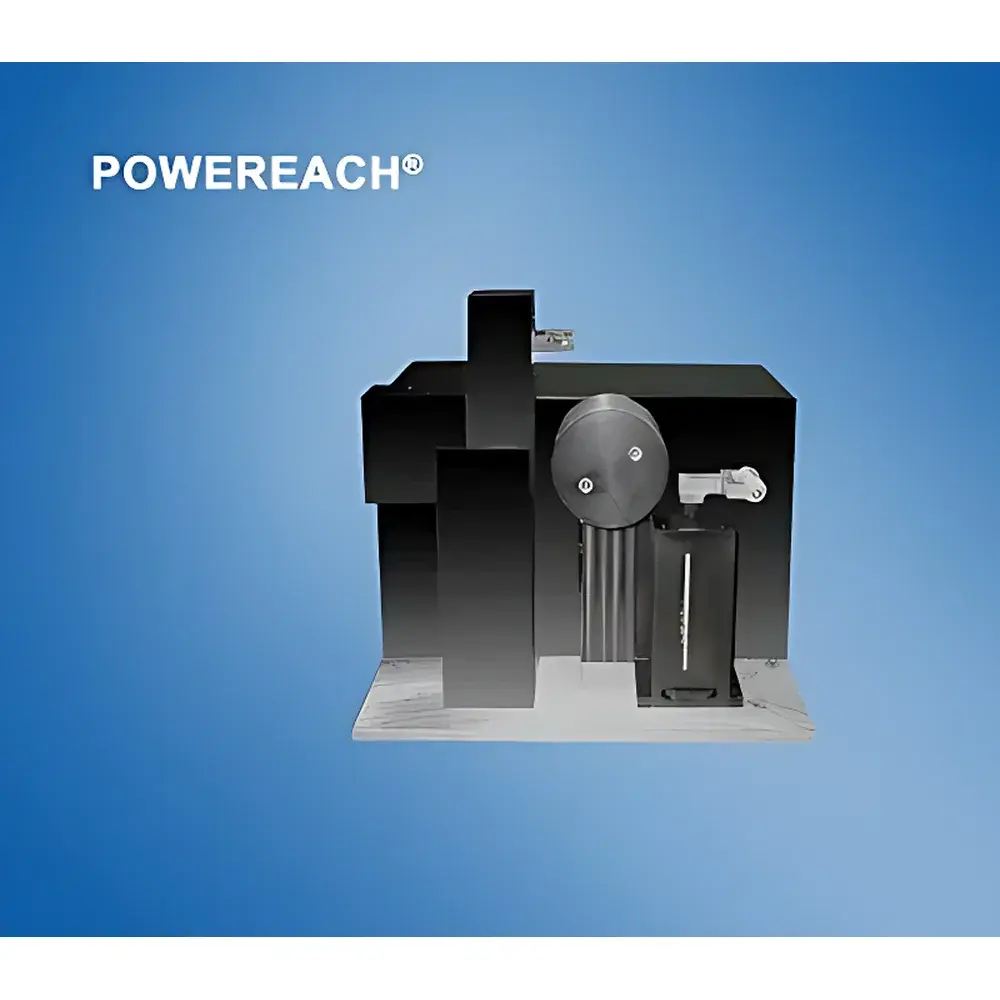
JDF05 Fabric Friction Tester
| Origin | Beijing |
|---|---|
| Manufacturer Type | Authorized Distributor |
| Origin Category | Domestic (China) |
| Model | JDF05 |
| Pricing | Available Upon Request |
Overview
The JDF05 Fabric Friction Tester is a precision-engineered instrument designed specifically for quantitative evaluation of surface friction behavior in textile materials, nonwovens, films, and flexible sheet substrates. It operates on the principle of controlled sliding contact between a standardized rotating friction wheel and a stationary fabric specimen under defined normal load and sliding velocity. The system measures dynamic and static coefficients of friction (COF) via high-resolution force transduction and synchronized motion control, delivering repeatable, traceable data aligned with fundamental tribological testing paradigms used in textile R&D and quality assurance laboratories.
Key Features
- Modular friction wheel assembly with embedded auxiliary test media—designed to maintain surface planarity and uniform contact geometry after media attachment
- Adjustable test duration control via programmable timer interface, supporting standardized dwell-time protocols per ASTM D3826, ISO 12947-2, and GB/T 3920
- Robust sample clamping mechanism ensuring zero lateral displacement during measurement; accommodates specimens up to 200 mm × 200 mm with edge tension uniformity
- Integrated mechanical safeguard system preventing operator exposure during active rotation and load application
- Calibration-ready architecture compliant with ISO/IEC 17025 requirements for laboratory accreditation; supports periodic verification using NIST-traceable reference standards
- Compact benchtop footprint (W×D×H: 420 × 360 × 280 mm) with low power consumption (<120 W), suitable for ISO Class 5–7 cleanroom-adjacent environments
Sample Compatibility & Compliance
The JDF05 accommodates woven, knitted, braided, and nonwoven fabrics—including technical textiles, geotextiles, medical gowns, and coated membranes—as well as elastomeric films and laminated composites. Specimen thickness range: 0.05–5.0 mm. Compliance includes alignment with key international textile testing standards: ASTM D3826 (friction resistance of fabrics), ISO 12947-2 (Martindale abrasion and friction), GB/T 3920 (colorfastness to rubbing), and ISO 8295 (plastics—determination of coefficient of friction). All mechanical interfaces and load paths are validated for GLP/GMP-relevant documentation workflows.
Software & Data Management
The instrument operates via embedded firmware with USB 2.0 connectivity for raw data export in CSV format. Force-time and displacement-time curves are recorded at ≥100 Hz sampling rate. No proprietary software installation is required; exported datasets are compatible with MATLAB, Python (NumPy/Pandas), JMP, and industry-standard statistical process control (SPC) platforms. Audit trail functionality supports FDA 21 CFR Part 11 readiness when deployed within validated laboratory information management systems (LIMS). Calibration logs, user access timestamps, and test parameter configurations are retained locally for ≥12 months.
Applications
- Quantifying inter-fiber and fiber-substrate friction in yarn formation and weaving process optimization
- Evaluating anti-slip performance of functional apparel (e.g., sportswear, firefighter turnout gear)
- Assessing tactile perception correlates—e.g., roughness, smoothness, and drag sensation—in consumer textile development
- Supporting regulatory submissions for medical textiles where surface friction impacts device handling and patient interface safety
- Validating coating adhesion and surface modification efficacy (e.g., silicone, fluoropolymer, or plasma treatments)
- Correlating frictional behavior with wear resistance in filtration media and protective barriers
FAQ
Does the JDF05 comply with ISO 12947-2 for Martindale-type friction testing?
No—the JDF05 implements a unidirectional rotational wheel method, distinct from the oscillatory elliptical motion of Martindale testers. It is optimized for COF quantification per ISO 8295 and ASTM D3826, not abrasion endurance.
Can it measure both static and kinetic coefficients of friction?
Yes—by integrating zero-velocity hold periods and controlled acceleration ramping, the system captures transition points between static and dynamic regimes.
Is third-party calibration certification available?
Yes—certified calibration services are offered by accredited metrology partners in China and EU member states, with full uncertainty budgets reported per ISO/IEC 17025.
What maintenance intervals are recommended?
Friction wheel surface inspection every 200 test cycles; load cell verification annually or after impact events; firmware updates issued biannually via secure download portal.
Are custom夹头 (sample holders) supported for irregular specimens?
Yes—custom fixture design and CNC fabrication services are available under NDA for research-grade applications requiring non-standard specimen geometries or clamping forces.





