
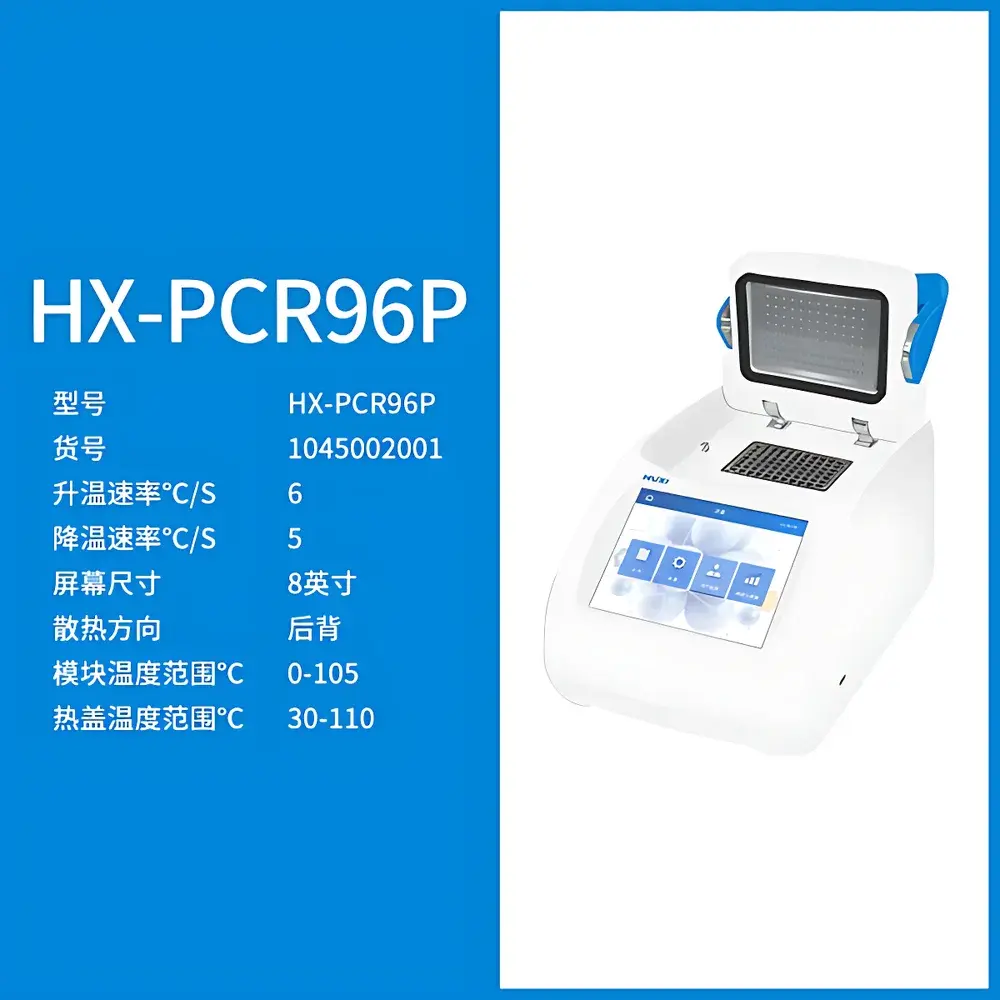
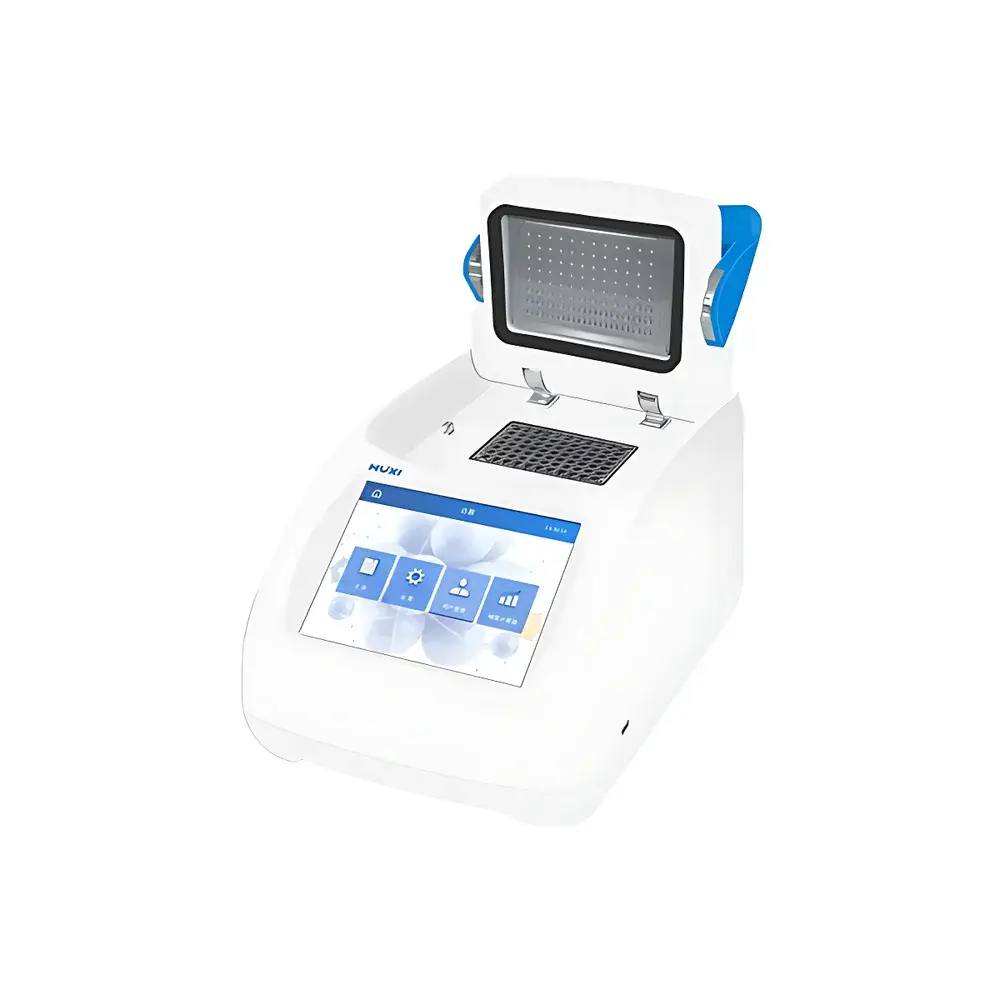
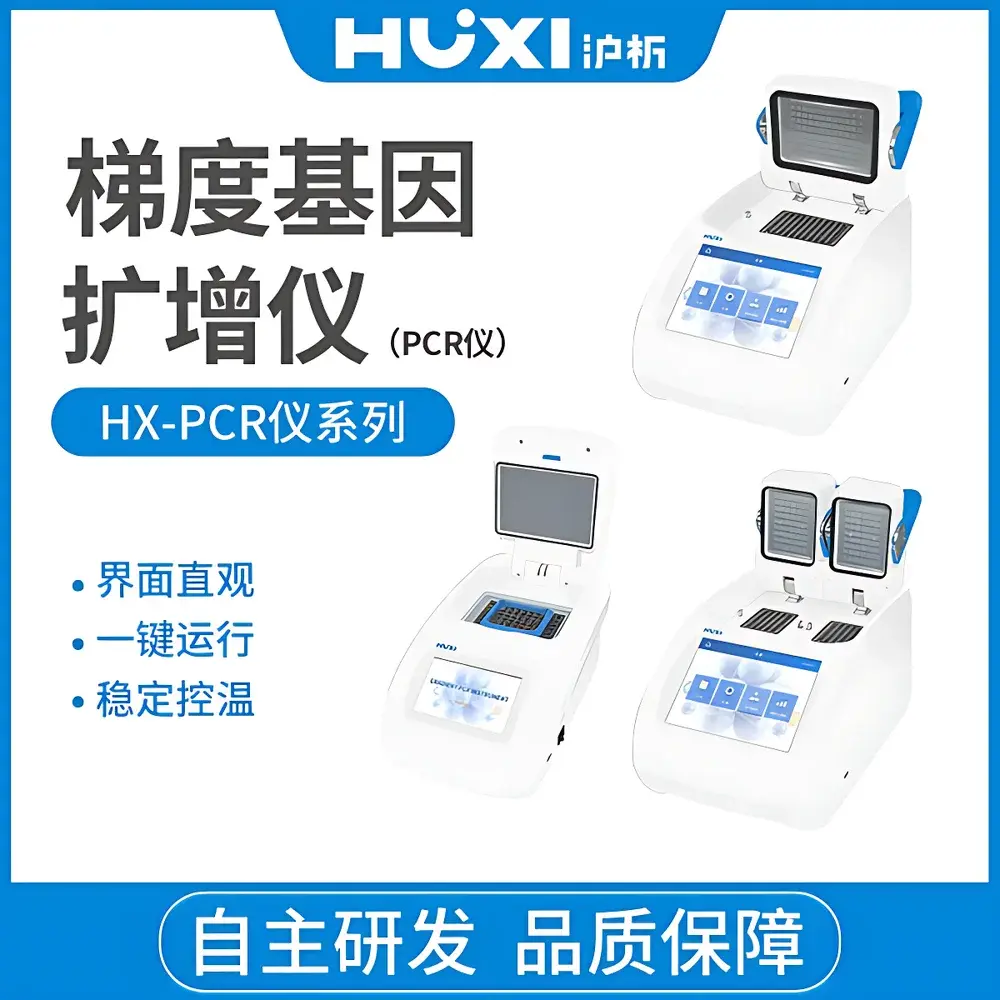

HUXI HX-PCR96P Gradient Thermal Cycler
| Brand | HUXI |
|---|---|
| Origin | Shanghai, China |
| Manufacturer Type | Direct Manufacturer |
| Product Category | Domestic (China-Made) |
| Model | HX-PCR96P |
| Instrument Type | Gradient PCR Thermal Cycler |
| Sample Throughput | 96 × 0.2 mL (compatible with individual 0.2 mL tubes, 8-tube strips, and standard 96-well PCR plates excluding full-skirted plates) |
| Max Heating Rate | 6 °C/s |
| Temperature Accuracy | ≤ ±0.3 °C |
| Block Uniformity | ≤ ±0.25 °C |
| Max Cooling Rate | 5 °C/s |
| Gradient Range | 30–105 °C |
| Gradient Span Setting | 0.1–42 °C |
| Gradient Uniformity | ≤ ±0.3 °C |
| Gradient Accuracy | ≤ ±0.3 °C |
| Gradient Temperature Points | 12 |
| Heat Lid Temperature Range | 30–110 °C |
| Time Increment/Decrement | −599 s to +599 s |
| Temperature Increment/Decrement | −9.9 °C to +9.9 °C |
| Input Power | AC 100–240 V, 50/60 Hz |
| Temperature Control Mode | Block or Tube-based |
| Block Temperature Range | 0–105 °C |
| Block Temperature Accuracy | ≤ ±0.2 °C |
| Timer Range | 1 s – 59 min 59 s (0 = indefinite) |
| Ramp Rate Adjustment | 0.1–5 °C/s |
| Temperature Display Resolution | 0.1 °C |
| Program Storage Capacity | >10,000 protocols |
| Max Cycle Number | 99 |
| Max Steps per Program | 30 |
| Pause Function | Yes |
| Power Failure Recovery | Yes |
| 16 °C Hold Function | Indefinite |
| Touchdown PCR Support | Yes |
| Long PCR Support | Yes |
| Display | 8-inch capacitive touchscreen, 1024 × 768 pixels |
| Operating System | Embedded Linux |
| Interface | USB 2.0 |
| Dimensions (W × D × H) | 260 × 390 × 230 mm |
| Net Weight | 8.5 kg |
| Max Power Consumption | 700 W |
Overview
The HUXI HX-PCR96P Gradient Thermal Cycler is a high-performance, semiconductor-based thermal cycler engineered for precision nucleic acid amplification in research, clinical diagnostics, and quality control laboratories. It operates on the fundamental principle of polymerase chain reaction (PCR), applying precisely controlled, rapid thermal transitions across a uniform aluminum heating block to facilitate DNA denaturation, primer annealing, and enzymatic extension. Its core architecture integrates six independent Peltier elements distributed across the block surface—enabling both high-speed ramping (up to 6 °C/s heating, 5 °C/s cooling) and exceptional spatial temperature homogeneity (≤ ±0.25 °C across all 96 positions). Designed for long-term reliability, the instrument supports over one million thermal cycles without performance degradation, making it suitable for high-throughput and mission-critical applications where reproducibility and operational continuity are non-negotiable.
Key Features
- Six-Peltier semiconductor module configuration ensures symmetrical heat distribution and minimizes edge effects common in conventional single- or dual-heater designs.
- Wide gradient capability (30–105 °C span; 0.1–42 °C adjustable gradient width across 12 discrete temperature zones) enables robust optimization of annealing conditions for multiplex assays, primer screening, and assay development.
- Industrial-grade embedded Linux OS provides deterministic real-time control, automatic power-failure recovery, and persistent protocol execution—even after unexpected interruption.
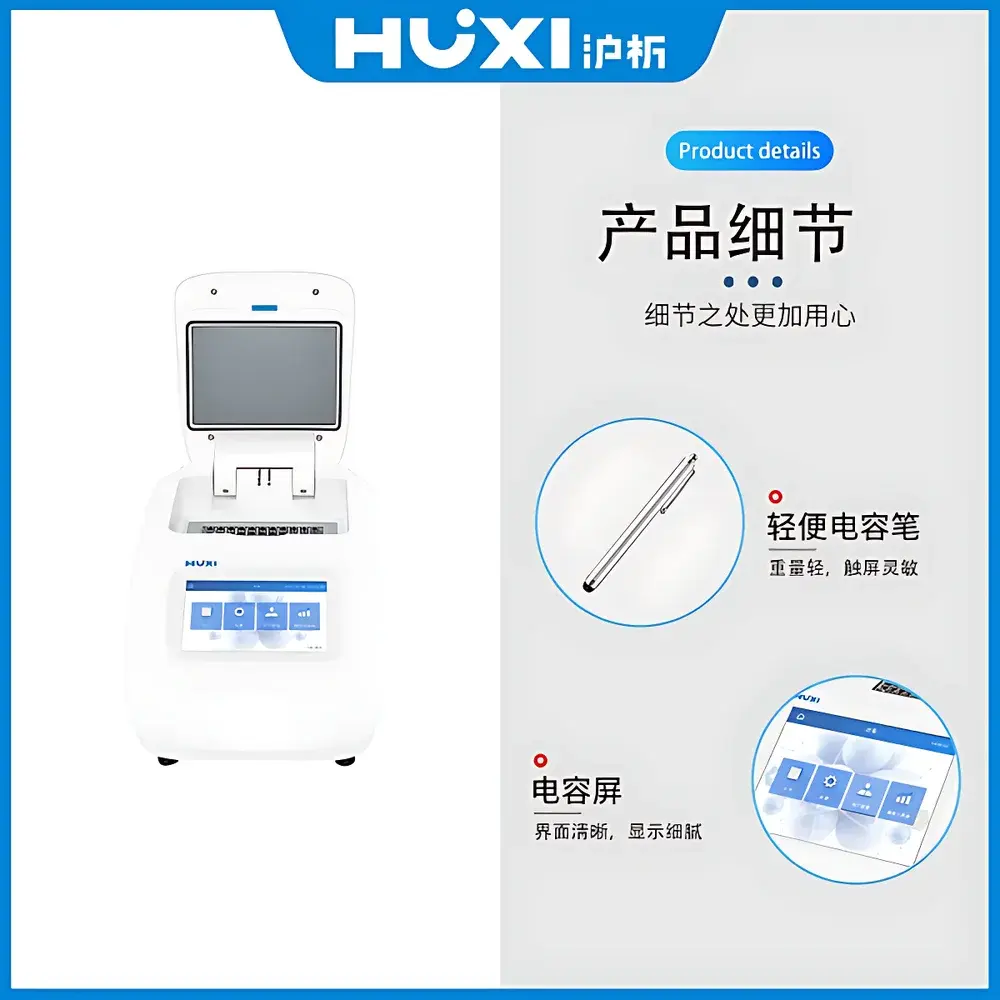
- Capacitive 8-inch touchscreen (1024 × 768 resolution) delivers intuitive navigation, multi-level parameter editing, and visual feedback for ramp profiles, gradient maps, and real-time temperature traces.
- Comprehensive protocol flexibility: supports touchdown PCR, long PCR, stepwise cycling, time/temperature incrementing, indefinite 16 °C hold, and user-defined pause points at any step.
- Heat lid with adjustable temperature (30–110 °C) prevents condensation and ensures consistent evaporation control across diverse tube types and sealing methods.
Sample Compatibility & Compliance
The HX-PCR96P accommodates standard 0.2 mL PCR consumables—including individual tubes, 8-tube strips, and ANSI/SLAS-compliant 96-well plates (excluding full-skirted variants due to mechanical clearance constraints). Its block geometry and thermal calibration are validated per ISO/IEC 17025-aligned internal protocols for uniformity and accuracy under load. While not certified to IVD directives, the system meets essential electrical safety requirements per IEC 61010-1 and electromagnetic compatibility standards (EN 61326-1). Its audit-ready operation log—including timestamped cycle records, temperature deviation alerts, and user login metadata—supports GLP and GMP environments when integrated into validated laboratory workflows.
Software & Data Management
Data handling is facilitated via USB 2.0 interface for secure offline transfer of protocols and run logs. The onboard file system stores >10,000 user programs with full version history, including modification timestamps and operator IDs. All thermal profiles are logged with second-resolution temperature sampling and annotated with block status, lid temperature, and error flags. For traceability, the system maintains immutable execution records compliant with FDA 21 CFR Part 11 principles when paired with external LIMS or ELN platforms using standardized CSV export formats. No cloud connectivity or remote access is implemented—ensuring data sovereignty and network isolation per institutional IT policies.
Applications
The HX-PCR96P serves as a primary thermal cycler in molecular biology core facilities, academic genomics labs, food safety testing centers, and pharmaceutical QC units. Typical use cases include: genomic DNA amplification for sequencing library prep; detection of pathogenic targets in clinical specimens (e.g., SARS-CoV-2, HPV, TB); SNP genotyping via allele-specific PCR; methylation-specific PCR (MSP); cDNA synthesis validation; and optimization of qPCR master mixes. Its gradient functionality is routinely employed in primer annealing temperature profiling, multiplex assay development, and troubleshooting nonspecific amplification—reducing experimental iteration cycles by up to 60% compared to serial single-temperature runs.
FAQ
What consumables are compatible with the HX-PCR96P?
Standard 0.2 mL thin-wall PCR tubes, 8-tube strips, and semi-skirted or non-skirted 96-well plates meeting ANSI/SLAS footprint specifications.
Does the instrument support remote monitoring or network integration?
No—this model operates as a standalone unit with local USB-based data export only, ensuring air-gapped operation for regulated environments.
Is the temperature calibration traceable to national standards?
Yes; factory calibration uses NIST-traceable reference thermistors, and users may perform field verification using certified PT100 probes per ISO 17025 guidelines.
Can the ramp rate be adjusted during a program?
Yes—ramp rates (0.1–5 °C/s) can be defined independently for each transition step, enabling fine-tuned control for sensitive templates such as GC-rich sequences or long amplicons.
How is data integrity maintained during power loss?
The system writes critical state variables to non-volatile memory before each cycle; upon restoration, it resumes from the exact step and timepoint where interruption occurred—without altering cycle count or timing parameters.





