
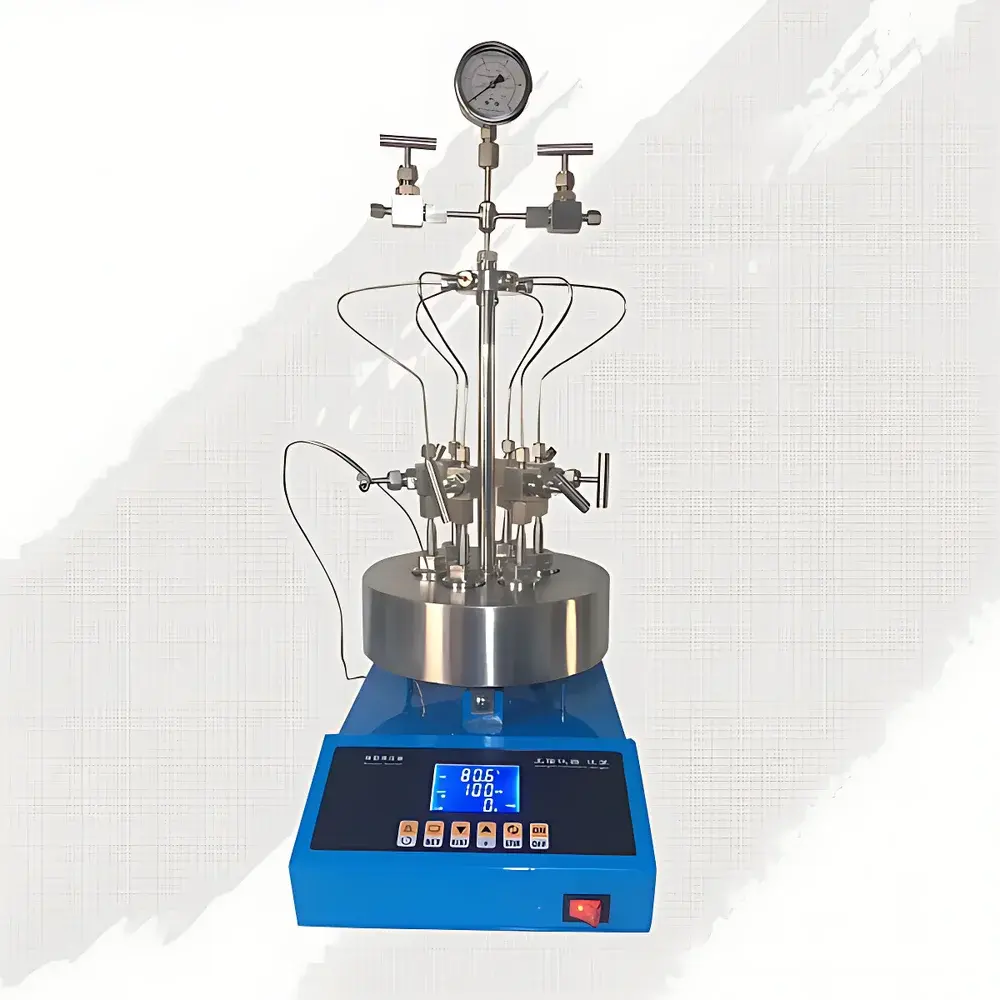
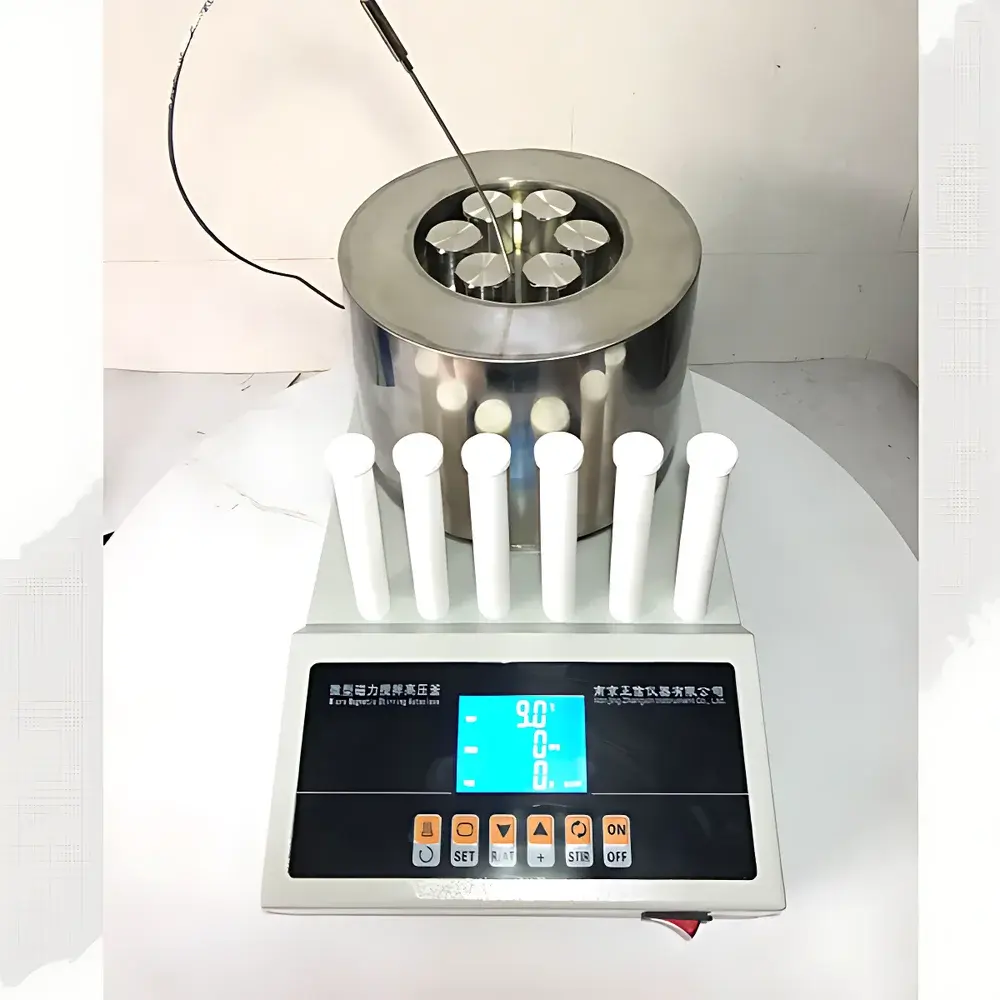
PSK Magnetic Stirring Parallel High-Pressure Reactor
| Brand | Zhengxin Instrument Factory (ZXYIQI) |
|---|---|
| Origin | Jiangsu, China |
| Manufacturer Type | Authorized Distributor |
| Country of Origin | China |
| Model | PSK-6-10 mL |
| Price | USD 5,780 (approx.) |
| Usable Volume | 0.05–0.3 mL per vessel |
| Vessel Material | 316L Stainless Steel |
| Maximum Working Pressure | 20 MPa |
| Operating Temperature Range | Ambient to 350 °C |
| Heating Method | Modular Fixed Electric Heater (1300 W) |
| Temperature Control | PID with Auto-Tuning (AT) and Timer Function |
| Stirring Mechanism | Magnetic Coupling with External Brushless Motor |
| Stirring Speed | 0–1500 rpm |
| Vacuum Level | ≤10 Pa |
| Gas Inlet/Outlet | 3 mm Swagelok®-compatible Needle Valves (Individual & Centralized Configurations) |
| Pressure Monitoring | Analog Stainless Steel Bourdon Tube Gauge |
| Power Supply | 220 V AC, 50/60 Hz |
| Number of Parallel Vessels | 6 |
| Vessel Separability | Fully Detachable from Heater Block |
Overview
The PSK Magnetic Stirring Parallel High-Pressure Reactor is an engineered platform for high-throughput, controlled chemical synthesis under elevated temperature and pressure conditions. Designed for laboratory-scale catalytic screening, kinetic studies, and materials discovery, the system employs magnetic coupling to transmit rotational torque across pressure-tight boundaries—eliminating mechanical seals and minimizing leakage risk. Each of the six independent reaction vessels operates within a shared thermal environment but maintains individual gas handling, stirring, and pressure monitoring capabilities. The reactor core utilizes a modular resistive heating block with precise spatial thermal uniformity (±2 °C across all vessel positions), enabling reproducible thermally driven reactions up to 350 °C and 20 MPa. Its architecture conforms to fundamental principles of sealed-vessel heterogeneous catalysis and supercritical fluid chemistry, supporting both batch and semi-batch operation modes.
Key Features
- Modular 6-vessel configuration with fully independent magnetic stirring—each vessel accommodates a PTFE- or glass-lined 316L stainless steel insert (0.05–0.3 mL usable volume) and supports individual rotation control (0–1500 rpm) via brushless DC motors.
- Integrated PID temperature controller with auto-tuning (AT) algorithm, programmable ramp/soak profiles, and real-time digital display; coupled with K-type thermocouples embedded in each vessel’s thermal well for localized feedback.
- Gas management system featuring dual needle valves per vessel (inlet and vent)—Swagelok® 3 mm compression fittings ensure leak-tight integrity during vacuum evacuation (<10 Pa), inert gas purging, reagent dosing, or controlled depressurization.
- Detachable vessel-heater interface: stainless steel reactor bodies mount directly onto the heated block via precision-machined thermal contact surfaces, enabling rapid disassembly without tools for post-reaction sampling or cleaning.
- Robust mechanical design compliant with ASME B31.3 process piping guidelines for small-bore high-pressure components; pressure containment verified per ISO 15848-1 for fugitive emissions control.
- Front-panel safety interlocks include overtemperature cutoff, pressure relief activation indicator, and motor stall detection—logically isolated from main control circuitry per IEC 61508 SIL-2 requirements.
Sample Compatibility & Compliance
The PSK reactor accommodates a broad spectrum of chemistries including hydrogenation, hydroformylation, CO₂ hydrogenation, polymerization initiations, and nanomaterial nucleation under non-oxidizing atmospheres. Vessel linings (optional PTFE, quartz, or Hastelloy C-276) extend compatibility to HF, hot chlorides, and strong oxidizers. All wetted parts meet ASTM A240 Grade 316L specifications. The system supports GLP-compliant workflows: temperature and pressure data are timestamped and exportable in CSV format; optional RS485 Modbus RTU interface enables integration into LIMS or SCADA environments meeting FDA 21 CFR Part 11 audit trail requirements.
Software & Data Management
While the base unit operates via front-panel controls, optional PC-based software (ZXYIQI ReactorControl v3.2) provides remote parameter logging at 1 Hz resolution, multi-channel trend visualization, and automated report generation (PDF/Excel). Data files include metadata headers specifying operator ID, vessel assignment, calibration timestamps, and firmware revision—enabling full traceability per ISO/IEC 17025 Clause 7.7. Raw sensor outputs are stored unprocessed to preserve integrity for retrospective analysis.
Applications
- Catalyst performance benchmarking across 6 parallel conditions (e.g., varying metal loading, ligand ratios, or H₂ partial pressures) with identical thermal history.
- High-pressure solvothermal synthesis of MOFs and perovskites where nucleation kinetics are sensitive to <0.1 mL solvent volumes.
- Reaction calorimetry pre-screening: comparative exotherm profiling using synchronized T/Δt acquisition across vessels.
- Accelerated aging studies of battery electrolyte formulations under CO₂ or N₂ at 8–15 MPa and 60–120 °C.
- Supercritical fluid extraction method development using tunable density windows achievable between 10–20 MPa at fixed T.
FAQ
What is the maximum allowable working pressure for continuous operation?
The PSK-6-10 mL reactor is rated for continuous service at 20 MPa at 25 °C; derating applies above 200 °C per ASME BPVC Section VIII Division 1 Annex 3–2 stress reduction curves.
Can vessels be operated at different temperatures simultaneously?
No—the heater block provides uniform thermal exposure; independent temperature control requires separate heating modules (available as PSK-DualZone add-on kit).
Is third-party calibration documentation provided?
Yes: NIST-traceable calibration certificates for pressure gauges and thermocouples are included; on-site verification services available upon request.
What maintenance intervals are recommended for the magnetic drive system?
No scheduled maintenance is required; the hermetic magnetic coupling has no wear parts and is rated for >10,000 hr MTBF under nominal load conditions.
Does the system support automated gas dosing sequences?
Not natively—but the needle valve ports accept standard pneumatic actuators (e.g., Parker ZM series); integration with external PLCs via dry-contact triggers is supported.
Related Products



