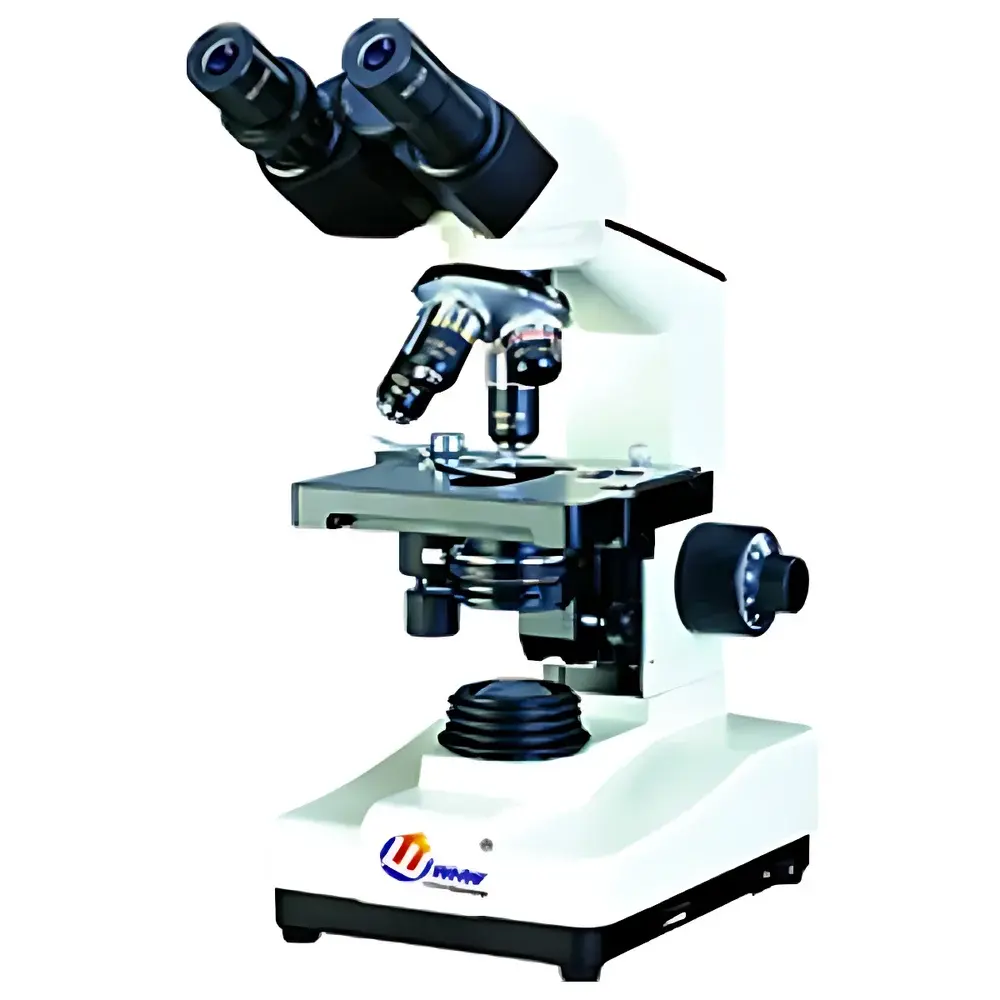
YANRUN BI-15 Biological Inverted Microscope
| Brand | YANRUN |
|---|---|
| Origin | Shanghai, China |
| Manufacturer Type | Direct Manufacturer |
| Product Category | Domestic (China-Made) |
| Model | BI-15 Biological Inverted Microscope |
| Instrument Type | Inverted Microscope |
| Eyepiece Configuration | Binocular Head (30° Inclination) |
| Magnification Range | 40×–1000× (Optional Extended Range: 64×–1600×) |
| Eyepieces | Wide-Field WF10× (Φ18 mm) |
| Objectives | Achromatic 4×/0.10, 10×/0.25, 40×/0.65 (Spring), 100×/1.25 (Spring, Oil Immersion) |
| Focusing Mechanism | Coaxial Coarse/Fine Focus (BI-15A/C: Limit Stop |
| BI-15B/D | Lockable + Adjustable Coarse Tension |
| Fine Focus Graduation | 4 µm) |
| Nosepiece | 4-Position (BI-15A/B: Outward Ball-Bearing |
| BI-15C/D | Inward Ball-Bearing) |
| Stage | Dual-Layer Mechanical Stage (125 mm × 115 mm) |
| Travel Range | 70 mm × 30 mm |
| Condenser | Abbe Condenser (N.A. 1.25), Adjustable Height, with Iris Diaphragm & Filter Holder |
| Filters | Blue Filter, Ground Glass |
| Illuminator | 12 V / 20 W Halogen Lamp, Continuously Variable Brightness Control |
| Optional Accessories | WF16× Eyepieces, Reticle Eyepieces, Monocular or Push-Pull Binocular Tubes, 3-Position Nosepiece, Movable Scale Stage, Green/Yellow Filters, 5 W Fluorescent Lamp, High-Intensity White LED Illuminator, Mirror Assembly, AC Input LED Power Adapters (9 V / 500 mA), USB/VIDEO Trinocular Photo-Adapter, Basic Polarization Kit (360° Rotatable Polarizer + Sliding Analyzer) |
Overview
The YANRUN BI-15 Biological Inverted Microscope is engineered for routine and advanced life science applications requiring stable, high-contrast observation of living cells, adherent cultures, and tissue specimens in standard Petri dishes, flasks, and multi-well plates. Its inverted optical architecture positions the objective lenses beneath the specimen stage and the condenser above—enabling unobstructed access to culture vessels while maintaining optimal working distance and ergonomic sample manipulation. The system employs Köhler illumination principles via a fully adjustable Abbe condenser (N.A. 1.25), ensuring uniform brightness, precise contrast control through an iris diaphragm, and compatibility with standard color filters for enhanced phase contrast or differential interference—without requiring dedicated phase optics. Designed for long-term reliability in academic teaching labs, QC environments, and small-scale research facilities, the BI-15 integrates mechanical stability with modular expandability, supporting both visual inspection and digital documentation workflows.
Key Features
- Wide-field optical path with achromatic objectives (4×, 10×, 40× spring-loaded, 100× oil immersion) delivering consistent flatness and chromatic correction across the full field of view.
- Binocular viewing head inclined at 30°, fitted with wide-field WF10× eyepieces (Φ18 mm field number), optimized for extended observation sessions and reduced ocular fatigue.
- Coaxial coarse/fine focusing mechanism available in four configurations (BI-15A–D), all featuring 4 µm fine focus graduation; BI-15B/D variants include lockable coarse focus and adjustable coarse tension for reproducible positioning under varying load conditions.
- Dual-layer mechanical stage (125 mm × 115 mm) with 70 mm × 30 mm travel range, enabling precise navigation across large-area cultures without repositioning the vessel.
- Halogen-based transmitted-light illumination (12 V / 20 W) with continuous intensity regulation and integrated heat-absorbing filter, minimizing thermal stress on live specimens during prolonged imaging.
- Modular design supports seamless integration of optional components—including LED illuminators, trinocular photo-tubes with USB/VIDEO output, polarization kits, and reticle eyepieces—without compromising optical alignment or mechanical integrity.
Sample Compatibility & Compliance
The BI-15 accommodates standard cell culture formats including 35 mm–150 mm Petri dishes, T-25 to T-225 flasks, and 6–96-well plates—making it suitable for routine passage monitoring, confluence assessment, and morphological evaluation per ISO 13485 and ASTM E2917 guidance for cellular assay instrumentation. Its open-stage architecture allows direct integration with environmental chambers (e.g., CO₂ incubator adapters) and micromanipulation tools. While not certified for GLP/GMP production environments out-of-the-box, the microscope’s mechanical repeatability, documented focus graduation, and standardized optical interfaces enable validation under internal SOPs aligned with FDA 21 CFR Part 11 data integrity requirements when paired with compliant digital capture systems.
Software & Data Management
The BI-15 does not include proprietary acquisition software but is fully compatible with third-party imaging platforms supporting UVC-compliant USB video devices (e.g., Ocular, AmScope, or custom LabVIEW-based solutions). When equipped with the optional USB/VIDEO trinocular adapter, image streams are captured at up to 30 fps (720p), supporting time-lapse recording, basic measurement (distance, area, count), and annotation. Metadata—including magnification, filter position, and illumination level—is manually logged or embedded via external metadata tagging protocols. For audit-ready workflows, users may implement timestamped storage, folder-based versioning, and checksum verification consistent with ALCOA+ principles.
Applications
- Routine cell culture monitoring: Assessment of viability, morphology, and confluence in mammalian, insect, and stem cell lines.
- In vitro toxicology assays: Real-time observation of cytotoxic responses (e.g., membrane blebbing, detachment, granulation) under controlled environmental conditions.
- Microinjection and electrophysiology support: Stable platform for coupling with micromanipulators and patch-clamp rigs due to rigid base and vibration-damped stage.
- Education and training: Used in undergraduate biology laboratories for teaching histology, microbiology, and developmental biology concepts with live or stained preparations.
- Quality control in biomanufacturing: Verification of monolayer integrity prior to harvest, detection of contamination (yeast, bacteria, mycoplasma), and documentation of batch release criteria.
FAQ
Is the BI-15 suitable for fluorescence imaging?
The standard configuration does not include fluorescence excitation/emission filters or a high-intensity mercury/xenon lamp. However, the optional 5 W fluorescent lamp and filter selection (blue/green/yellow) permit basic epifluorescence when combined with appropriate fluorophore-labeled samples and a dedicated fluorescence attachment.
Can the BI-15 be upgraded to support phase contrast?
Phase contrast capability is not built-in but can be added via third-party phase contrast sliders and matching phase objectives—provided the condenser’s centering and N.A. alignment are maintained per manufacturer specifications.
What is the maximum working distance for the 40× objective?
The spring-loaded 40×/0.65 objective provides a working distance of approximately 0.6 mm, sufficient for observation through standard 1 mm-thick glass-bottom culture dishes.
Does the microscope meet CE or UL safety standards?
As a domestically manufactured instrument intended primarily for the Chinese market, formal CE or UL certification documentation is not provided. Users deploying the BI-15 in regulated international settings must conduct independent electrical safety and EMC assessments per IEC 61010-1.
Is service and calibration support available outside China?
YANRUN offers remote technical guidance and spare parts distribution via authorized regional partners. On-site calibration and preventive maintenance require coordination with local biomedical engineering service providers using traceable reference standards.