
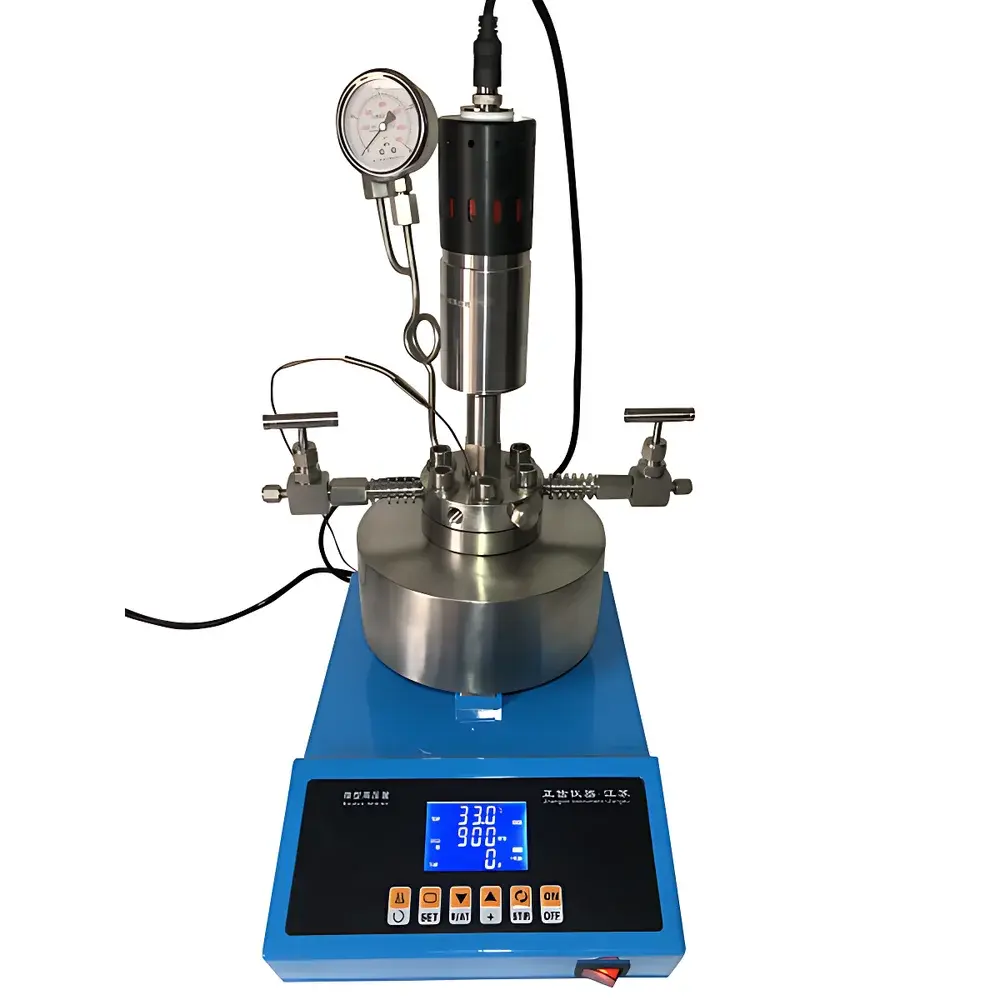
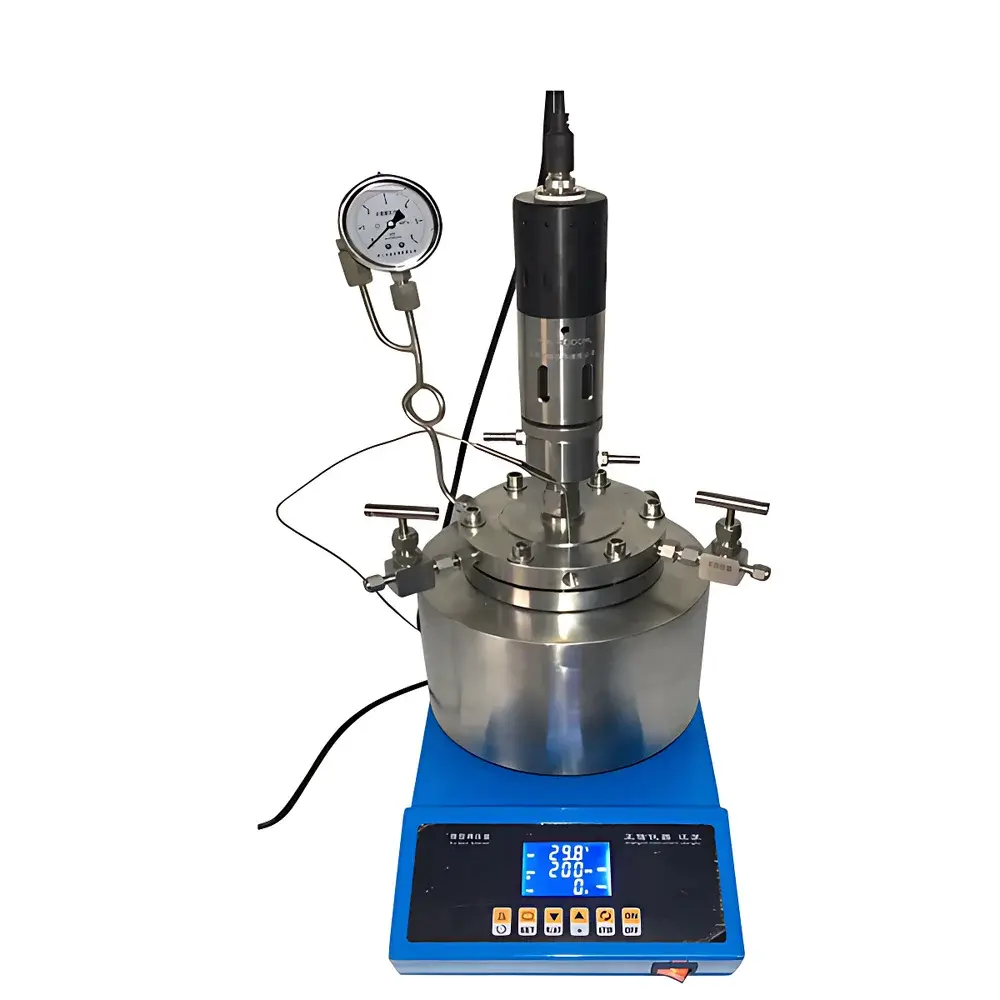
Zhengxin K-PSK High-Temperature & High-Pressure Magnetic Coupling Stirred Reactor
| Brand | Zhengxin Instruments |
|---|---|
| Origin | Jiangsu, China |
| Model | K-PSK |
| Vessel Capacity | 50–5000 mL |
| Construction Material | 316L Stainless Steel (standard), optional 304 SS, Hastelloy, Titanium, Zirconium, PTFE/PPL/Quartz linings |
| Operating Temperature Range | 0–600 °C |
| Operating Pressure Range | –0.1 to 70 MPa (vacuum to high pressure) |
| Heating Method | Integrated Modular Electric Heater (400–1800 W) |
| Stirring | Magnetic coupling-driven impeller, 0–1500 rpm, bidirectional |
| Temperature Control | LCD-display PID controller with auto-tuning (AT) and dual-mode timer (hold time / run time, 0–999 min/h) |
| Temperature Sensing | High-accuracy K-type thermocouple |
| Pressure Monitoring | Stainless steel analog pressure gauge |
| Safety Systems | Pressure-relief burst disc, overpressure automatic venting, explosion-proof design |
| Vacuum Capability | ≤ –0.1 MPa (absolute) |
| Gas Inlet/Outlet Valves | High-temp/high-pressure needle valves with 1/8″ (3 mm) and 1/4″ (6 mm) compression fittings |
| Optional Accessories | Sampling tube, digital pressure transmitter, data logging interface |
Overview
The Zhengxin K-PSK High-Temperature & High-Pressure Magnetic Coupling Stirred Reactor is an engineered laboratory-scale reaction system designed for controlled synthesis, catalytic testing, hydrothermal processing, and kinetic studies under demanding thermal and mechanical conditions. It operates on the principle of magnetically coupled mechanical agitation—eliminating dynamic seals while maintaining full pressure integrity—enabling safe, leak-free operation across vacuum to 70 MPa and temperatures up to 600 °C. The reactor’s modular architecture separates the heating jacket from the pressure vessel, facilitating rapid disassembly, cleaning, and liner replacement. This design supports reproducible batch-to-batch experimentation in R&D environments where regulatory traceability, material compatibility, and process scalability are critical.
Key Features
- Magnetic coupling drive: Hermetically sealed torque transmission eliminates rotating shaft seals, preventing leakage and contamination—essential for handling toxic, volatile, or oxygen-sensitive reagents.
- Multi-material construction: Standard 316L stainless steel body; optional liners (PTFE, PPL, quartz) and full-vessel alternatives (Hastelloy C-276, titanium Grade 2, zirconium) ensure chemical compatibility with aggressive media including halogenated solvents, strong acids, and molten salts.
- Precision thermal management: Fixed-position modular electric heater delivers uniform axial and radial heat distribution; PID controller with auto-tuning (AT) ensures ±1 °C stability over full temperature range, with programmable hold/run timers supporting multi-step thermal protocols.
- Robust pressure containment: ASME Section VIII Division 1–compliant pressure boundary design (validated per EN 13445 principles); integrated analog pressure gauge with 0–100 MPa scale; certified rupture disc and spring-loaded safety valve provide redundant overpressure protection.
- Configurable gas handling: Dual high-integrity needle valves (1/8″ and 1/4″ compression fittings) enable precise inert gas purging, vacuum evacuation (< –0.1 MPa abs), reactant dosing, and controlled venting—fully compatible with Schlenk-line integration.
- Modular serviceability: Quick-release flange connections and tool-free heater detachment reduce maintenance downtime; all wetted components are accessible without specialized tools or calibration recalibration.
Sample Compatibility & Compliance
The K-PSK reactor accommodates heterogeneous, multiphase, and highly viscous systems—including slurries, suspensions, and supercritical fluid mixtures—without compromising mixing efficiency or thermal homogeneity. Its broad material options meet ASTM G31 (corrosion testing), ISO 15142 (high-pressure equipment), and USP (container integrity for pharmaceutical intermediates) requirements. When equipped with optional digital pressure transducers and calibrated thermocouples, the system supports GLP-compliant data acquisition per FDA 21 CFR Part 11 when paired with validated third-party software. All pressure-bearing components undergo hydrostatic proof testing at 1.5× maximum allowable working pressure (MAWP) prior to shipment.
Software & Data Management
While the base unit features a standalone LCD PID controller, the K-PSK platform supports RS485/Modbus RTU integration for connection to SCADA or LIMS environments. Optional data loggers record timestamped temperature, pressure, and stir speed at user-defined intervals (1–60 s resolution), generating CSV-compatible files suitable for statistical process control (SPC) analysis. Audit trails—including parameter changes, alarm events, and manual overrides—are retained locally on non-volatile memory. For regulated laboratories, optional firmware upgrades enable electronic signature capture and role-based access control aligned with Annex 11 and ALCOA+ data integrity principles.
Applications
- Catalytic hydrogenation and oxidation under elevated H₂/O₂ partial pressures
- Hydrothermal synthesis of metal oxides, MOFs, and nanomaterials
- Supercritical CO₂ extraction process development
- High-temperature polymerization (e.g., polyimide, polyetheretherketone precursors)
- Electrochemical precursor synthesis under inert atmosphere
- Corrosion resistance testing of alloys in simulated geothermal brines
- Thermal decomposition kinetics of energetic materials (under controlled venting)
FAQ
What pressure and temperature ratings are certified for continuous operation?
The K-PSK series is rated for continuous operation at ≤ 70 MPa and ≤ 600 °C. Maximum ratings assume use of appropriate liner material (e.g., Inconel 625 or zirconium for > 500 °C service) and adherence to recommended thermal ramp rates (≤ 5 °C/min).
Can the reactor be configured for automated sequential reagent addition?
Yes—via optional syringe pump interfaces and solenoid-controlled inlet manifolds, compatible with third-party automation controllers (e.g., LabVIEW, Delta Tau PMAC).
Is validation documentation (IQ/OQ) available?
Factory-installed instruments include as-built drawings, material test reports (MTRs), pressure test certificates, and calibration records for standard sensors. Custom IQ/OQ protocols can be developed in collaboration with end-user QA teams.
How is stirring performance verified at high viscosity?
Torque monitoring is supported via optional strain-gauge–based motor current feedback; empirical correlation curves (rpm vs. apparent viscosity) are provided for common solvent–polymer systems upon request.
Related Products



