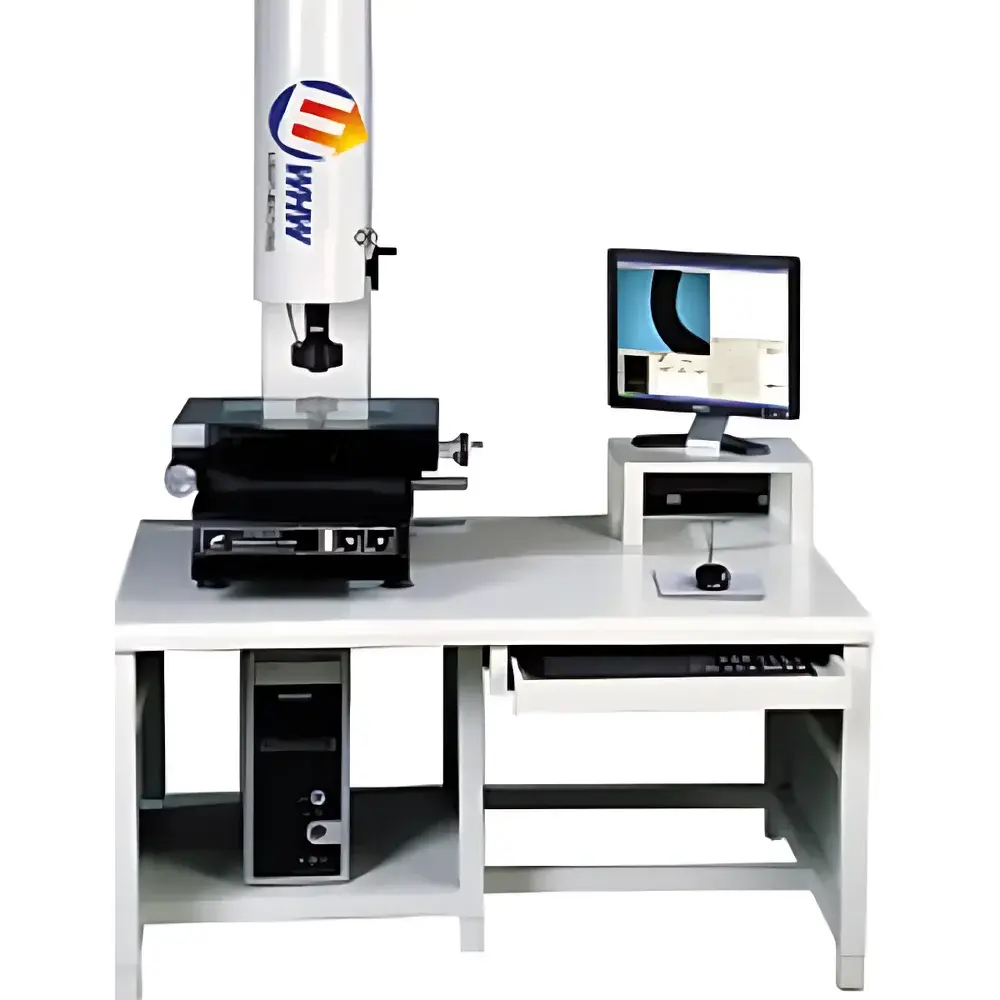
YANRUN YR-F3020 Practical Image Measuring System
| Brand | YANRUN |
|---|---|
| Origin | Shanghai, China |
| Manufacturer Type | Direct Manufacturer |
| Region Classification | Domestic (China) |
| Model | YR-F3020 |
| Price | USD 1 (Reference Only) |
| Table Dimensions (Metal) | 510 × 290 mm |
| Glass Stage Dimensions | 360 × 260 mm |
| Travel Range (X×Y) | 300 × 200 mm |
| Overall Dimensions (W×D×H) | 780 × 670 × 1060 mm |
| Z-Axis Vertical Travel | 175 mm |
| Digital Readout Resolution (X/Y/Z) | 0.0005 mm |
| Positioning Accuracy (X/Y) | ≤ (3 + L/200) µm |
| Imaging System | Sony Color CCD Camera |
| Objective Zoom Ratio | 0.7×–4.5× |
| Total Optical Magnification | 28×–180× |
| Illumination | Adjustable LED Surface & Transmission Light Sources |
| Power Supply | 220 V ±10%, 50 Hz |
| Operating Environment | 20 °C ±3 °C, 45–75% RH |
| Standard Software | Auto-Edge Detection, Deburring, Geometric Feature Measurement (Points, Lines, Circles, Circle-to-Circle Distance, Part Alignment), etc. |
| Stage Load Capacity | ≥300 kg |
| Stage Footprint (L×W×H) | 1120 × 730 × 780 mm |
Overview
The YANRUN YR-F3020 Practical Image Measuring System is a high-stability, manually operated coordinate measuring instrument engineered for precision geometric metrology in quality control laboratories, mechanical workshops, and R&D facilities. It operates on the principle of optical projection and digital image analysis: parts are placed on a rigid granite or reinforced metal stage, illuminated via coaxial surface and bottom-transmitted LED sources, and imaged through a motorized zoom objective lens coupled to a high-sensitivity Sony color CCD sensor. The system captures high-contrast 2D silhouette images, which are processed by embedded measurement algorithms to extract dimensional features—including point coordinates, line profiles, circle diameters, concentricity, parallelism, and angular deviations—with traceable repeatability under controlled environmental conditions (20 °C ±3 °C, 45–75% RH). Designed for ISO/IEC 17025-aligned calibration workflows, the YR-F3020 delivers certified measurement uncertainty consistent with ISO 15530-3 and GB/T 16857.12 (Chinese national standard equivalent to ISO 10360-7 for vision-based CMMs).
Key Features
- Rigid mechanical architecture with 300 mm × 200 mm travel range and 175 mm Z-axis vertical clearance—optimized for medium-sized machined components, stampings, and injection-molded parts.
- High-resolution digital encoder system offering 0.5 µm (0.0005 mm) positional resolution across X, Y, and Z axes, supporting manual fine positioning and repeatable feature reacquisition.
- Dual-mode LED illumination system: independently adjustable surface ring light for edge contrast enhancement and uniform transmitted backlight for silhouette-based profile measurement.
- Optical path featuring a 0.7×–4.5× continuous zoom objective, enabling seamless magnification scaling from 28× to 180× without mechanical lens swapping—critical for multi-scale inspection of both macro features and fine contours.
- Integrated granite base and vibration-damped stage assembly (load capacity ≥300 kg), mounted on a dedicated 1120 mm × 730 mm × 780 mm support platform to minimize thermal drift and structural deflection during extended measurement cycles.
- Compliance-ready firmware architecture supporting audit trails, user-level access control, and configurable report templates aligned with internal QA protocols and external regulatory expectations (e.g., IATF 16949 clause 7.1.5.2).
Sample Compatibility & Compliance
The YR-F3020 accommodates flat, semi-rigid, and low-height 3D parts up to 175 mm in height and 300 kg in mass. Typical use cases include stamped sheet metal brackets, PCB stencils, gaskets, plastic housings, and precision-machined bearing races. Its glass stage (360 mm × 260 mm) supports transparent or translucent samples requiring backlit contour analysis; the larger metal stage (510 mm × 290 mm) provides enhanced rigidity for heavier fixtures and tooling plates. All measurements adhere to ISO 14253-1 (Geometrical Product Specifications — Verification of conformity to specifications) and support traceability to national metrology institutes via optional calibration certificate issuance per ISO/IEC 17025 requirements. Environmental operation limits (20 °C ±3 °C) align with ISO 22093 for industrial metrology environments.
Software & Data Management
The system ships with YANRUN’s proprietary AutoVision-ME measurement software, compliant with GLP data integrity principles. Core capabilities include automated edge detection using sub-pixel interpolation, adaptive thresholding for variable surface reflectivity, and noise-resistant deburring filters. Users define geometric constructs (e.g., best-fit circles, minimum-zone parallelism) via intuitive drag-and-drop geometry tools. All measurement sequences are timestamped and logged with operator ID, machine configuration, and environmental metadata. Export formats include CSV, DXF, PDF reports with GD&T callouts, and XML-compatible structured logs suitable for integration into MES or QMS platforms. Software supports 21 CFR Part 11-compliant electronic signatures when deployed with validated authentication modules.
Applications
- Dimensional verification of CNC-machined aerospace fittings against ASME Y14.5 geometric tolerancing.
- First-article inspection of automotive brake caliper mounting holes, including position, diameter, and perpendicularity.
- Quality gate screening of medical device polymer components (e.g., syringe barrels) for wall thickness uniformity and concentricity.
- Tooling validation for progressive die sets—measuring punch-to-die clearance, hole pitch, and alignment fidelity.
- Educational metrology labs conducting hands-on training in coordinate measurement fundamentals, image-based GD&T interpretation, and uncertainty budgeting.
FAQ
What standards does the YR-F3020 comply with for measurement accuracy?
It conforms to ISO 15530-3 (calibration using reference parts), ISO 10360-7 (performance verification of vision systems), and GB/T 16857.12 (national standard for optical CMMs). Uncertainty budgets follow ISO/IEC Guide 98-3 (GUM).
Can the system be integrated into an existing factory QA database?
Yes—via standardized CSV/DXF exports and optional API-enabled data push modules compatible with common QMS platforms (e.g., ETQ Reliance, MasterControl, Siemens Opcenter Quality).
Is environmental conditioning required for routine use?
A temperature-controlled lab (20 °C ±3 °C) is mandatory for achieving stated accuracy; humidity control (45–75% RH) prevents condensation on optics and ensures stable encoder performance.
Does the system support third-party calibration services?
Yes—certified metrology labs can perform on-site verification using NIST-traceable step gauges, ball bars, and grid plates per ISO 10360-7 Annex B.
What maintenance intervals are recommended?
Biannual optical alignment verification, annual encoder recalibration, and quarterly LED intensity profiling are advised under continuous operation; full preventive maintenance is scheduled every 24 months.