
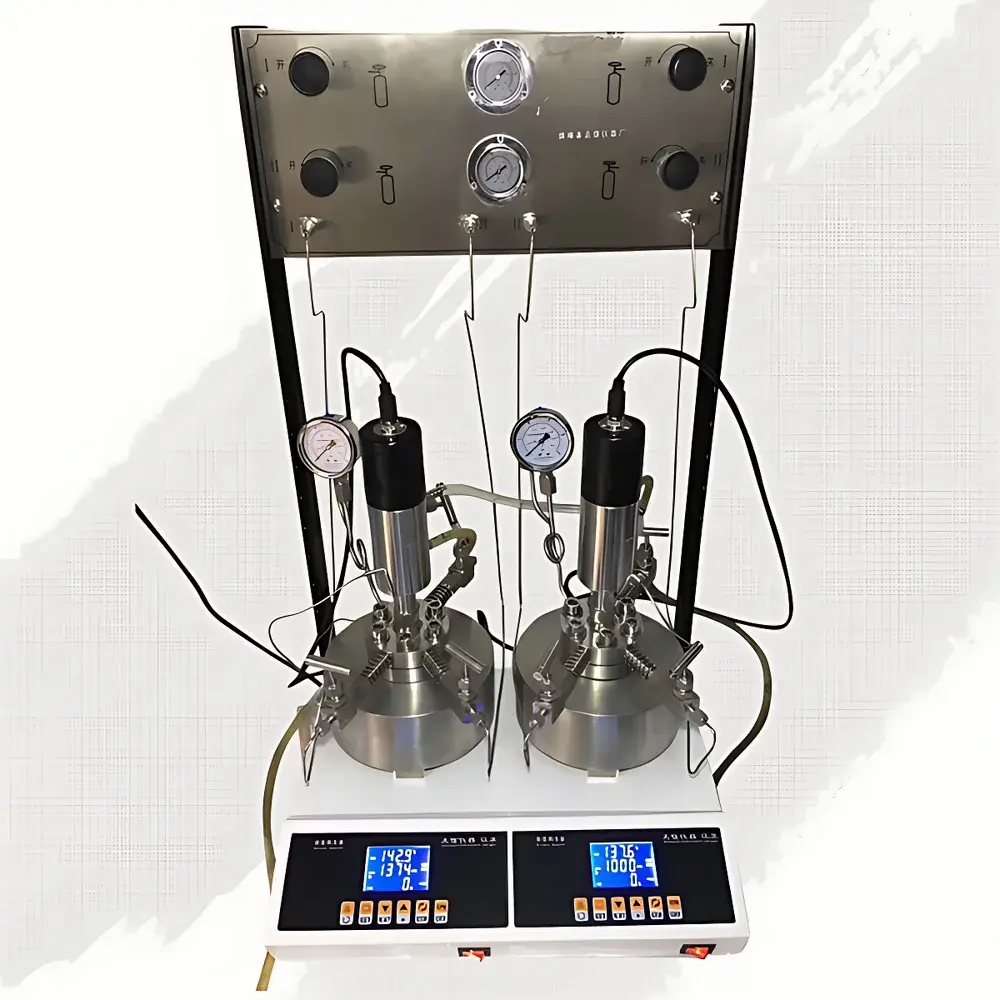
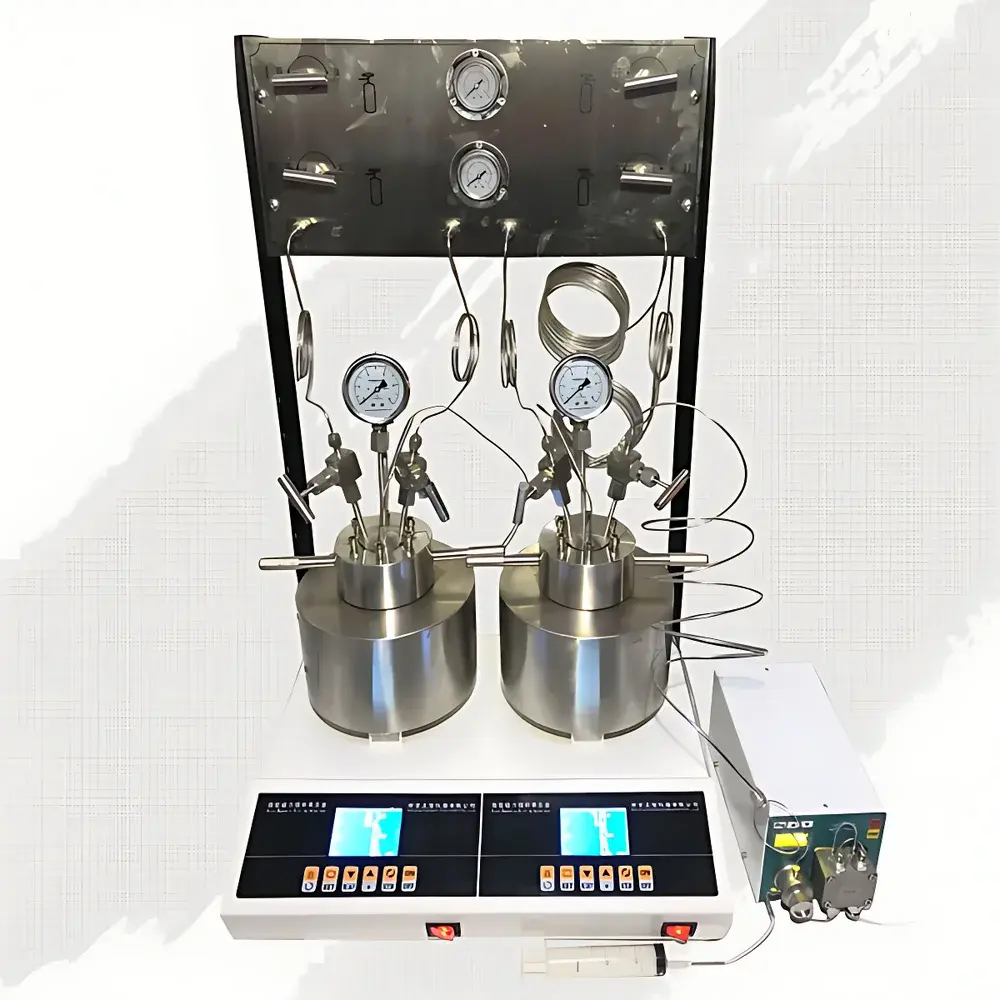
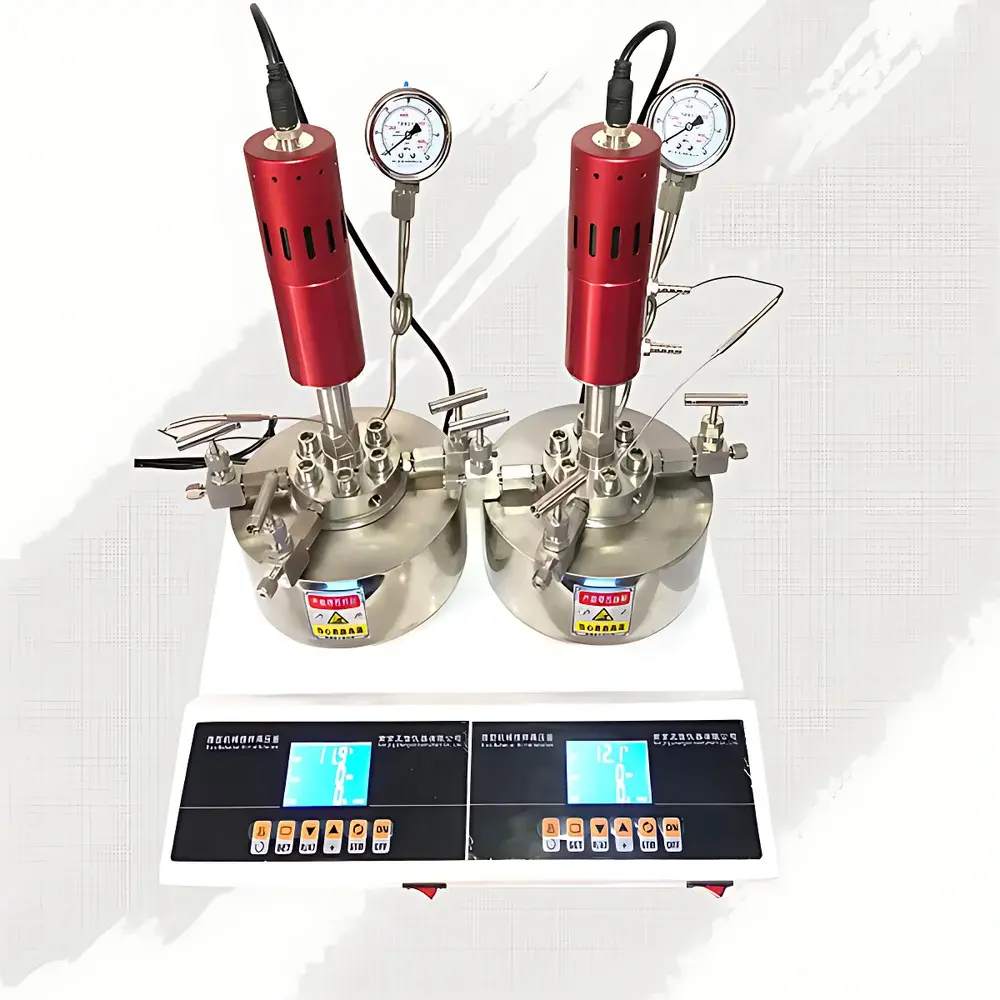
ZxYiqi K-PSA-2-100ML Parallel Stirred Mini Stainless Steel High-Pressure Reactor
| Brand | ZxYiqi |
|---|---|
| Origin | Jiangsu, China |
| Model | K-PSA-2-100ML |
| Vessel Material | 316L Stainless Steel |
| Working Pressure Range | –0.1 to 50 MPa |
| Volume Capacity | 0.25–1000 mL |
| Heating Method | Integrated Modular Electric Heater |
| Temperature Control | LCD PID Controller with Auto-Tuning (AT) & Timer (0–999 min/h) |
| Stirring Speed | 0–1500 rpm |
| Stirring Mechanism | Magnetic Coupling Drive with Impeller |
| Vacuum Capability | –0.1 MPa (absolute) |
| Safety System | Integrated Burst Disc + Pressure Relief Valve |
| Sensor | High-Accuracy K-Type Thermocouple |
| Inlet/Outlet Valves | SS Needle Valves (1/8″ & 1/4″ Swagelok®-compatible) |
| Optional Linings | PTFE, PPL, Quartz, or Metal Cladding |
| Customization | Available for geometry, lining, ports, and instrumentation per client specifications |
Overview
The ZxYiqi K-PSA-2-100ML Parallel Stirred Mini Stainless Steel High-Pressure Reactor is an engineered solution for controlled high-pressure synthesis, catalytic screening, hydrogenation, oxidation, and kinetic studies under reproducible thermobaric conditions. Designed around a robust 316L stainless steel pressure vessel architecture, it operates across a validated pressure range of –0.1 MPa (full vacuum) to 50 MPa (7,250 psi), supporting both inert atmosphere handling and reactive gas introduction (e.g., H₂, O₂, CO, NH₃). Its magnetic coupling drive eliminates dynamic seal leakage—a critical failure point in high-pressure stirred reactors—ensuring long-term integrity during extended runs at elevated temperatures (up to 600 °C, depending on configuration). The reactor integrates modular thermal management, precision digital control, and multi-port fluidic interfaces, enabling seamless integration into parallel reaction workflows or single-vessel optimization protocols.
Key Features
- 316L stainless steel pressure vessel with optional corrosion-resistant linings (PTFE, PPL, quartz, or alloy claddings) for compatibility with aggressive reagents including halogenated solvents, strong acids, and alkalis.
- Magnetic torque-coupled stirring system delivering consistent 0–1500 rpm operation with zero shaft penetration, eliminating seal wear and cross-contamination risk.
- Modular fixed-position electric heating mantle with power output scalable from 400 W to 1800 W, ensuring uniform thermal distribution and minimal thermal gradient across the reactor wall.
- LCD-based PID temperature controller featuring auto-tuning (AT), dual-mode timing (run timer / hold timer), and programmable ramp-soak profiles for GLP-compliant thermal protocols.
- Dual-function needle valves (inlet and outlet) with 1/8″ and 1/4″ Swagelok®-compatible ferrule connections for precise gas dosing, vacuum evacuation, inert purging, and controlled venting.
- Integrated safety subsystem comprising a calibrated stainless steel Bourdon-tube pressure gauge (0–60 MPa scale), rupture disc assembly, and spring-loaded pressure relief valve—each independently certified to ASME BPVC Section VIII Division 1 design criteria.
- Quick-disconnect vessel-to-heater interface enabling tool-free separation for rapid cleaning, sample recovery, or liner replacement without disturbing instrumentation calibration.
Sample Compatibility & Compliance
The K-PSA-2-100ML supports heterogeneous, homogeneous, and multiphase reaction systems—including solid-catalyzed gas–liquid reactions, slurry-phase polymerizations, and supercritical fluid syntheses. Its wide pressure–temperature envelope aligns with ASTM E2913 (high-pressure reaction calorimetry), ISO 4775 (pressure equipment safety), and USP analytical instrument qualification guidelines when deployed in QC/QA environments. All wetted components comply with FDA 21 CFR Part 11 requirements for electronic records when paired with validated data acquisition software. Optional PTFE or PPL linings meet USP Class VI biocompatibility standards for pharmaceutical intermediate synthesis.
Software & Data Management
While the base unit operates via front-panel controls, optional RS485/Modbus RTU or USB-C connectivity enables integration with third-party SCADA platforms (e.g., LabVIEW™, DeltaV™, or custom Python-based logging). Real-time acquisition of temperature, pressure, stir speed, and elapsed time is supported at 1 Hz resolution. Audit-trail-enabled firmware versions provide timestamped event logs—including setpoint changes, alarm triggers, and safety interlock activations—satisfying GLP/GMP traceability mandates. Data export formats include CSV and XML, compatible with LIMS and ELN systems.
Applications
- Catalyst screening under industrially relevant H₂ partial pressures (1–10 MPa) for asymmetric hydrogenation and hydrodeoxygenation.
- Hydrothermal synthesis of metal–organic frameworks (MOFs) and nanomaterials at subcritical water conditions (200–374 °C, 5–22 MPa).
- High-pressure oxidation kinetics using O₂ or air, with in situ pressure decay monitoring as a proxy for reaction progress.
- Supercritical CO₂-assisted impregnation and extraction processes requiring precise density control via pressure modulation.
- Corrosion testing of alloys and coatings under simulated sour-gas (H₂S/CO₂) environments per NACE TM0177.
- Process intensification studies comparing batch vs. semi-batch operation across variable agitation intensity and mass transfer regimes.
FAQ
What pressure and temperature ratings are certified for continuous operation?
The standard K-PSA-2-100ML is rated for continuous service up to 35 MPa and 350 °C. Higher ratings (50 MPa / 600 °C) require bespoke validation, alloy selection (e.g., Inconel 718), and third-party hydrostatic certification.
Can multiple reactors be operated in parallel with synchronized control?
Yes—via optional master–slave Modbus network configuration, up to eight units can share common setpoints and log data to a centralized historian with millisecond-level timestamp alignment.
Is the magnetic coupling rated for viscous or particle-laden media?
The coupling maintains full torque transmission up to 1500 cP viscosity and suspended solids loadings ≤20 wt% provided impeller geometry is optimized for shear-sensitive systems.
How is calibration traceability maintained for pressure and temperature sensors?
Each unit ships with NIST-traceable calibration certificates for the pressure transducer and K-type thermocouple; field recalibration intervals follow ISO/IEC 17025 recommendations (typically annually or after 500 operating hours).
Are explosion-proof electrical options available for Zone 1 hazardous areas?
ATEX-certified variants (II 2G Ex db IIB T4 Gb) and IECEx-compliant versions are available upon request, including intrinsically safe signal conditioning and purged enclosure configurations.
Related Products



