
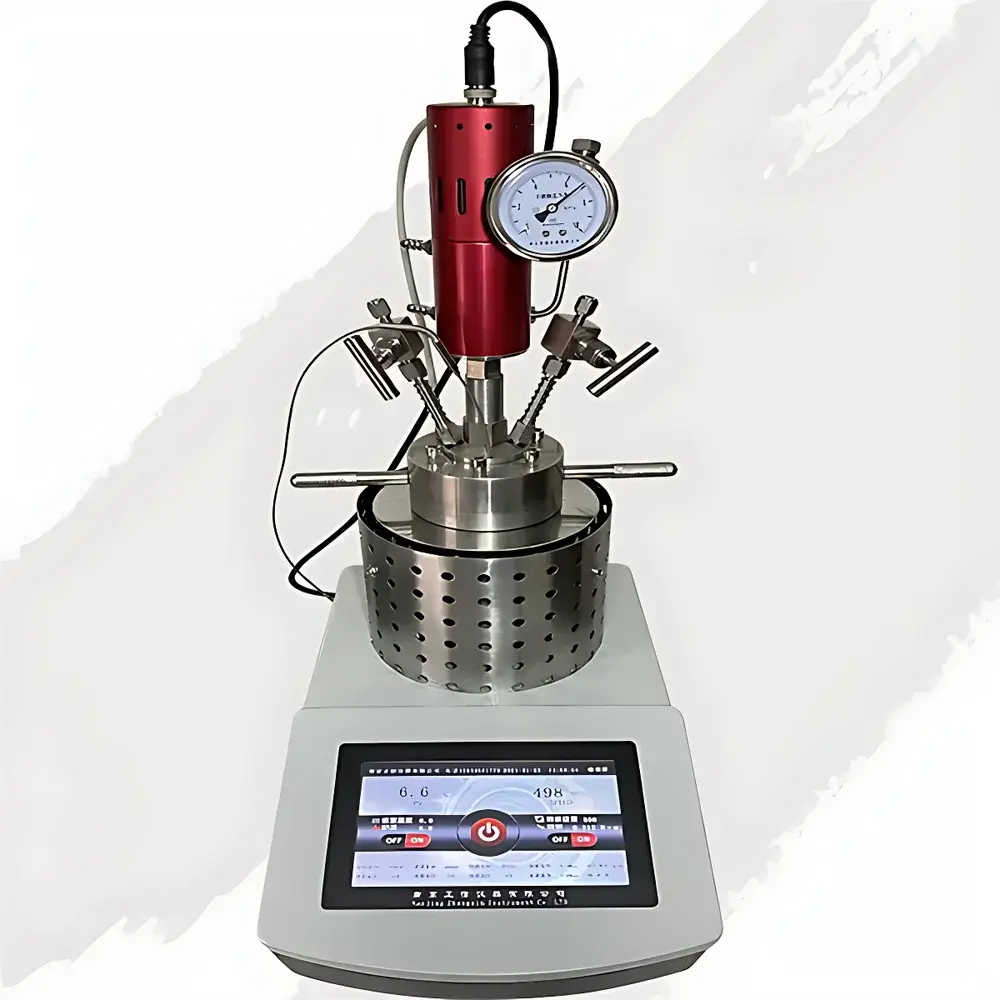
Zhengxin C-K-PSA Series Miniature Mechanical Stirring High-Pressure Reactor
| Brand | Zhengxin Instrument Factory (ZXYIQI) |
|---|---|
| Origin | Jiangsu, China |
| Model | C-K-PSA |
| Capacity | 0.03–10 L |
| Vessel Material | SS304 / SS316L / SS310S / 904L / Hastelloy / Titanium |
| Sealing Type | Hard or Soft Seal |
| Structure | Quick-Release or Flanged |
| Internal Lining Options | PTFE / Quartz / SS316L / Hastelloy / Titanium / Monel |
| Max Operating Temperature | Ambient to 600 °C |
| Max Working Pressure | 0–60 MPa |
| Burst/Relief Pressure | 7–62 MPa |
| Stirring Method | Magnetic Coupling with Mechanical Impeller (3-Blade) |
| Speed Range | 0–1000 rpm |
| Heating | Electric, Closed-Type Stainless Steel Heater (800–5500 W) |
| Temperature Control | Dual-Loop PID (US-imported Smart PID algorithm), ±1 °C accuracy (under stable thermal conditions), 0.1 °C resolution |
| Pressure Monitoring | Dual Display (Stainless Steel Bourdon Gauge + 4–20 mA Pressure Transmitter) |
| Safety Systems | Over-Temperature / Over-Pressure / Over-Time Interlock, Auto-Depressurization, Explosion-Proof Relief Device (Hastelloy) |
| Data Logging | Real-time recording of temperature (vessel & heater), pressure, speed, torque, time |
| Interface | 7-inch true-color touchscreen HMI |
| Compliance | Designed for GLP/GMP-aligned lab environments |
Overview
The Zhengxin C-K-PSA Series Miniature Mechanical Stirring High-Pressure Reactor is an engineered platform for controlled, reproducible chemical synthesis under elevated temperature and pressure conditions. It operates on the principle of sealed-vessel batch reaction kinetics, integrating precision magnetic-coupled mechanical agitation with dual-zone thermal regulation and real-time multivariable process monitoring. Unlike atmospheric or low-pressure glass reactors, this system maintains structural integrity and leak-tightness at pressures up to 60 MPa—enabling studies in supercritical fluid chemistry, heterogeneous catalysis, hydrogenation under inert atmospheres, and high-temperature polymerization where volatile reagents or exothermic pathways demand rigorous containment. The reactor vessel is CNC-machined in one piece from solid alloy billet, eliminating weld seams that compromise fatigue resistance and corrosion performance at extreme operating envelopes.
Key Features
- Monolithic reactor body fabricated from high-purity stainless steel or exotic alloys (e.g., Hastelloy C-276, Grade 2 Titanium), ensuring long-term compatibility with aggressive media including halogenated solvents, strong acids, and hydrides.
- Quick-release clamp design secured by 6–12 high-strength alloy bolts, enabling repeatable sealing force distribution and minimizing gasket creep during thermal cycling.
- Triple-blade impeller driven via hermetic magnetic coupling—eliminating dynamic shaft seals while delivering consistent torque transmission up to 1000 rpm, even at 600 °C internal temperature.
- ZX-CTSCS-TC integrated control system featuring dual-loop PID temperature regulation: primary loop controls internal vessel temperature using K-type thermocouple feedback; secondary loop manages furnace zone power to suppress thermal overshoot and stabilize gradient profiles.
- Four independent heating zones with programmable power modulation per zone, allowing spatial thermal profiling for endothermic/exothermic reaction staging or wall-to-core temperature homogenization.
- Redundant pressure monitoring: analog stainless steel bourdon tube gauge for immediate visual verification + digital 4–20 mA transmitter for data acquisition and automated safety interlocks.
- Explosion-proof relief mechanism constructed from Hastelloy alloy, calibrated to activate within 7–62 MPa range—designed to meet ASME BPVC Section VIII Div. 1 rupture disc requirements when installed per manufacturer specifications.
Sample Compatibility & Compliance
The C-K-PSA accommodates heterogeneous slurries, viscous melts, and gas–liquid–solid multiphase systems without compromising mixing efficiency or measurement fidelity. Optional linings—including PTFE, quartz, and Monel—extend operational compatibility to HF-based etchants, molten alkali metals, and photoactive precursors. All wetted surfaces comply with FDA 21 CFR 177.1550 (for PTFE components) and ASTM A240/A480 (for stainless grades). The system architecture supports Good Laboratory Practice (GLP) workflows: timestamped event logs (including alarm triggers, parameter changes, and manual overrides) are stored locally and exportable in CSV/Excel format. When deployed with validated third-party SCADA or LIMS integration, it satisfies audit requirements under ISO/IEC 17025 and USP analytical instrument qualification protocols.
Software & Data Management
Process variables—including vessel temperature, furnace temperature, absolute pressure, rotational speed, torque load, and elapsed time—are sampled at 1 Hz and displayed synchronously on the 7-inch capacitive touchscreen. Historical datasets are retained onboard for ≥30 days and exported via USB 2.0 to standard FAT32-formatted drives. For networked operation, the embedded Ethernet port enables Modbus TCP communication, permitting remote supervision through industry-standard OPC UA clients or custom Python/Node-RED dashboards. While cloud connectivity requires user-provisioned infrastructure (e.g., AWS IoT Core or Azure IoT Hub), Zhengxin provides documented RESTful API endpoints and TLS 1.2–compliant firmware updates to support secure over-the-air deployment in regulated environments.
Applications
This reactor serves as a scalable development tool across multiple R&D domains: catalytic screening for Fischer–Tropsch synthesis or ammonia decomposition; kinetic modeling of cross-linking reactions in epoxy resin formulations; hydrothermal carbonization of biomass feedstocks; supercritical CO₂ extraction optimization; and high-pressure hydrogenation of unsaturated pharmaceutical intermediates. Its modular construction permits integration with external condensers, syringe pumps, and online FTIR cells—facilitating reaction progress analysis without venting. In metallurgical research, it supports solvothermal synthesis of nanostructured transition metal oxides under controlled O₂ partial pressure, leveraging its dual-gas inlet capability and precision back-pressure regulation.
FAQ
What materials are available for reactor vessel construction?
Standard options include ASTM A240 UNS S30400 (304 SS), S31603 (316L), S31008 (310S), N08904 (904L), N10276 (Hastelloy C-276), and Grade 2 Titanium. Custom alloys such as Inconel 625 or duplex 2205 may be quoted upon request.
Is the system compliant with international pressure equipment directives?
The C-K-PSA is designed in accordance with PED 2014/68/EU Category IV requirements for Group 1 fluids; CE marking applies only when installed with certified pressure relief devices and operated within defined limits per EN 13445-1.
Can torque measurement be used for real-time reaction progress tracking?
Yes—the magnetic coupling assembly includes strain-gauge-based torque sensing with ±0.5% full-scale linearity; torque transients correlate strongly with viscosity evolution during polymerization or crystallization events.
Does the controller support ramp-hold-soak temperature programming?
Yes—up to 32 segments with independent rate, target, and dwell settings; each segment can assign different PID tuning parameters to accommodate nonlinear thermal mass behavior.
What validation documentation is provided with the system?
Factory calibration certificates for temperature (NIST-traceable K-type thermocouples), pressure (deadweight tester verified), and speed (laser tachometer) are included. IQ/OQ templates aligned with ASTM E2500 are available upon purchase.



