
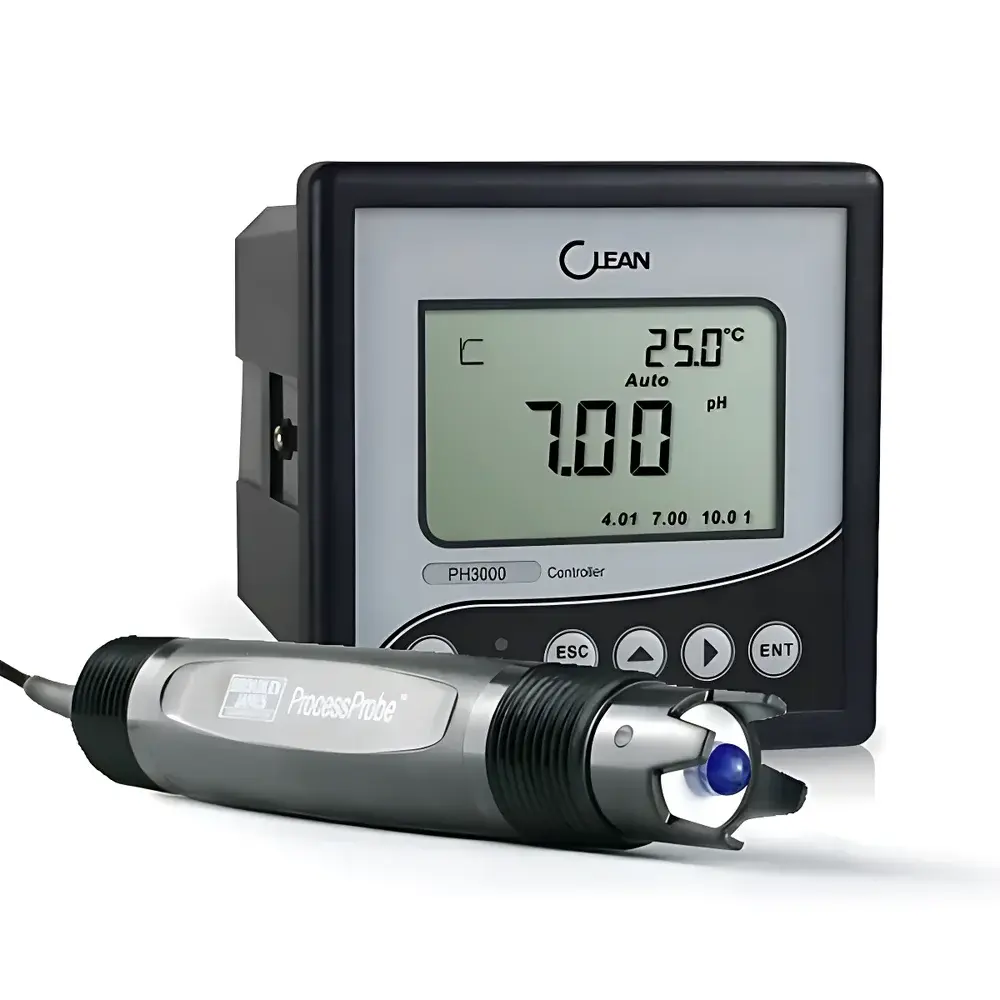
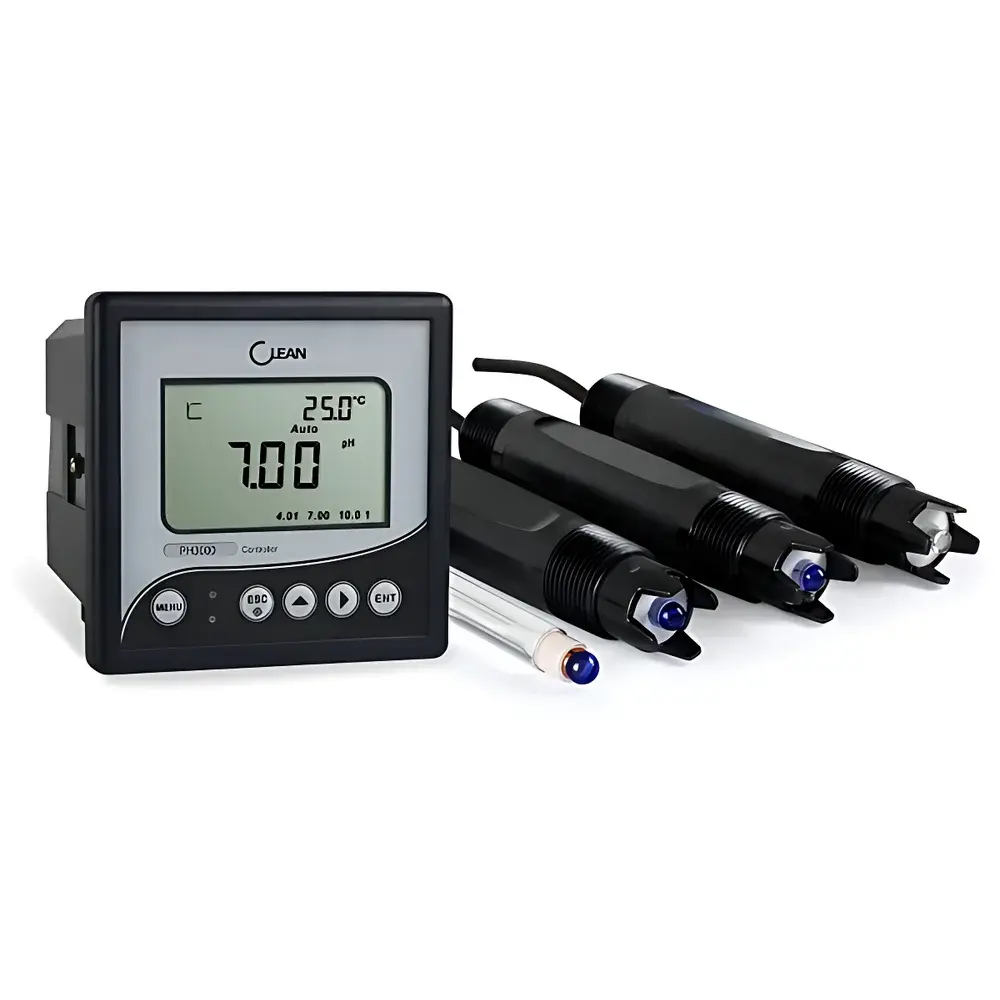
BJC S400-RT330-M10BC Industrial Online pH Electrode
| Origin | USA |
|---|---|
| Manufacturer Type | Authorized Distributor |
| Origin Category | Imported |
| Model | S400-RT330-M10BC |
| Instrument Type | Online Water Quality Analyzer |
| pH Range | 0–14 |
| Temperature Range | 0–105 °C |
| Max. Pressure | 150 psig (10 bar) at 100 °C |
| Max. Flow Rate | 3 m/s |
| Reference System | Ag/AgCl |
| Salt Bridge | Dual-compartment |
| Liquid-contact Materials | Ryton (PPS), PTFE, HT-3 blue glass |
| Sensing Membrane | HT-3 borosilicate glass bulb |
| Output Impedance | < 250 MΩ at 25 °C |
| Process Connection | 3/4" NPT male thread |
| Cable | 3 m, 5 mm OD, BNC termination |
Overview
The BJC S400-RT330-M10BC is an industrial-grade, submersible online pH electrode engineered for continuous, high-reliability measurement in demanding wastewater, effluent, and process water applications. Based on the fundamental principle of potentiometric pH measurement—where the potential difference between a pH-sensitive glass membrane and a stable reference electrode is converted into a logarithmic pH value—the S400 delivers consistent performance under extreme chemical, thermal, and hydraulic conditions. Its design adheres to core electrochemical engineering principles governing ion-selective electrode stability, junction potential minimization, and long-term drift suppression. Unlike general-purpose laboratory electrodes, the S400 is purpose-built for unattended operation in real-time monitoring systems, where sensor longevity, fouling resistance, and calibration stability directly impact process control integrity and regulatory compliance.
Key Features
- HT-3 High-Performance Glass Membrane: A proprietary borosilicate glass formulation with optimized alkali error suppression and rapid hydration kinetics, ensuring accurate response across the full 0–14 pH range—even in low-ionic-strength or high-sodium environments.
- Dual-Compartment Reference System: Two physically separated salt bridge chambers minimize contamination ingress from aggressive matrices (e.g., sulfide-rich sewage, heavy-metal-laden industrial discharge), extending service intervals and maintaining reference potential stability over extended deployment cycles.
- Coaxial Large-Area PTFE Liquid Junction: A precision-machined, annular Teflon junction provides uniform electrolyte outflow and significantly reduces clogging risk compared to ceramic or wood-based junctions—critical for suspended solids-laden streams and biologically active wastewaters.
- Ryton (PPS) Housing: Polyphenylene sulfide construction offers exceptional resistance to strong acids (e.g., H₂SO₄, HCl), caustics (e.g., NaOH), oxidizers (e.g., chlorine, ozone), and organic solvents—meeting material compatibility requirements per ASTM D543 and ISO 17359 for industrial process sensors.
- Robust Mechanical Design: Rated for continuous operation up to 10 bar (150 psig) at 100 °C and dynamic flow velocities up to 3 m/s, the electrode withstands high-pressure recirculation loops, aerated basins, and turbulent pipe installations without seal failure or membrane stress.
Sample Compatibility & Compliance
The S400-RT330-M10BC is validated for use in raw influent, activated sludge effluent, cooling tower water, chemical process streams, and leachate—environments characterized by variable conductivity (50 µS/cm to >20 mS/cm), particulate loadings (>100 mg/L TSS), and redox potentials ranging from −300 to +600 mV. Its dual-reference architecture and chemically inert wetted materials comply with functional requirements outlined in EPA Method 150.1, ISO 10523, and ASTM D1293 for field-deployable pH instrumentation. The electrode supports GLP/GMP data integrity workflows when integrated with compatible transmitters featuring audit-trail logging and user-access controls aligned with FDA 21 CFR Part 11.
Software & Data Management
While the S400 itself is an analog sensing element (BNC output), it is fully interoperable with industry-standard pH transmitters—including models from Emerson Rosemount, Endress+Hauser, and Yokogawa—that provide digital signal conditioning, temperature compensation (via integrated Pt100 or thermistor), automatic calibration validation, and Modbus TCP/RTU or HART communication. When paired with compliant transmitter firmware, the system enables secure data export, trend analysis, alarm thresholding, and electronic record generation suitable for environmental reporting (e.g., NPDES permit submissions) and internal QA/QC documentation.
Applications
- Continuous pH monitoring in municipal wastewater treatment plant influent channels, equalization tanks, and final effluent discharge points
- Real-time process control of neutralization reactors in electroplating, pharmaceutical manufacturing, and food processing facilities
- Corrosion mitigation monitoring in closed-loop cooling water systems
- Leachate pH tracking in landfill liner integrity verification programs
- Regulatory compliance sampling support for state and federal environmental agencies requiring traceable, time-stamped measurements
FAQ
What is the recommended calibration frequency for the S400 in continuous wastewater monitoring?
Calibration interval depends on matrix severity and regulatory requirements; typical practice is daily two-point (4.01/7.00 or 7.00/10.01) calibration in high-variability streams, with weekly verification in stable effluents. Automatic calibration validation features in modern transmitters reduce manual intervention.
Can the S400 be used in seawater or brine solutions?
Yes—its HT-3 glass and dual-salt-bridge design mitigate sodium error and junction clogging common in high-chloride media; however, extended exposure above 50,000 ppm Cl⁻ may accelerate reference depletion and warrants more frequent maintenance.
Is the 3/4″ NPT interface compatible with standard process fittings?
Yes—the male NPT thread conforms to ANSI/ASME B1.20.1 and mates directly with female NPT ports on flow cells, immersion housings, and pipe tees commonly used in industrial water monitoring skids.
Does the electrode require a specific cable shield or grounding configuration?
For optimal noise immunity in electrically noisy plants, a grounded-shielded coaxial cable (e.g., Belden 8761) and proper transmitter chassis grounding are recommended; floating ground configurations should be avoided to prevent common-mode interference.
How does the S400 compare to gel-filled or polymer-bodied pH electrodes?
Unlike gel-filled electrodes—which suffer from slow response and irreversible junction blockage in dirty water—the S400’s flowing electrolyte design and PTFE junction ensure sustained accuracy; unlike polymer-bodied units, its Ryton housing maintains dimensional stability and chemical resistance at elevated temperatures and pH extremes.
Related Products







