
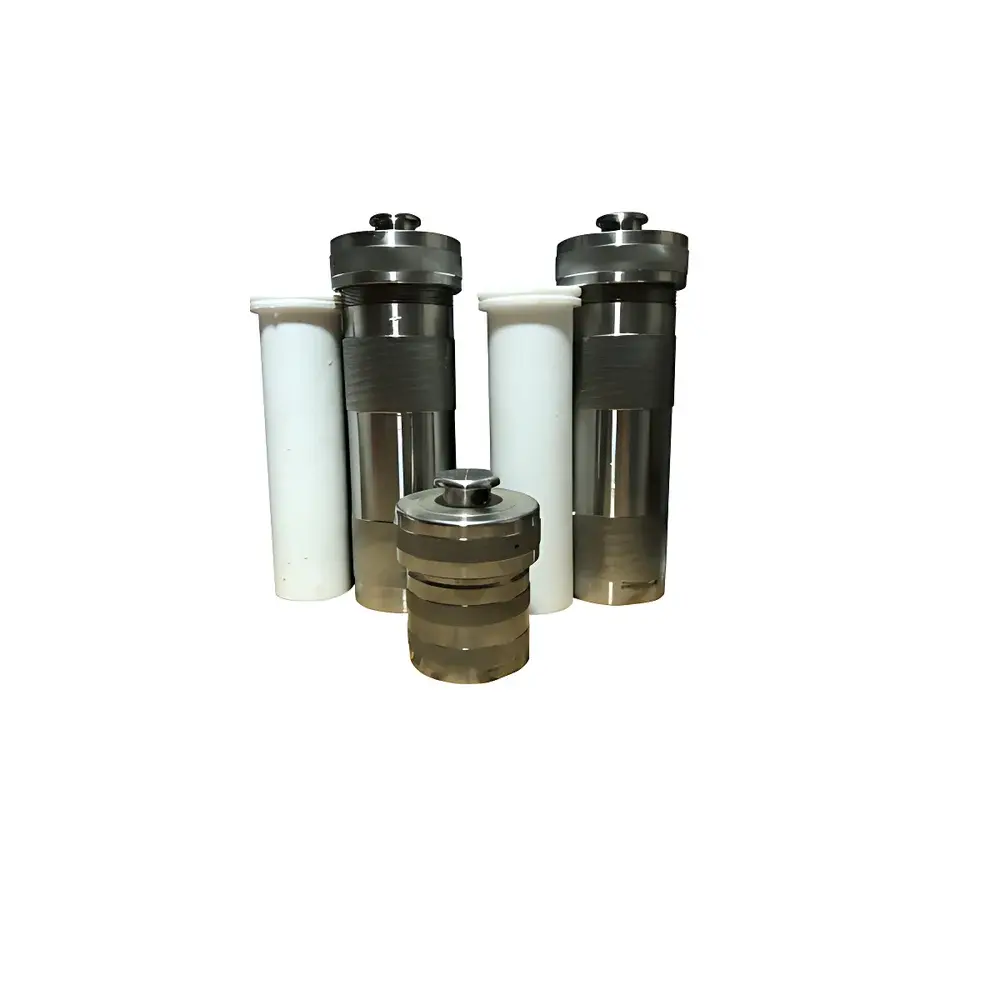
Zhengxin PF-250ML Ultra-Height Hydrothermal Synthesis Reactor
| Brand | Zhengxin Instrument Factory (ZXYIQI) |
|---|---|
| Origin | Jiangsu, China |
| Model | PF-250ML |
| Capacity | 250 mL |
| Construction Material | Forged 304 Stainless Steel Body with PTFE (F4) or PPS Liner |
| Operating Pressure | Low-Pressure Design (Max. Rated Pressure ≤ 3 MPa) |
| Vacuum Capability | Up to –0.1 MPa (Absolute) |
| Temperature Range | –200 °C to +240 °C (PTFE liner) |
| Sealing Type | Circular Tenon-Groove Mechanical Seal with Manual Spiral Tightening |
| Safety Features | Dual Anti-Explosion Vents on Lid and Inner Cap |
| Compliance | Designed for ASTM E2912-compliant sample digestion |
Overview
The Zhengxin PF-250ML Ultra-Height Hydrothermal Synthesis Reactor is a precision-engineered low-pressure batch reactor designed for controlled high-temperature, high-humidity chemical synthesis and closed-vessel sample digestion under inert or reactive atmospheres. Based on the fundamental principles of hydrothermal chemistry—where aqueous solutions undergo accelerated reaction kinetics under elevated temperature and autogenous pressure—the PF-250ML enables reproducible crystallization of nanomaterials (e.g., metal oxides, perovskites, MOFs), mineral dissolution, and trace-element solubilization in compliance with analytical standards such as USP , EPA Method 3052, and ISO 11885. Its ultra-height geometry enhances vapor-phase residence time and improves thermal gradient uniformity across the reaction volume, supporting consistent nucleation and crystal growth without external pressurization systems.
Key Features
- Forged 304 stainless steel body with circular tenon-groove sealing interface—ensures leak-tight integrity at temperatures up to 240 °C and pressures up to 3 MPa (autogenous)
- Removable liner options: Chemically inert PTFE (F4) rated from –200 °C to +240 °C or high-purity para-phenylene sulfide (PPS) liner rated to +260 °C, both exhibiting sub-ppt metal blank values (Pb < 10–11 g/mL; U < 10–12 g/mL)
- Dual mechanical anti-explosion vents integrated into both upper lid and inner cap—provides passive overpressure relief without compromising seal integrity during rapid heating cycles
- Manual spiral tightening mechanism with calibrated torque feedback—eliminates reliance on hydraulic or pneumatic clamping while maintaining repeatable sealing force
- Optimized aspect ratio (height-to-diameter > 3.5) for enhanced vertical convection and reduced localized superheating in heterogeneous slurries
- Low-acid-consumption design: Typical reagent volume ≤ 30% of liner capacity, minimizing contamination risk and post-digestion matrix effects
Sample Compatibility & Compliance
The PF-250ML supports digestion and synthesis of diverse matrices including geological samples (silicates, clays), biological tissues (liver, bone), environmental solids (sediments, sludge), foodstuffs (spices, cereals), and advanced ceramics (Al2O3, Y2O3). It replaces platinum crucibles in high-purity alumina trace-metal analysis per ASTM C760 and meets GLP requirements for audit-trail-capable digestion protocols when paired with validated SOPs. All wetted components comply with FDA 21 CFR 177.1550 (PTFE) and ISO 10993-5 (cytotoxicity testing). The reactor is routinely employed in laboratories accredited to ISO/IEC 17025 for heavy metal testing (Cd, Pb, As, Hg) in consumer products and agricultural commodities.
Software & Data Management
While the PF-250ML operates manually, its design integrates seamlessly into digital lab workflows. Each unit carries a unique serial number engraved on the base flange for LIMS tracking. Users are advised to log batch-specific parameters—including charge ratio (≤ 0.8 fill factor), ramp rate (≤ 5 °C/min), hold time, and cooldown profile—in electronic notebooks compliant with 21 CFR Part 11. Optional thermocouple feedthrough ports (M12 threaded) allow real-time internal temperature monitoring when used with third-party data loggers. No proprietary software is required; calibration records and maintenance logs may be maintained using standard ELN platforms.
Applications
- Synthesis of nanostructured metal oxides (TiO2, ZnO, Fe3O4) via controlled hydrolysis and condensation
- Digestion of refractory silicates and rare-earth-containing minerals for ICP-MS quantification
- Preparation of single-crystal precursors for solid-state battery cathode materials (e.g., LiCoO2, NMC)
- Trace mercury stabilization in fish tissue prior to cold-vapor AAS analysis
- Hydrothermal carbonization of lignocellulosic biomass for functional carbon material production
- Acid-free decomposition of polymer composites for elemental recovery assessment
FAQ
What is the maximum safe operating temperature for the PTFE-lined PF-250ML?
The PTFE liner is rated for continuous use up to +240 °C; however, sustained operation above +220 °C requires strict adherence to ≤ 0.6 fill factor and ramp rates ≤ 3 °C/min.
Can this reactor be used for oxygen-sensitive reactions?
Yes—after evacuation via the vacuum port (–0.1 MPa absolute), the reactor can be backfilled with inert gas (N2, Ar) using standard Schlenk-line techniques.
Is the PPS liner chemically compatible with hydrofluoric acid (HF)?
No—neither PTFE nor PPS exhibits resistance to anhydrous HF or concentrated HF/HNO3 mixtures; use only for HCl, HNO3, H2SO4, and aqua regia below 200 °C.
How often should the sealing gasket be replaced?
Under normal usage (≤ 50 cycles/year at ≤ 200 °C), the PTFE-coated stainless steel gasket maintains integrity for ≥ 2 years; visual inspection for compression set or surface cracking is recommended before each use.
Does the reactor meet CE or PED certification requirements?
As a low-pressure (< 0.5 MPa) laboratory vessel intended for non-continuous operation, it falls outside the scope of the Pressure Equipment Directive (PED 2014/68/EU); full compliance documentation is available upon request for institutional safety review.



