
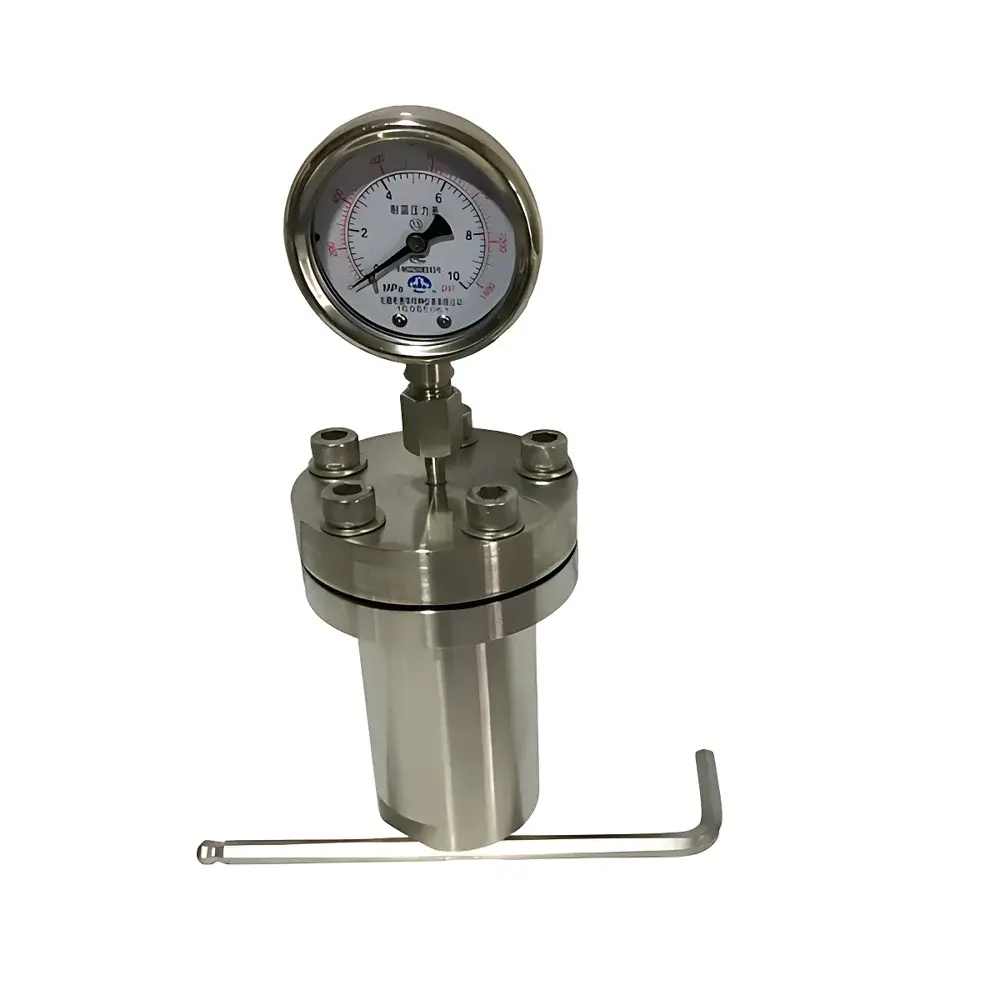
Zhengxin Instruments PS-500ML High-Temperature & High-Pressure Batch Reactor
| Brand | Zhengxin Instruments |
|---|---|
| Origin | Jiangsu, China |
| Manufacturer Type | Authorized Distributor |
| Country of Origin | China |
| Model | PS-500ML |
| Capacity | 500 mL |
| Construction Material | Stainless Steel (304/316L standard) |
| Operating Pressure Range | –0.1 to 6 MPa |
| Operating Temperature Range | 0–400 °C |
| Vacuum Capability | –0.1 MPa (absolute) |
| Heating Method | Electric heating (400–3500 W, configurable) |
| Temperature Control | LCD PID controller, ±1 °C accuracy, ramp rate ≤10 °C/min (adjustable) |
| Optional Accessories | High-pressure inlet/outlet needle valves (1/8" & 1/4" Swagelok®-compatible), digital pressure gauge, internal Pt100 temperature probe, rupture disc safety system, finned heat dissipation module, quartz or metallic liner, sampling tube |
Overview
The Zhengxin Instruments PS-500ML High-Temperature & High-Pressure Batch Reactor is an engineered laboratory-scale reaction vessel designed for controlled synthesis, catalytic studies, hydrothermal processing, and material precursor development under non-ambient thermodynamic conditions. It operates on the principle of sealed-vessel batch reaction dynamics, where precise regulation of internal pressure and temperature enables kinetic investigation of reactions that are otherwise inaccessible under ambient conditions—such as hydrogenation, oxidation, supercritical fluid synthesis, and solid-state crystallization. Constructed with a primary body of ASTM A240-certified stainless steel (standard grade 304 or optional 316L), the reactor supports sustained operation up to 400 °C and 6 MPa, with full vacuum compatibility down to –0.1 MPa (absolute). Its modular design accommodates user-defined configurations—including custom liners (quartz, titanium, Hastelloy®, or zirconium), integrated thermal management, and process instrumentation—making it suitable for both exploratory research and method-development workflows in academic, pharmaceutical, and materials science laboratories.
Key Features
- Robust pressure-rated vessel body with double-walled insulation option and standardized ASME B16.5 flanged sealing interface
- Configurable temperature control via PID-regulated electric heating mantle, with real-time monitoring through embedded Pt100 sensor (±1 °C accuracy)
- Integrated safety architecture including mechanical rupture disc (ASME Section VIII compliant), overpressure venting path, and fail-safe thermal cutoff
- Modular valve train: high-purity stainless steel needle valves (Swagelok®-compatible 1/8″ and 1/4″ compression fittings) for inert gas purging, reactant injection, and controlled venting
- Optional finned aluminum heat sink assembly for accelerated cooldown post-reaction, reducing thermal soak time by up to 40% versus passive cooling
- Customizable internal geometry and liner materials to mitigate corrosion or catalytic interference—validated for use with aggressive media including HF, molten alkalis, and supercritical CO₂
Sample Compatibility & Compliance
The PS-500ML supports heterogeneous, homogeneous, and slurry-phase reactions involving organic solvents, aqueous electrolytes, gaseous reagents (H₂, O₂, NH₃, Cl₂), and solid catalysts. Its pressure/temperature envelope complies with ISO 4744:2021 (pressure equipment — design and construction of autoclaves) and aligns with GLP-compliant documentation requirements for reaction traceability. When equipped with audit-trail-capable controllers and calibrated transducers, the system meets data integrity prerequisites under FDA 21 CFR Part 11 for regulated environments. All wetted components conform to USP Class VI biocompatibility standards when specified with electropolished 316L or titanium liners.
Software & Data Management
While the base configuration utilizes a standalone LCD PID controller, optional digital integration enables RS485/Modbus RTU communication with third-party SCADA or LIMS platforms. Data logging (temperature, pressure, time-stamped events) is supported at 1 Hz resolution via external DAQ systems. Optional firmware upgrades provide CSV export, alarm history retention (>30 days), and password-protected parameter locking—facilitating SOP adherence and audit readiness per ISO/IEC 17025 calibration management frameworks.
Applications
- Catalyst screening under industrially relevant H₂ partial pressures (up to 4 MPa)
- Hydrothermal synthesis of metal oxides, MOFs, and quantum dot precursors
- Thermal stability testing of battery electrolytes and solid-state electrolytes
- Supercritical water oxidation (SCWO) kinetics for wastewater treatment modeling
- High-boiling-point solvent-based polymerizations (e.g., polyimide, polyetheretherketone)
- Accelerated aging studies for encapsulation materials in photovoltaic and aerospace sectors
FAQ
What maximum operating temperature and pressure does the PS-500ML support under continuous duty?
The reactor is rated for continuous operation at 400 °C and 6 MPa, with validation per EN 13445-3 Annex C fatigue analysis for cyclic thermal/pressure loading.
Can the reactor be supplied with GMP-compliant documentation packages?
Yes—upon request, Zhengxin Instruments provides Factory Acceptance Test (FAT) reports, material traceability certificates (MTRs), and calibration records aligned with ISO 17025-accredited providers.
Is remote monitoring or Ethernet connectivity available?
Standard units feature analog 4–20 mA outputs; Ethernet-enabled controllers (with OPC UA support) are available as a factory-configured option.
What liner materials are certified for use with hydrofluoric acid (HF)?
Zirconium and Hastelloy® C-276 liners are qualified for intermittent HF exposure up to 120 °C; full compatibility requires review of concentration, exposure duration, and thermal cycling profile.
Does the system include validation protocols for IQ/OQ/PQ execution?
A comprehensive User Requirement Specification (URS)-aligned validation protocol package—including test scripts, acceptance criteria, and blank execution logs—is provided for all configured options.



