
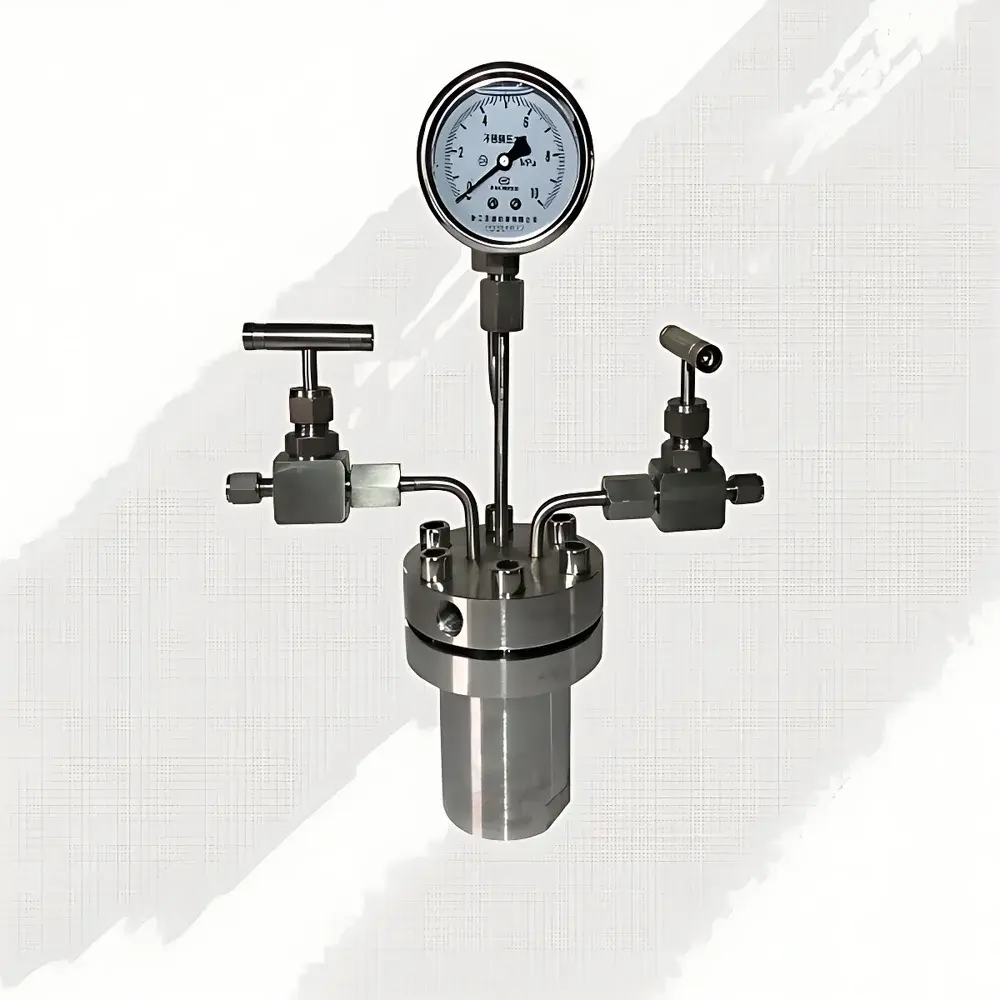
ZxYiqi EP-250ML High-Temperature & High-Pressure Stainless Steel Reactor
| Brand | ZxYiqi |
|---|---|
| Origin | Jiangsu, China |
| Manufacturer Type | Authorized Distributor |
| Country of Origin | China |
| Model | EP-250ML |
| Capacity | 250 mL |
| Construction Material | AISI 304 or 316L Stainless Steel (customizable to Hastelloy, Titanium, Zirconium) |
| Operating Temperature Range | 0–400 °C |
| Design Pressure | –0.1 to 6 MPa (gauge) |
| Vacuum Capability | ≤ –0.1 MPa |
| Pressure Monitoring | Integrated stainless steel Bourdon-tube pressure gauge |
| Safety System | Spring-loaded rupture disc + passive pressure relief valve |
| Optional Accessories | PID-controlled LCD temperature controller (±0.1 °C accuracy), finned heat dissipation module, gas inlet/outlet needle valves (1/8″ & 1/4″ VCR/KF fittings), thermocouple port (Type K), liquid sampling tube, quartz or metal liner |
Overview
The ZxYiqi EP-250ML High-Temperature & High-Pressure Stainless Steel Reactor is a benchtop batch reactor engineered for controlled synthesis, catalytic testing, hydrothermal reactions, and kinetic studies under elevated thermal and mechanical stress conditions. Designed around Couette-type sealed vessel architecture with dual-seal integrity, it operates on the principle of static pressurization—where reactants are sealed within a mechanically robust chamber and subjected to precisely regulated temperature and internal pressure. Its core function is to maintain stable process conditions across extended reaction durations (up to 72 h continuous operation at 350 °C / 4 MPa), enabling reproducible data acquisition for R&D-scale chemical process development, materials synthesis (e.g., MOFs, nanomaterials), and corrosion-resistant catalyst evaluation.
Key Features
- Modular pressure containment system fabricated from ASTM A240-certified AISI 304 or 316L stainless steel; optional upgrade paths to ASTM B575 Hastelloy C-276, Grade 2 titanium, or zirconium for aggressive halide or acidic media.
- Dual-stage sealing configuration: primary metallic gasket (Inconel 718) combined with secondary PTFE-encapsulated O-ring, validated to ISO 15848-1 for fugitive emission control under cyclic thermal loading.
- Integrated pressure monitoring via calibrated 0–10 MPa stainless steel Bourdon-tube gauge (EN 837-1 compliant, Class 1.6 accuracy), mounted on a dedicated front-panel port with isolation valve.
- Gas handling subsystem featuring two independently controllable needle valves (Swagelok SS-4S6G series): one for inert gas purging/vacuum evacuation (–0.1 MPa ultimate vacuum achievable with external pump), the other for controlled repressurization or venting post-reaction.
- Thermal management architecture supports both heating and cooling modes: electric cartridge heaters (400–3500 W configurable) coupled with optional finned aluminum heat sink for rapid cooldown; temperature sensing via threaded Type K thermocouple (IEC 60584-1) with direct immersion into reaction medium.
- Passive safety redundancy: factory-set rupture disc (ASME BPVC Section VIII Div. 1 certified) paired with spring-loaded pressure relief valve (set point adjustable between 4.5–6.0 MPa), both routed to external vent line per OSHA 1910.119 requirements.
Sample Compatibility & Compliance
The EP-250ML accommodates homogeneous liquid-phase reactions, slurry-based heterogeneous catalysis, solid-gas interface studies (e.g., CO₂ hydrogenation), and hydrothermal crystallization. Internally, it accepts removable liners—including fused quartz (operable to 800 °C in inert atmosphere), PTFE, or custom-machined metal inserts—to prevent cross-contamination and enable corrosive reagent compatibility. All wetted surfaces comply with USP Class VI biocompatibility standards. The reactor meets CE marking requirements under Machinery Directive 2006/42/EC and PED 2014/68/EU for Category I pressure equipment. Documentation includes full traceability of material test reports (MTRs), weld procedure specifications (WPS), and non-destructive testing (NDT) records (radiographic + dye penetrant).
Software & Data Management
While the base unit operates via standalone PID controller (LCD interface with ramp-soak programming), optional integration with ZxYiqi’s LabControl Pro software enables automated data logging (temperature, pressure, time stamps) at user-defined intervals (1–60 s resolution). Export formats include CSV and XML, compatible with LIMS platforms such as LabWare LIMS and Thermo Fisher SampleManager. Audit trail functionality complies with FDA 21 CFR Part 11 when used with electronic signature modules; all parameter changes are timestamped, user-ID logged, and immutable after session closure.
Applications
- Kinetic modeling of Fischer–Tropsch synthesis under syngas (H₂/CO) atmospheres at 200–300 °C and 2–4 MPa.
- Hydrothermal synthesis of LiFePO₄ cathode precursors with real-time pH and redox potential monitoring (via optional electrode ports).
- Accelerated aging tests of polymer electrolytes for solid-state batteries under humidified N₂ at 85 °C / 0.5 MPa.
- Corrosion rate quantification of candidate alloys in supercritical water oxidation (SCWO) environments (374 °C / 22.1 MPa simulated via stepwise pressurization).
- Small-volume screening of photocatalytic water splitting using integrated quartz liner and external UV-Vis irradiation coupling.
FAQ
What is the maximum allowable working pressure for the EP-250ML at 400 °C?
The design pressure remains 6 MPa up to 400 °C when constructed from AISI 316L; derating applies for Hastelloy or titanium variants per ASME Section II Part D allowable stress tables.
Can the reactor be operated under vacuum prior to pressurization?
Yes—equipped with dual needle valves and a calibrated vacuum gauge port, it supports pre-reaction evacuation to ≤ –0.1 MPa using standard lab-grade vacuum pumps.
Is third-party calibration certification available for the pressure and temperature sensors?
NIST-traceable calibration certificates (ISO/IEC 17025 accredited) are available upon request for both the pressure gauge and thermocouple assembly.
Does the system support automated pressure ramping profiles?
Not natively; however, optional LabControl Pro software enables scripted pressure sequencing via external solenoid valve control (requires add-on pneumatic actuation kit).
What documentation is provided for GMP/GLP-compliant labs?
Full IQ/OQ protocol templates, material compliance dossiers, and 21 CFR Part 11 validation packages are included with enterprise-tier orders.



