
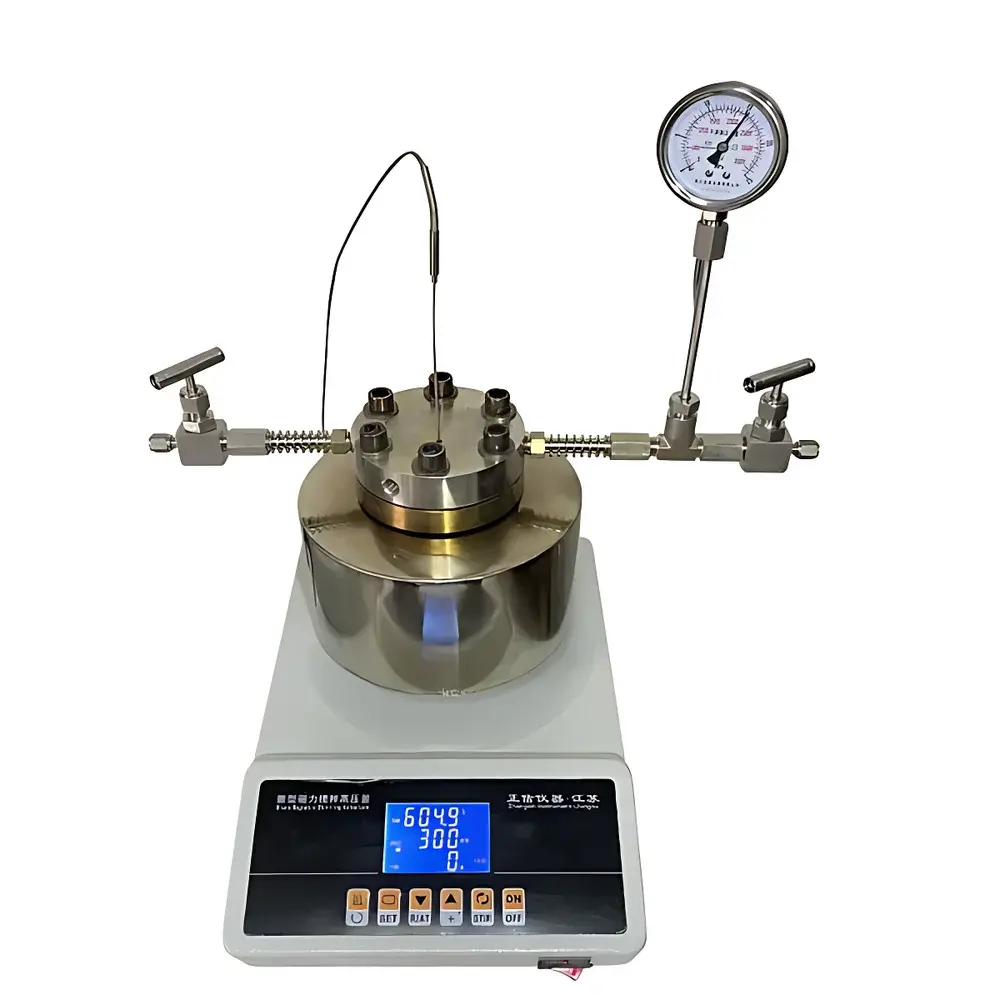
PSK-300mL High-Temperature and High-Pressure Batch Reactor
| Origin | Jiangsu, China |
|---|---|
| Manufacturer Type | Authorized Distributor |
| Country of Origin | China |
| Model | PSK-300mL |
| Capacity | 300 mL (adjustable range: 100–1000 mL) |
| Construction Material | AISI 304 Stainless Steel (optional: 316L, Hastelloy C-276, titanium, zirconium) |
| Maximum Operating Pressure | 60 MPa |
| Vacuum Capability | Up to –0.1 MPa (absolute) |
| Temperature Range | Ambient to 900 °C |
| Heating Method | Integrated Modular Electric Heater |
| Temperature Control | PID-based Intelligent Controller with Auto-Tuning (AT), 30-Stage Programmable Ramp/Soak |
| Temperature Accuracy | ±1 °C (standard), optional ±0.1 °C |
| Heating Rate | Adjustable up to 10 °C/min |
| Cooling | Optional External Cooling Jacket or Internal Cooling Coil |
| Safety Features | Dual-Stage Pressure Relief Valve, Burst Disc, Overpressure Automatic Shutdown |
| Pressure Monitoring | Analog & Digital Stainless Steel Bourdon Tube Gauge (0–70 MPa full scale) |
| Gas Inlet/Outlet Valves | SS 316 Needle Valves with 1/8″ and 1/4″ VCR fittings |
| Thermal Management | Aluminum Finned Heat Dissipation Assembly |
Overview
The PSK-300mL High-Temperature and High-Pressure Batch Reactor is an engineered laboratory-scale reaction system designed for controlled synthesis, catalytic testing, hydrothermal processing, and supercritical fluid reactions under extreme thermodynamic conditions. Based on the Couette-type sealed vessel architecture, it operates on a static batch principle—where reactants are loaded into a hermetically sealed chamber, subjected to precisely regulated temperature and pressure profiles, and monitored in real time. Its robust construction meets ISO 15143-1 (pressure equipment safety) and ASME BPVC Section VIII Div. 1 design guidelines for Class I pressure vessels. The reactor supports both inert atmosphere operation (e.g., N₂, Ar purging) and reactive gas introduction (e.g., H₂, CO, NH₃), making it suitable for heterogeneous catalysis, materials precursor decomposition, and geochemical simulation studies. All wetted surfaces comply with ASTM A240 and ASTM B564 standards for corrosion-resistant alloys.
Key Features
- Modular thermal management: Fixed-position electric heating modules ensure uniform axial and radial heat distribution; finned aluminum heat sinks mitigate thermal accumulation at the flange interface.
- Full-separation design: The reactor body and heater assembly are mechanically decoupled via standardized flange interfaces, enabling rapid disassembly without tool re-alignment—critical for high-throughput screening workflows.
- Dual-range pressure instrumentation: Analog stainless steel pressure gauge (0–70 MPa) provides immediate visual feedback, while optional digital transducer output (4–20 mA or RS485) enables integration with SCADA or LIMS platforms.
- Multi-point safety redundancy: Includes mechanical burst disc (rated at 110% of MAWP), spring-loaded relief valve with manual reset, and programmable overpressure cut-off logic tied to the PID controller’s analog input loop.
- Configurable material options: Standard AISI 304 stainless steel construction; upgrade paths available for 316L (chloride resistance), Hastelloy C-276 (reducing acid environments), titanium Grade 2 (lightweight + halogen compatibility), or zirconium 702 (HF service).
- Gas handling infrastructure: Precision-machined SS 316 needle valves with VCR face-seal connections (1/8″ and 1/4″) provide leak-tight control for inlet, purge, vent, and sampling lines—validated per ISO 15848-1 Class A fugitive emission limits.
Sample Compatibility & Compliance
The PSK-300mL accommodates solid, liquid, slurry, and gaseous reactants—including corrosive media such as concentrated acids, alkalis, halogenated solvents, and supercritical CO₂. Optional quartz or PTFE-lined inserts extend compatibility to HF-based etching chemistries and photoreactive systems. All configurations conform to GLP and GMP documentation requirements: traceable calibration certificates (NIST-traceable pressure and temperature references), material test reports (MTRs) per EN 10204 3.1, and FAT/SAT protocols available upon request. The system supports audit-ready electronic records when paired with compliant data acquisition software (see Software & Data Management section).
Software & Data Management
The integrated PID controller features embedded data logging (up to 10,000 points) with timestamped pressure, temperature, and setpoint values stored internally or exported via USB. Optional PC-based software (Windows/Linux compatible) provides real-time graphing, alarm event tagging, and CSV export compliant with ASTM E2500-22 for raw data integrity. When configured with FDA 21 CFR Part 11-compliant firmware, the system delivers electronic signatures, audit trails, role-based access control, and immutable record retention—meeting requirements for regulated pharmaceutical process development and QC release testing.
Applications
- Catalyst evaluation under industrially relevant conditions (e.g., Fischer–Tropsch, ammonia synthesis, hydrodesulfurization)
- Synthesis of metal–organic frameworks (MOFs), perovskites, and nanomaterials via solvothermal routes
- Thermal stability assessment of battery electrolytes and electrode slurries
- Geochemical modeling of mineral dissolution/precipitation kinetics at crustal P–T conditions
- Polymerization kinetics studies under supercritical monomer environments
- Hydrogenation, oxidation, and nitration reactions requiring precise stoichiometric gas dosing
FAQ
What is the maximum allowable working pressure (MAWP) for the standard PSK-300mL configuration?
The standard AISI 304 version is rated for 60 MPa at 20 °C, derated linearly per ASME UG-27 to 42 MPa at 500 °C. Higher-pressure variants require Hastelloy or titanium construction and third-party hydrostatic certification.
Can the reactor be used for corrosive halogen-containing media?
Yes—when constructed from titanium Grade 2 or zirconium 702, it demonstrates immunity to wet chlorine, hydrogen fluoride, and bromine vapors up to 400 °C. Quartz liners are recommended for HF–HNO₃ mixtures.
Is vacuum capability validated to ISO 2859-1 sampling standards?
The integrated vacuum system achieves ≤1 Pa absolute (verified by calibrated Pirani gauge), sufficient for degassing, solvent removal, and inert gas purging cycles per ISO 14644-1 Class 5 cleanroom protocols.
Does the system support automated gas dosing and mass flow control?
While not included as standard, the 1/8″ and 1/4″ VCR ports are fully compatible with commercial MFCs (e.g., Brooks Instrument SLA series) and pneumatic actuators for closed-loop gas addition—integration requires custom manifold design and I/O mapping.
Are calibration certificates provided for pressure and temperature sensors?
Yes—each unit ships with NIST-traceable calibration reports for the pressure gauge and K-type thermocouple, valid for 12 months from date of manufacture. Annual recalibration services are available under ISO/IEC 17025-accredited procedures.



