
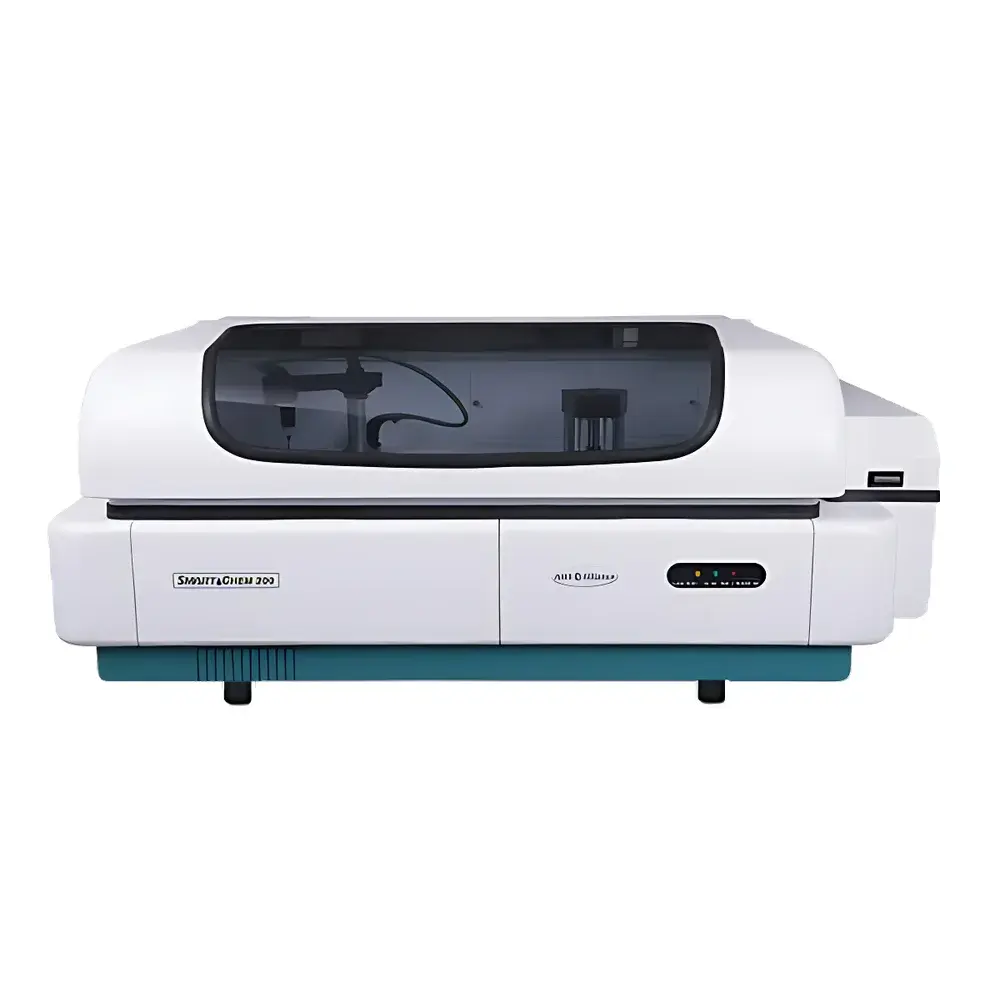
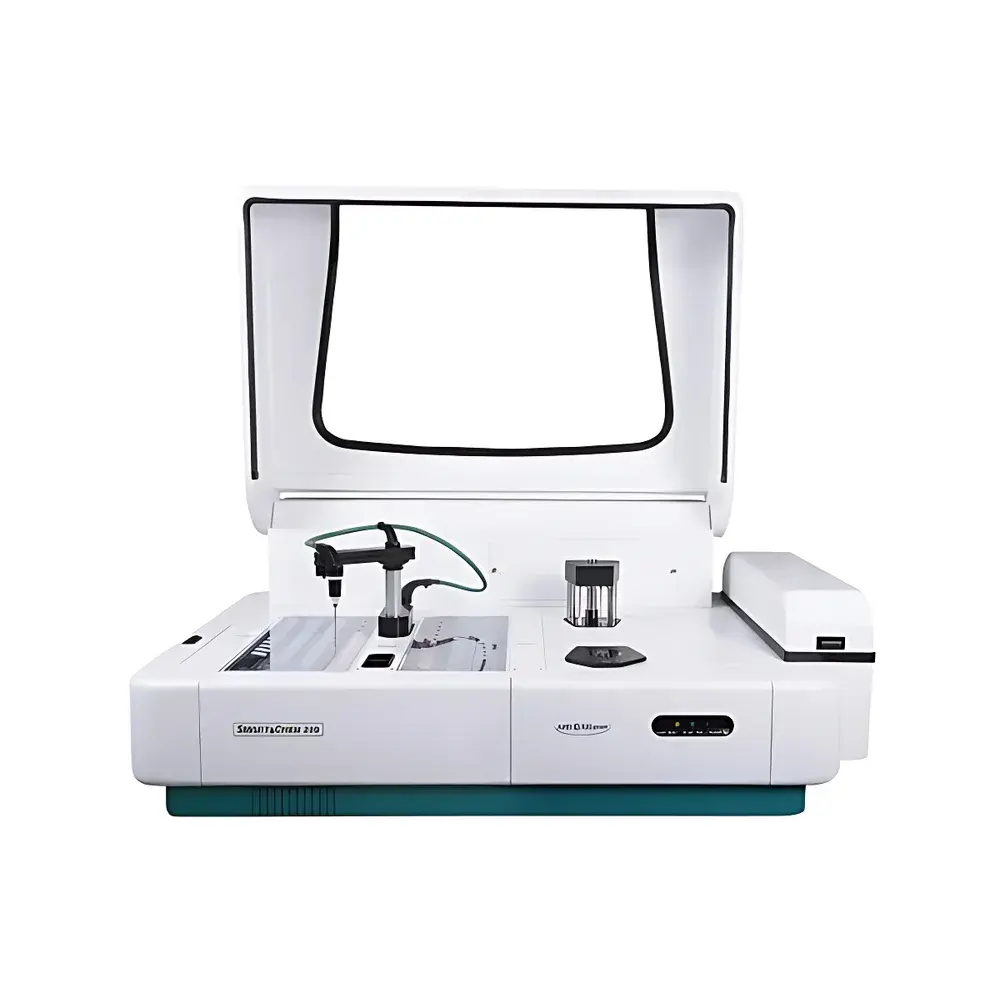
KPM AMS SmartChem 200 Automated Discrete Chemistry Analyzer for Soil, Water, and Beverage Analysis
| Brand | KPM AMS |
|---|---|
| Origin | USA |
| Model | SmartChem 200 |
| Instrument Type | Laboratory Water Quality Analyzer |
| Detection Parameters | Nitrate, Nitrite, Ammonia-N, Phosphate, Sulfide, Cyanide, Volatile Phenols, Total Phosphorus, Total Nitrogen, Urea, Silicate, Sulfate, Borate, Formaldehyde, Chlorine, Chloride, Fluoride, Hexavalent Chromium, Copper, Aluminum, Iron, pH, Hardness, Conductivity, Volatile Acids |
| Sample Capacity | 126 positions per run |
| Reagent Positions | 16 |
| Optical Path Length | 10 mm |
| Minimum Reaction Volume | 180 µL |
| Temperature Control Range | Ambient to 45 °C (±0.1 °C) |
| Absorbance Range | 0–2.500 Abs |
| Detection Sensitivity | 0.0001 Abs |
| Filter Wheel | 12-position (340–880 nm), 9 filters + blind position |
| Measurement Modes | Endpoint, Fixed-Time, Kinetic, Differential-Time, Dual-Beam |
| Compliance | ASTM, ISO, AOAC, OIV, US EPA Method 353.2, AFNOR, COFRAC, BATF |
Overview
The KPM AMS SmartChem 200 is a fully automated discrete chemistry analyzer engineered for high-precision, multi-parameter analysis of environmental, agricultural, food, and beverage matrices. Unlike continuous-flow or segmented-flow systems, the SmartChem 200 employs true discrete analytical architecture: each sample and reagent combination is pipetted into an individual optical cuvette, where colorimetric or photometric reactions occur under precisely controlled thermal and temporal conditions. This eliminates cross-contamination from shared fluidic pathways, enables real-sample blanking, and supports rigorous method validation per ISO/IEC 17025 and GLP requirements. The system implements standardized wet-chemistry principles—such as cadmium column reduction for nitrate-to-nitrite conversion (US EPA Method 353.2), enzymatic assays, and ion-selective electrode (ISE) measurements—within a unified, computer-controlled platform. Designed for unattended operation, it delivers traceable, auditable results suitable for regulatory reporting in environmental monitoring labs, municipal water utilities, wineries, and contract testing facilities.
Key Features
- XYZ robotic arm with capacitive liquid-level sensing for sub-millimeter depth sampling (2 mm fixed immersion), minimizing probe clogging and ensuring reproducible aspiration across viscous or particulate-laden samples.
- High-accuracy microdispensing: ±0.1 µL precision with integrated pre-heating (37 °C) and intelligent internal/external needle washing between every aspiration cycle.
- 60-position reusable optical cuvette carousel using UV-transparent polycarbonate (quartz optional); each cuvette undergoes five-stage cleaning (acid rinse, deionized water flush, air drying, optical integrity verification) before reuse; up to 15 failed cuvettes automatically bypassed without interrupting throughput.
- Dual-beam digital photometer with 12-filter wheel (340–880 nm), 9 filters mounted simultaneously; linear dynamic range 0–2.500 Abs; resolution 0.0001 Abs; lamp standby mode extends source lifetime.
- Integrated cadmium column reduction module: fully automated regeneration, cleaning, and performance validation; >95% nitrate reduction efficiency; compliant with US EPA Method 353.2.
- Optional ISE module for simultaneous pH, conductivity, and redox potential measurement—fully synchronized with optical assays within the same analytical sequence.
- Reagent cabinet with thermoelectric cooling (4–10 °C) and low-volume sensor alerts; 16 independent reagent positions support concurrent 9-parameter analysis without hardware reconfiguration.
Sample Compatibility & Compliance
The SmartChem 200 accepts liquid samples directly—including raw wastewater, filtered surface water, soil extracts (e.g., Mehlich-3, Olsen), wine must, juice concentrates, tobacco digests, and fertilizer solutions—without requiring filtration or dilution in most cases. Its discrete architecture accommodates heterogeneous suspensions and high-turbidity matrices better than flow-based analyzers. All validated methods align with internationally recognized standards: ISO 11905-1 (ammonia), ISO 6878 (phosphate), ISO 10304-1 (anions), US EPA 300.0/300.1 (anions), US EPA 353.2 (nitrate), OIV-MA-AS313 (wine volatile acidity), and AOAC 985.23 (total phosphorus). The system supports full audit trails, electronic signatures, and 21 CFR Part 11-compliant data handling when configured with LIMS integration and user-role access controls.
Software & Data Management
SMARTCHEM software provides a validated, Windows-native environment (compatible with Windows 10 and Windows Server 2016+) featuring method library management (>900 pre-validated protocols), dynamic standard curve generation (including real-sample blank correction and auto-spiking for recovery calculation), and adaptive dilution logic for out-of-range samples. It supports dual-language UI (English/Chinese), diagnostic self-tests, and scheduled maintenance prompts. All raw absorbance values, temperature logs, reagent consumption records, and cuvette optical validation metrics are stored in structured SQLite databases. Export formats include CSV, Excel (.xlsx), and TXT; direct LIMS interfacing via ASTM E1384 or HL7 messaging ensures seamless integration into enterprise laboratory workflows. QC charts (Levey-Jennings, Shewhart) auto-generate with customizable control limits and alert thresholds.
Applications
The SmartChem 200 serves as a central analytical hub across regulated sectors: In environmental labs, it quantifies nutrients (NO₃⁻, NO₂⁻, NH₄⁺, PO₄³⁻, SiO₄⁴⁻), contaminants (CN⁻, Cr⁶⁺, F⁻, ClO⁻), and physicochemical parameters (pH, hardness, conductivity) in drinking water, effluent, and groundwater per USEPA and EU WFD directives. In agriculture and soil science, it measures extractable N, P, K, B, and S forms from routine extractions. Wineries deploy it for OIV-compliant analysis of SO₂ species, titratable acidity, organic acids (malic, tartaric, lactic), and residual metals. Food and beverage QA/QC teams use it for nitrate/nitrite in cured meats, sulfite in juices, and sugar profiles in dairy products—all without method-specific hardware changes.
FAQ
Does the SmartChem 200 require dedicated plumbing or compressed air?
No. It operates on standard 110–240 V AC power and uses internal peristaltic pumps and vacuum-assisted waste evacuation—no external gas supply or drain line required.
Can it analyze solid or semi-solid samples directly?
Not natively. Soil, plant tissue, or sediment samples must first be extracted using standardized protocols (e.g., EPA SW-846 Methods 3050B, 3015A); the analyzer processes only the resulting aqueous phase.
How is calibration traceability maintained?
Each analytical run includes certified reference materials (CRMs), matrix-matched blanks, and duplicate spikes; calibration curves are generated fresh per batch using NIST-traceable standards, with slope/intercept stability logged for regulatory review.
Is remote monitoring and troubleshooting supported?
Yes. SMARTCHEM software includes secure remote desktop capability (with user permission logging) and real-time instrument status dashboards accessible via browser-based interface.
What is the typical maintenance interval for the optical cuvettes?
Polycarbonate cuvettes withstand >10,000 reaction cycles under routine cleaning; quartz cuvettes (optional) extend lifetime further in aggressive acid/base applications—no scheduled replacement needed unless optical transmission falls below 95% at reference wavelength.







