
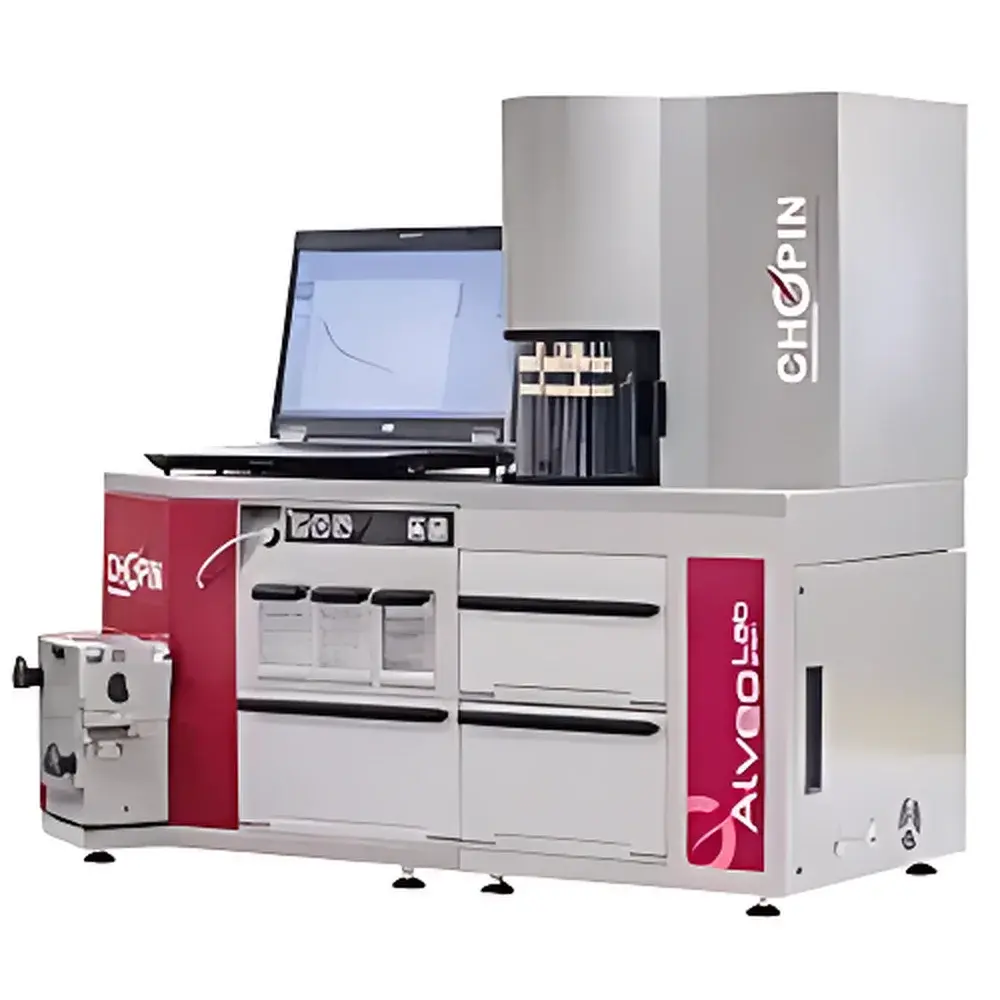
Chopin Alveolab Automated Extensigraph for Gluten Rheology Characterization
| Brand | Choppin |
|---|---|
| Origin | France |
| Manufacturer Type | Authorized Distributor |
| Origin Category | Imported |
| Model | Alveolab |
| Price Range | USD 68,000 – 109,000 |
Overview
The Choppin Alveolab Automated Extensigraph is a precision-engineered instrument for the quantitative rheological characterization of wheat flour doughs, grounded in the classical alveographic principle first commercialized by Marcel Chopin in 1920. It measures the viscoelastic deformation of a standardized dough bubble under controlled, constant air pressure — a method rooted in Couette-type extensional flow mechanics. Unlike shear-based rheometers, the Alveolab subjects dough to biaxial extension, directly simulating the mechanical stresses experienced during breadmaking (e.g., gas retention during proofing and oven spring). The resulting force–deformation curve — the alveogram — yields three primary empirical parameters: P (dough tenacity, in mm H₂O), L (extensibility, in mm), and W (energy of deformation, in 10⁻⁴ J), which collectively define gluten strength, elasticity, and resistance to extension. This methodology is physiologically relevant to end-use performance and forms the basis for international classification of wheat classes (strong, medium, weak) across breeding programs, mill quality control, and bakery R&D.
Key Features
- Fully automated dough sheet preparation, inflation, and post-test cleaning — eliminating operator variability in hydration, sheet thickness, and bubble initiation.
- Integrated climate-controlled chambers: kneading bowl (±0.5 °C), fermentation chamber (±0.3 °C), and inflation chamber (±0.5 °C / ±2% RH) ensuring strict adherence to AACC and ISO conditioning protocols.
- Dual hydration modes: fixed-water (constant %H₂O) and variable-water (optimal consistency via “consistency adjustment” algorithm), enabling both standardized compliance testing and research-grade optimization.
- Real-time pressure and displacement transduction with 0.1 mm resolution and <1% repeatability (CV) across ≥20 replicates per sample, validated per ISO 27971 Annex B.
- Touchscreen interface with guided workflow, multilingual prompts (EN/FR/DE/ES), audible alerts, and context-sensitive help — designed for GLP-compliant lab environments.
- Modular firmware architecture supporting future parameter development (e.g., strain-rate sensitivity, relaxation time estimation) via authorized software updates.
Sample Compatibility & Compliance
The Alveolab accepts all milled cereal flours (wheat, spelt, rye, triticale) and composite blends, including those modified with enzymes, oxidants, or hydrocolloids. It accommodates flour samples ranging from 10 g to 300 g batch sizes, with automatic scaling of water addition and inflation timing. The system complies with AACC Method 54-30.02 (Alveograph Test), ICC Standard 121/171, NF EN ISO 27971:2012, GB/T 14614.4–2005, and LS/T 3248–2017. All measurement sequences generate audit-ready metadata (operator ID, timestamp, environmental logs, calibration status), satisfying FDA 21 CFR Part 11 requirements when paired with Choppin’s optional secure user authentication and electronic signature module.
Software & Data Management
Alveolab Control Suite v4.2 (Windows-based) provides real-time curve visualization, comparative overlay of up to 12 alveograms, statistical reporting (mean, SD, CV%, ANOVA), and export to CSV, PDF, or LIMS-compatible XML. Raw data files include full sensor time-series (pressure vs. time, height vs. time) at 100 Hz sampling. The software supports configurable report templates aligned with national wheat board reporting formats (e.g., French ONIGC, Australian Grain Technologies). Audit trails record every parameter change, file export, and user login — traceable to individual accounts with role-based permissions (Admin, Technician, Viewer). Data integrity is preserved via SHA-256 hashing and optional encrypted local storage.
Applications
- Wheat breeding programs: high-throughput screening of F₂–F₅ progeny for gluten strength stability under varying nitrogen regimes or drought stress.
- Mill quality assurance: daily monitoring of flour batches against target P/L and W thresholds to adjust blending ratios pre-milling.
- Food ingredient development: quantifying synergistic or antagonistic effects of vital wheat gluten, transglutaminase, or xylanase on dough extensibility profiles.
- Academic research: correlating alveographic indices with SDS-PAGE gliadin/glutenin band intensities, LC-MS/MS protein quantification, or synchrotron X-ray scattering of starch-gluten matrix organization.
- Regulatory and trade laboratories: generation of certified reference data for national wheat variety registration and export documentation (e.g., USDA-FAS Wheat Quality Reports).
FAQ
What standards does the Alveolab comply with for regulatory reporting?
It meets AACC 54-30.02, ISO 27971, ICC 121/171, and multiple national standards including GB/T 14614.4 and LS/T 3248 — all referenced in official wheat grading frameworks.
Can the Alveolab differentiate between gliadin- and glutenin-dominant dough behavior?
While not a direct protein assay, the shape of the alveogram (e.g., steepness of initial slope vs. plateau duration) correlates strongly with glutenin polymer size distribution and gliadin plasticizing effect — validated in peer-reviewed studies using size-exclusion HPLC.
Is routine calibration required, and how is it performed?
Yes — daily verification using certified reference flour (CRF) and annual factory recalibration of pressure and displacement sensors are recommended per ISO 27971 Clause 7.3.
Does the system support unattended overnight operation?
Yes — with pre-loaded sample racks and scheduled start times, up to 24 consecutive tests can be executed with automatic chamber recovery cycles between runs.
How is data integrity ensured for GMP/GLP audits?
Full electronic audit trail, user authentication, immutable raw data archives, and optional 21 CFR Part 11 compliance package (including digital signatures and system validation documentation) are available.





