
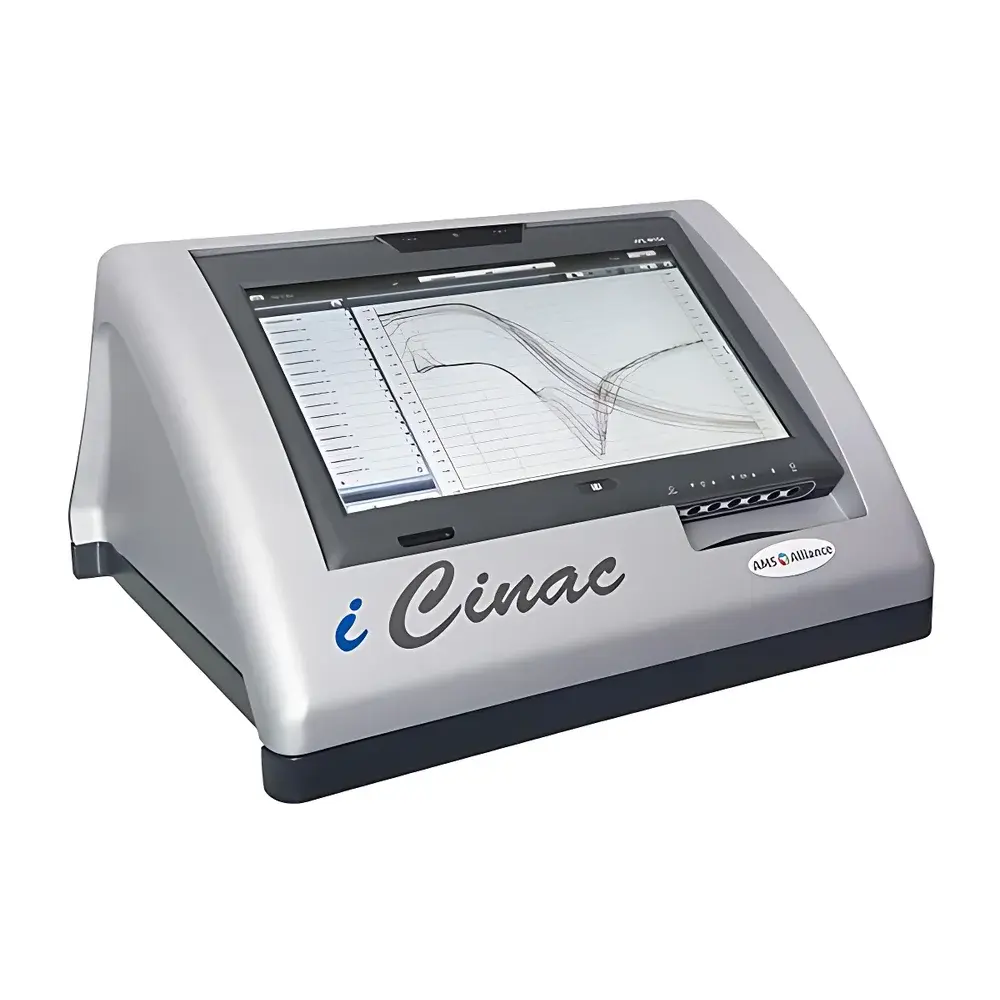
iCinac Dairy Acidification Analyzer by KPM AMS
| Brand | KPM AMS |
|---|---|
| Origin | USA |
| Model | iCinac |
| Detection Parameters | pH, Temperature, Redox Potential (mV) |
| Channel Capacity | Up to 96 simultaneous channels (configurable as 16-, 32-, or 96-channel systems) |
| Automation Level | Semi-automatic with modular control outputs (up to 32 configurable digital/analog outputs) |
| Compliance | Fully compliant with ISO 26323:2021 — “Dairy products — Method for monitoring acidification behaviour by continuous pH measurement” |
| Sensor Technology | Digital multi-parameter ISM®-enabled electrodes (pH + temperature + redox in single probe per channel) |
| Software Platform | Integrated Windows®-compatible touchscreen interface with real-time data acquisition, automatic feature-point calculation, and GLP-compliant audit trail |
Overview
The iCinac Dairy Acidification Analyzer is a purpose-built, semi-automatic instrumentation platform engineered for high-fidelity, real-time monitoring of lactic acid fermentation dynamics in dairy matrices. Developed by KPM AMS (USA) as the fourth-generation evolution of the original CINAC system—originally co-engineered with INRAE (France) for industrial-scale starter culture evaluation—the iCinac implements a rigorously validated electrochemical measurement architecture grounded in continuous potentiometric sensing. It operates on the principle of simultaneous, synchronized acquisition of three fundamental physicochemical parameters: hydrogen ion activity (pH), thermal state (temperature), and electron transfer potential (redox, expressed in mV). This tri-parameter acquisition enables kinetic modeling of acidification profiles under controlled thermal conditions, supporting quantitative assessment of microbial starter performance—including lag phase duration, maximum acidification rate (dpH/dtmax), time to target pH, and buffering capacity response. Designed explicitly to meet the metrological and procedural requirements of ISO 26323:2021, the system delivers traceable, reproducible data essential for strain selection, process validation, and quality assurance in fermented dairy R&D and production environments.
Key Features
- Multi-channel scalability: Configurable architectures supporting 16, 32, or up to 96 independent measurement channels via modular sensor racks and composite digital electrode arrays.
- Digital ISM®-integrated sensors: Each channel employs a single, calibrated digital probe capable of concurrent, drift-compensated acquisition of pH, temperature, and redox potential—eliminating analog signal degradation and enabling automatic sensor diagnostics, lifetime tracking, and calibration history logging.
- Modular control output system: Up to 32 programmable outputs per unit—including isolated digital I/O and dual-mode analog outputs (4–20 mA and 0–10 VDC)—supporting integration with external water baths, peristaltic pumps, or PLC-based process controllers for closed-loop thermal or agitation profiling.
- Integrated touchscreen host: A dedicated Windows®-based embedded PC with 10.1″ capacitive display provides local instrument control, real-time curve overlay, and offline analysis without requiring external computers.
- Process simulation capability: Built-in thermal profile editor allows users to define and replay custom heating/cooling ramps, enabling comparative analysis of starter behavior across standardized thermal protocols—critical for predicting performance in diverse fermentation vessels or seasonal ambient conditions.
Sample Compatibility & Compliance
The iCinac is validated for use with raw milk, standardized milk, reconstituted skim milk powder (RSM), cream, whey-based media, and defined bacterial growth broths. Its measurement range covers pH 2.5–10.0 (±0.02 pH units), temperature −5 °C to +80 °C (±0.1 °C), and redox potential −1500 mV to +1500 mV (±2 mV). All hardware and firmware comply with ISO/IEC 17025 general requirements for testing laboratories and align with FDA 21 CFR Part 11 electronic record and signature provisions when deployed with enabled audit-trail and user-access controls. Data export formats (CSV, XML, PDF) support integration into LIMS and ERP platforms used in GMP-regulated facilities. The system satisfies mandatory verification criteria outlined in ISO 26323:2021 for sampling frequency (≥1 measurement per 10 seconds), sensor immersion depth, thermal equilibration time, and baseline stability thresholds prior to acidification onset.
Software & Data Management
The iCinac Control Suite is a native Windows® application featuring role-based user authentication, timestamped electronic signatures, and full ALCOA+ (Attributable, Legible, Contemporaneous, Original, Accurate, Complete, Consistent, Enduring, Available) data governance. Core functions include automated temperature compensation using Nernst equation correction, real-time derivative calculation (dpH/dt), identification and labeling of critical inflection points (e.g., Tlag, Tmax, Ttarget), and batch-wise statistical aggregation (mean curves, standard deviation envelopes, coefficient of variation). Raw and processed datasets are stored in an encrypted local SQL database with optional network backup. Export modules support direct ingestion into JMP®, MATLAB®, or Python-based analytics pipelines via structured CSV exports containing metadata headers (sample ID, operator, date/time, sensor SN, calibration status).
Applications
- Starter culture qualification: Comparative evaluation of commercial and proprietary lactic acid bacteria (LAB) strains across pH/temperature gradients.
- Fermentation process development: Optimization of incubation protocols for yoghurt, cheese, kefir, and probiotic beverages.
- Raw material consistency monitoring: Detection of natural buffering variations in milk batches affecting acidification kinetics.
- Regulatory dossier preparation: Generation of ISO 26323-compliant reports for health claim substantiation (e.g., EFSA QPS dossiers).
- Teaching and method validation: Used in university food science curricula and ISO/IEC 17025-accredited reference labs for inter-laboratory proficiency testing.
FAQ
Does the iCinac require daily recalibration?
No—digital ISM® sensors retain calibration coefficients and diagnostic logs internally; field recalibration is recommended only after electrode replacement or if diagnostic flags indicate drift beyond ±0.05 pH units.
Can the system interface with third-party water baths?
Yes—via its configurable analog/digital outputs and Modbus TCP option, the iCinac can synchronize temperature setpoints and monitor bath status in real time.
Is raw data export compliant with 21 CFR Part 11?
Yes—when audit trail, electronic signature, and user permission modules are activated, all data operations meet Part 11 requirements for electronic records in regulated environments.
What maintenance is required for long-term reliability?
Routine maintenance includes quarterly verification of sensor response time (<5 sec), biannual cleaning of electrode junctions with enzymatic solution, and annual verification of analog output linearity using certified test loads.
How does the iCinac handle sample evaporation during extended runs?
The system supports optional sealed vial adapters and inert gas purging modules to minimize surface dehydration—particularly critical for >24-hour ripening studies at elevated temperatures.







