
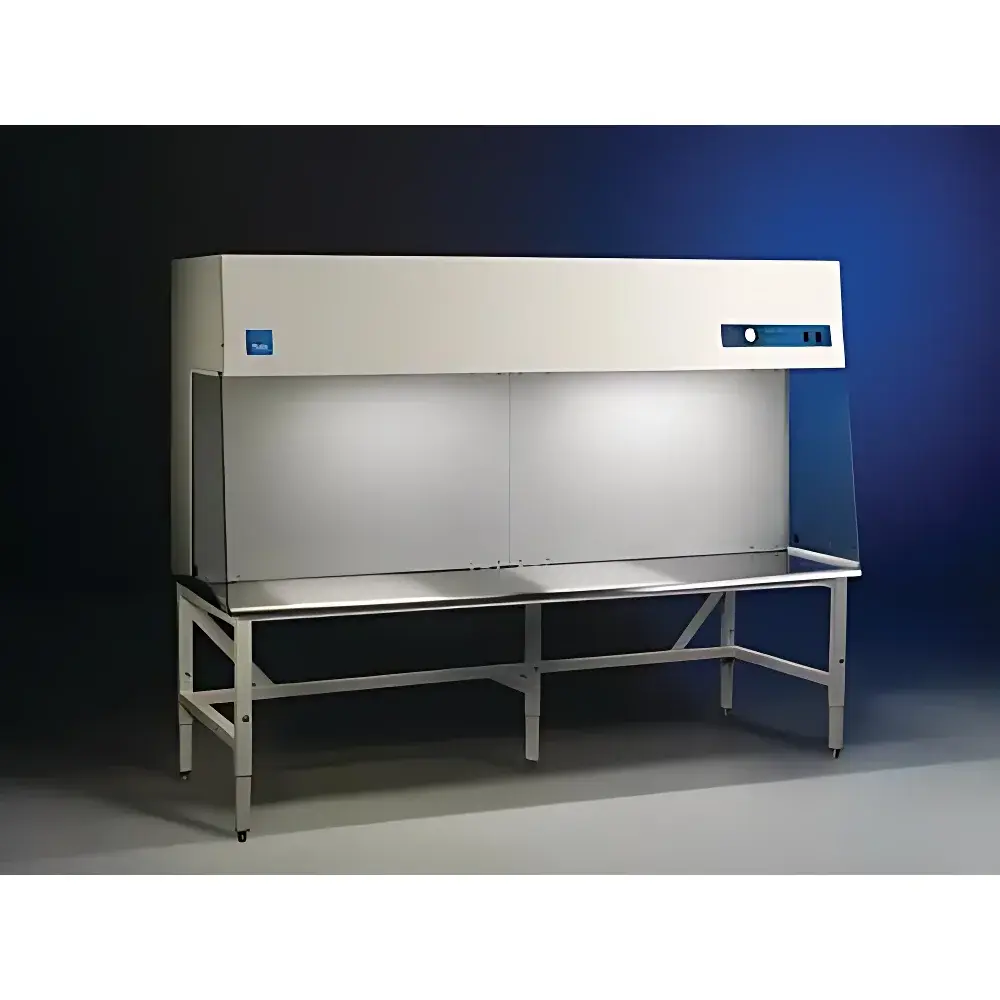
VWR Purifier® Horizontal Clean Bench (LABCONCO® Brand)
| Brand | VWR |
|---|---|
| Manufacturer | LABCONCO® |
| Origin | USA |
| Type | Horizontal Laminar Flow Clean Bench |
| ISO Classification | ISO Class 5 (≤ 3,520 particles/m³ ≥ 0.5 µm) |
| Construction | 304 Stainless Steel Work Surface & 6 mm Tempered Safety Glass Side Panels |
| Airflow Velocity | Adjustable 0.3–0.5 m/s (typical), certified uniform laminar flow |
| Filtration | Dual-stage — Pre-filter + 99.99% @ 0.3 µm HEPA filter |
| UV System (optional) | 254 nm germicidal lamp with safety interlock and UV-blocking shield |
| Electrical | 230 V / 50–60 Hz (region-specific configurations available) |
| Dimensions (W × D × H) | 914–2438 mm (3′–8′) × 533–660 mm (21″–26″ internal depth) × ~762 mm (30″) working height |
| Compliance | Meets NSF/ANSI 49 Annex E for non-recirculating horizontal flow devices |
Overview
The VWR Purifier® Horizontal Clean Bench is a laboratory-grade laminar flow workstation engineered by LABCONCO® and distributed globally by VWR International. Designed for applications requiring particle-free environments without operator protection from hazardous agents, this ISO Class 5 (formerly Federal Standard 209E Class 100) clean bench delivers unidirectional, low-turbulence airflow across the work surface. Unlike vertical flow hoods, horizontal laminar flow systems direct filtered air parallel to the work surface—from back to front—minimizing turbulence-induced contamination of sensitive samples such as cell cultures, semiconductor wafers, optical components, or sterile pharmaceutical preparations. The unit operates on a non-recirculating principle: ambient air is drawn through a pre-filter to capture coarse particulates, then forced through a certified 99.99% efficient HEPA filter (tested per IEST-RP-CC001.3 at 0.3 µm), producing laminar flow with velocity uniformity ≤ ±15% across the full work plane. All models comply with NSF/ANSI 49 Annex E performance criteria for horizontal flow clean benches and are validated for use in environments governed by ISO 14644-1, USP , and EU GMP Annex 1.
Key Features
- ISO Class 5-certified laminar airflow with traceable HEPA filter validation reports (filter serial number and efficiency test data supplied with each unit)
- Robust 304 stainless steel work surface (1/4″ thick) resistant to corrosion, thermal shock, and common lab solvents
- 6 mm tempered safety glass side panels with ergonomic forward tilt—reducing visual obstruction and improving ergonomics for users of varying height
- Dual-seal gasket system and negative-pressure leak detection design ensure structural integrity and prevent bypass leakage around the filter housing
- Integrated pre-filter compartment accessible from the front panel—designed for rapid replacement without tools to extend HEPA service life
- UV germicidal option (254 nm) includes safety interlock switch, UV-blocking acrylic shield, and timer-controlled operation compliant with IEC 62471 photobiological safety standards
- Modular electrical configuration supporting regional input specifications (UK, CH/AU, SCHUKO, UK, and standard 230 V/50–60 Hz variants)
- Optional telescoping base stands with casters or fixed feet (certified for static load capacity up to 855 lbs) enable stable installation on uneven floors and facilitate mobility during facility reconfiguration
Sample Compatibility & Compliance
The Purifier® Horizontal Clean Bench is intended for use with non-hazardous, non-toxic, and non-volatile materials where personnel protection is not required. It is routinely deployed in cell culture labs, microelectronics fabrication support areas, analytical sample preparation zones, and quality control testing suites handling sterile APIs or medical device components. Units are manufactured under ISO 9001-certified processes and meet mechanical and airflow performance requirements outlined in NSF/ANSI 49 Annex E. While not classified as biosafety cabinets (BSCs), they support compliance with GLP and GMP documentation frameworks when integrated into controlled-environment monitoring programs—including scheduled filter integrity testing (DOP/PAO), airflow velocity mapping (per ISO 14644-3), and routine particle counting (ISO 14644-1). UV-equipped models include audit-ready operational logs compatible with FDA 21 CFR Part 11–enabled software platforms when connected via optional RS-232 interface.
Software & Data Management
This clean bench operates as a standalone hardware platform with no embedded firmware or proprietary software. However, its modular design supports integration into facility-wide environmental monitoring systems (EMS) via analog 4–20 mA airflow velocity output (available on select configurations) or digital RS-232 communication port (optional accessory). When paired with third-party EMS platforms—such as Siemens Desigo CC, Honeywell Experion PKS, or custom LabVIEW-based dashboards—the unit enables real-time logging of fan status, UV cycle duration, and filter differential pressure (via optional DP sensor kit). All UV operation events—including activation time, duration, and interlock engagement—are timestamped and exportable as CSV for regulatory review. Documentation packages include Factory Acceptance Test (FAT) reports, HEPA filter certification certificates, and ISO 14644-3-compliant airflow uniformity maps.
Applications
- Aseptic handling of mammalian and insect cell lines in academic and biopharmaceutical research labs
- Preparation of sterile ophthalmic solutions and parenteral dosage forms under USP guidance
- Microassembly of MEMS devices and optical alignment procedures requiring sub-micron particulate control
- Environmental sampling media preparation for ISO 14644-2 surveillance programs
- Calibration and verification of particle counters and aerosol generators in metrology laboratories
- Non-hazardous reagent dispensing and lyophilized powder weighing in QC/QA settings
FAQ
Does this clean bench provide protection for the operator or the environment?
No. As a horizontal laminar flow device, it protects only the product—not personnel or the surrounding environment. It must not be used with volatile chemicals, radioactive isotopes, or biohazards requiring containment.
What maintenance intervals are recommended for the HEPA filter?
HEPA filter replacement is typically required every 3–5 years under normal use, contingent upon pre-filter maintenance frequency and ambient particulate load. Differential pressure monitoring is advised to determine optimal replacement timing.
Can the unit be installed in a room with positive pressure?
Yes. Horizontal flow clean benches operate independently of room pressure differentials but perform optimally in ISO Class 8 (100,000) or cleaner ambient environments to minimize pre-filter loading.
Is UV validation included with the UV-equipped models?
UV intensity mapping (at 1 cm from lamp surface) is performed at the factory and documented in the Certificate of Conformance. Users must conduct periodic radiometric verification per ISO 15858.
Are spare parts and service support available outside North America?
Yes. VWR maintains authorized service partners across EMEA, APAC, and LATAM regions, with localized inventory of HEPA filters, pre-filters, UV lamps, and fan assemblies. Technical documentation is available in English, German, French, and Simplified Chinese.



