
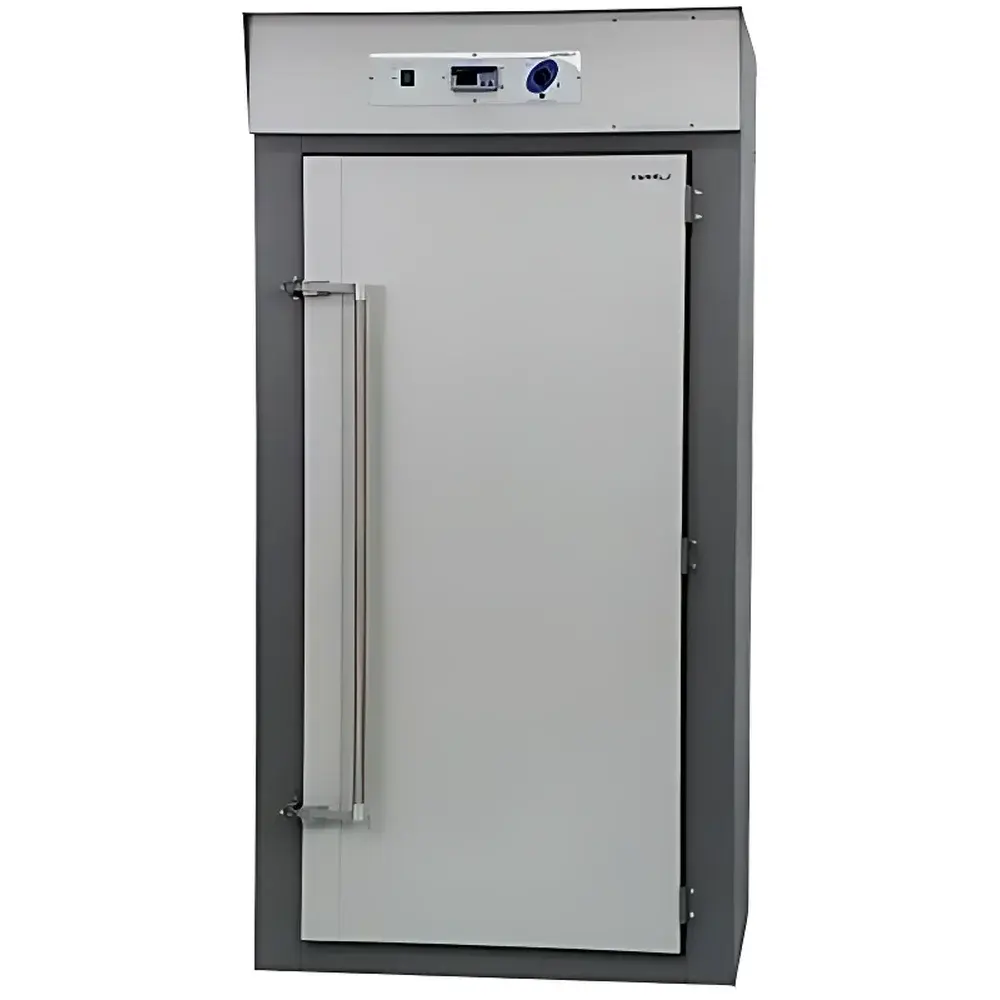
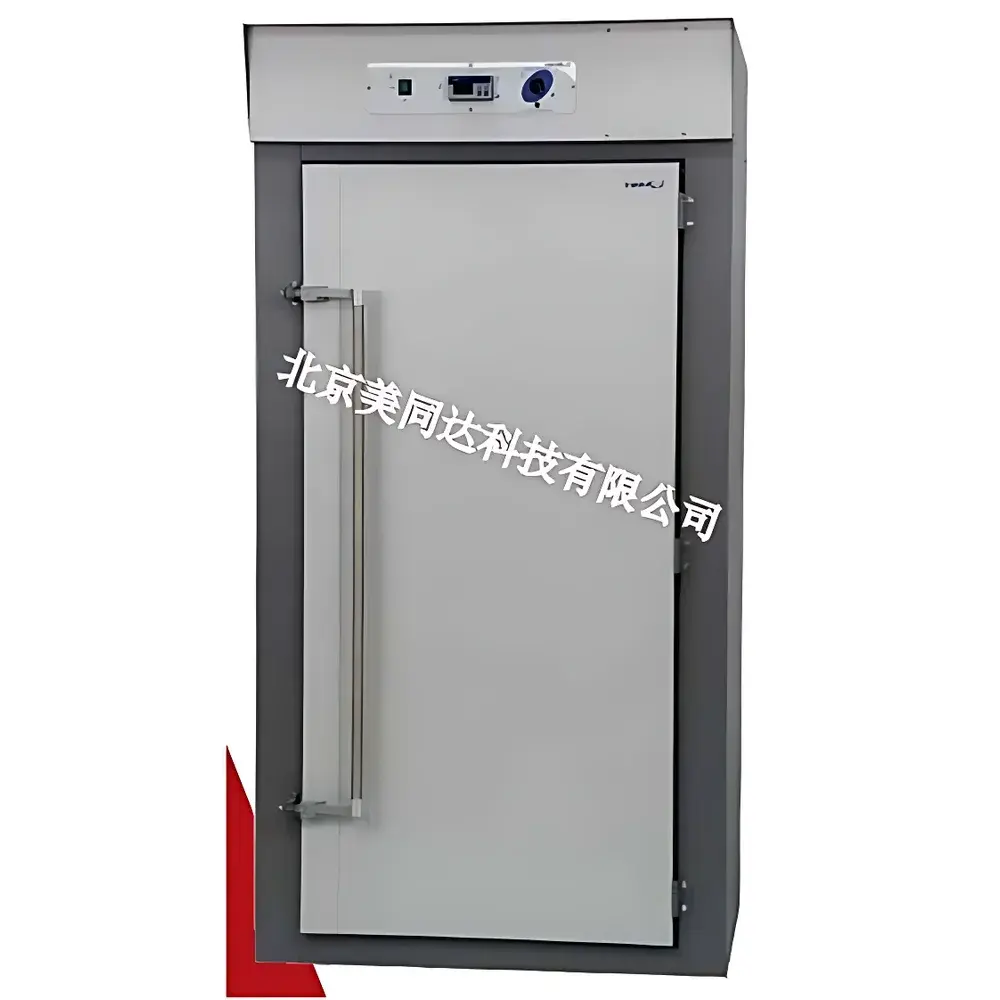
VWR Signature High-Performance Horizontal Air Flow Oven Model 52202-258
| Brand | VWR |
|---|---|
| Origin | USA |
| Model | 52202-258 |
| Temperature Range | 40–260 °C (104–500 °F) |
| Temperature Uniformity | ±1.5 °C |
| External Dimensions | 109.3 × 87.0 × 217.2 cm (43.0 × 34.3 × 85.5 in) |
| Internal Chamber Dimensions | 95.2 × 66.0 × 153.6 cm (37.5 × 26.0 × 60.5 in) |
| Insulation | 8.9 cm thick dual-layer high-density alumina-silicate + high-temp glass fiber |
| Airflow System | Turbo-driven horizontal forced convection |
| Controller | Watlow microprocessor-based, 0.1 °C resolution, 24-step ramp-soak programming |
| Construction | 304 stainless steel interior and exterior, powder-coated steel frame |
| Safety | Independent adjustable overtemperature protection, silicone rubber door gasket, user-adjustable door latches/hinges |
Overview
The VWR Signature High-Performance Horizontal Air Flow Oven Model 52202-258 is an engineered solution for laboratories requiring precise, repeatable thermal processing across demanding applications—including drying, curing, sterilization validation, stability testing, and moisture content analysis. Unlike conventional vertical airflow ovens, this unit employs a true horizontal forced-air architecture driven by a high-efficiency turbo blower. This design ensures laminar, unidirectional air movement parallel to the shelf plane—minimizing thermal stratification and eliminating cold spots regardless of load configuration. The chamber’s five-sided high-density insulation (8.9 cm total thickness), composed of alumina-silicate ceramic board and high-temperature glass fiber, significantly reduces heat loss and enhances energy efficiency while maintaining structural integrity at sustained temperatures up to 260 °C. Its robust 304 stainless steel construction—both internally and externally—provides long-term resistance to corrosion from solvents, acids, and humidity-laden environments common in QC, pharmaceutical, and materials science labs.
Key Features
- True horizontal forced-air circulation system with turbo blower for uniform temperature distribution (±1.5 °C) across full chamber volume—even under variable loading conditions
- Watlow F4T microprocessor-based controller with 0.1 °C setpoint resolution, supporting 24-step ramp-soak profiles, time-based slope programming, and automatic power-fail recovery
- Double-wall insulation: 8.9 cm total thickness comprising high-density alumina-silicate board and high-temp glass fiber, applied to all five chamber surfaces
- High-integrity sealing: High-temperature silicone rubber door gasket, plus user-adjustable latches and hinges to compensate for thermal expansion/contraction over extended service life
- Dual safety architecture: Independent adjustable overtemperature cut-off circuit, isolated from the primary controller, compliant with IEC 61010-1 requirements for laboratory equipment safety
- Front-access 7.6 cm (3″) inlet and exhaust ports with integrated dampers for integration into exhaust hoods or environmental control systems
- Standard stainless steel adjustable shelving (quantity configurable per application); shelves support ≥25 kg each with reinforced cross-bracing
Sample Compatibility & Compliance
This oven accommodates a broad range of sample formats—including Petri dishes, weighing boats, glassware, polymer films, metal coupons, and bulk powder trays—without compromising thermal homogeneity. Its horizontal airflow minimizes convective disturbance to delicate samples during drying or aging protocols. The unit meets essential regulatory prerequisites for GLP and GMP environments: temperature mapping validation support (per ISO 17025 and ASTM E2297), traceable calibration documentation, and compatibility with 21 CFR Part 11-compliant data acquisition systems when paired with optional analog/digital I/O modules. All electrical components conform to UL 61010-1 and CE EN 61010-1 standards. The stainless steel chamber and non-porous surfaces facilitate cleaning verification per USP and ISO 14644-1 Class 8 cleanroom maintenance protocols.
Software & Data Management
While the onboard Watlow controller operates independently, the oven supports analog output (4–20 mA or 0–10 V) for real-time temperature monitoring via external SCADA or LIMS platforms. Optional Ethernet or RS-485 communication modules enable remote parameter setting, event logging, and alarm forwarding. Audit trail functionality—including operator ID, timestamped setpoint changes, and deviation alerts—is available through third-party software integrations validated under FDA 21 CFR Part 11. Calibration certificates include as-found/as-left data with NIST-traceable references. Firmware updates are performed via secure USB interface with version-controlled release notes.
Applications
- Pharmaceutical: Residual solvent removal from APIs, excipient drying, stability chamber qualification (ICH Q1A–Q1E), and accelerated aging per ISO 11137
- Materials Science: Curing of composites and adhesives, thermal aging of polymers, moisture desorption kinetics, and coefficient of thermal expansion (CTE) studies
- Food & Agriculture: Moisture content determination (AOAC 950.46), fat extraction pre-drying, and shelf-life modeling
- Electronics: PCB bake-out prior to conformal coating, solder paste moisture mitigation, and component preconditioning per J-STD-033
- Environmental Testing: Soil sample drying per EPA Method 5035A, filter media conditioning, and gravimetric particulate analysis
FAQ
What is the maximum recommended operating temperature for continuous use?
The oven is rated for continuous operation at 260 °C; however, sustained use above 220 °C may reduce gasket service life and requires periodic inspection per maintenance schedule.
Can the oven be validated for IQ/OQ/PQ protocols?
Yes—dimensional drawings, electrical schematics, and factory calibration reports are provided. The unit includes dedicated sensor ports for thermocouple insertion during mapping studies.
Is the controller password-protected and audit-trail capable?
The base Watlow controller supports user-level access control (three-tier privilege), but full electronic audit trails require integration with validated external software per 21 CFR Part 11.
Does the oven meet explosion-proof requirements for solvent-rich environments?
No—it is not certified for Class I, Division 1 hazardous locations. For flammable solvent applications, consult VWR Application Engineering for compatible purge or inert-gas retrofit options.
What is included in the standard two-year warranty?
Coverage includes parts and labor for defects in materials or workmanship; excludes consumables (gaskets, fuses), damage from misuse, or modifications performed outside authorized service channels.



