
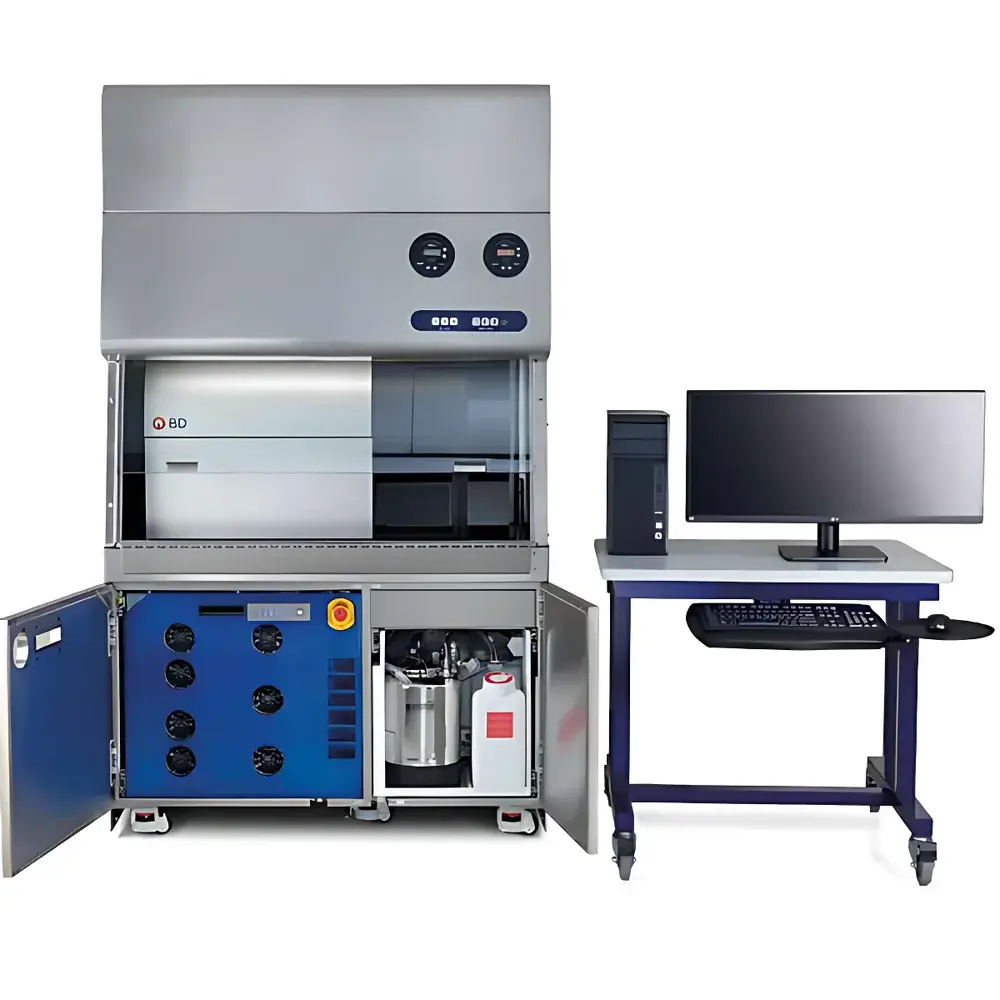
BD FACSymphony™ S6 Cell Sorter
| Brand | BD |
|---|---|
| Origin | USA |
| Manufacturer | BD Biosciences |
| Category | Imported Instrument |
| Model | BD FACSymphony™ S6 |
| Pricing | Upon Request |
Overview
The BD FACSymphony™ S6 Cell Sorter is a high-parameter, research-grade flow cytometer engineered for precision single-cell isolation in complex biological systems. Built upon the optical and electronic architecture of the BD FACSymphony™ A5 Analyzer and the proven fluidic platform of the BD FACSAria™ Fusion, the S6 implements hydrodynamic focusing, electrostatic droplet sorting, and real-time index sorting to enable simultaneous identification and purification of up to six distinct cell populations defined by up to 60 parameters—including forward scatter (FSC), side scatter (SSC), and ≥20 fluorescence channels per laser line. Its core measurement principle relies on multi-laser excitation (up to nine spatially separated lasers), high-quantum-efficiency photomultiplier tubes (PMTs), and gel-coupled quartz flow cells to maximize signal-to-noise ratio—critical for detecting low-abundance antigens and resolving phenotypically subtle subsets such as rare stem or regulatory T cell populations.
Key Features
- Up to nine independently configurable lasers with >25 selectable wavelengths (e.g., 355 nm, 405 nm, 488 nm, 561 nm, 640 nm), supporting broad-spectrum excitation of BD Horizon™ Brilliant dyes, fluorescent proteins, and conventional fluorochromes.
- High-parameter cascade matrix optics enabling up to 20 fluorescence parameters per laser line without compromising detection sensitivity or resolution.
- Index sorting capability integrated with plate-based collection (e.g., 96-well, 384-well formats), preserving one-to-one correspondence between each sorted cell’s full phenotypic profile and its physical location.
- Patented BD FACS™ AccuDrop technology (US Patent No. 6,372,506) for real-time droplet break-off optimization, ensuring consistent drop delay calibration and minimizing cross-contamination during sort pauses or transitions.
- Interchangeable nozzle system with standard options at 70 µm, 85 µm, and 100 µm; optional 130 µm nozzles available for fragile or large-diameter cells (e.g., primary neurons, megakaryocytes).
- Field-upgradable architecture supporting future laser additions, detector enhancements, or biosafety cabinet integration without system decommissioning.
Sample Compatibility & Compliance
The BD FACSymphony™ S6 accommodates suspension cells from human, murine, non-human primate, and other mammalian sources—including PBMCs, bone marrow aspirates, tumor digests, and dissociated tissues—as well as engineered cell lines and primary organoids. It complies with international biosafety standards when paired with the Baker Company Class II Type A2 Biological Safety Cabinet (BSC), meeting NSF/ANSI 49, EN 12469, AS 2252.2–2009, and YY 0569–2005 requirements for personnel and product protection. The closed-sample pathway, stainless-steel sorting chamber, and automated sterile wash protocols support GLP-compliant workflows. While not FDA 510(k)-cleared for diagnostic use, the instrument meets ISO 13485 design controls and supports 21 CFR Part 11–compliant data integrity when used with validated BD FACSDiva™ software configurations and audit-trail-enabled network environments.
Software & Data Management
Controlled via BD FACSDiva™ Software v10.x (Windows 10 64-bit), the system provides intuitive experimental setup, real-time acquisition monitoring, and gate-based sorting logic with dynamic re-sorting triggers. Experimental templates developed on the BD FACSymphony™ A5 Analyzer can be directly imported and executed on the S6 with minimal parameter recalibration—reducing method transfer time and reagent consumption. Raw FCS 3.1/4.1 files are natively compatible with FlowJo™ v10+, including HyperFinder™ plugin integration for unsupervised clustering and gate strategy export. BD’s open API framework allows interoperability with third-party analysis pipelines (e.g., Cytobank, R-based Cytofkit, Python-based Scanpy) and LIMS integration for sample tracking and metadata annotation.
Applications
- Isolation of rare immune subsets (e.g., antigen-specific T cells, tissue-resident memory T cells, plasmablasts) for functional assays, scRNA-seq, or adoptive transfer studies.
- Multi-omic sample preparation: coupling index-sorted cells with BD Rhapsody™ Single-Cell Analysis System for simultaneous protein and transcript profiling via BD AbSeq™ technology.
- Stem cell and progenitor enrichment across hematopoietic, neural, and mesenchymal lineages using combinatorial surface marker panels.
- CRISPR screen validation—sorting edited vs. unedited populations based on reporter expression or surface phenotype prior to NGS library prep.
- Preclinical biomarker discovery in oncology and autoimmunity, where high-dimensional phenotyping enables identification of predictive subpopulations missed by conventional gating strategies.
FAQ
What is the maximum number of parameters supported for simultaneous acquisition and sorting?
The BD FACSymphony™ S6 supports up to 60 total parameters—including light scatter and fluorescence—and can sort up to six populations defined by ≥20 fluorescence markers per laser line.
Can I transfer an experimental panel optimized on the BD FACSymphony™ A5 directly to the S6?
Yes—panel configurations, compensation matrices, and gating hierarchies created in FACSDiva™ on the A5 can be imported into the S6 with automatic channel mapping and minimal revalidation.
Does the system support biosafety cabinet integration?
Yes—the BD FACSymphony™ S6 is certified for seamless integration with the Baker Class II Type A2 BSC, with field installation typically completed within one business day.
What nozzle sizes are standard, and how do they affect sort purity and recovery?
Standard nozzles include 70 µm (optimal for lymphocytes), 85 µm (balanced for monocytes and small epithelial cells), and 100 µm (recommended for larger or fragile cells); selection directly impacts droplet stability, sort speed, and post-sort viability.
Is index sorting compatible with downstream single-cell sequencing platforms?
Yes—index-sorted FCS files contain full per-cell fluorescence intensities and positional metadata, enabling direct correlation with sequencing-derived clonal or transcriptional profiles in tools like Seurat or Loupe Browser.





