
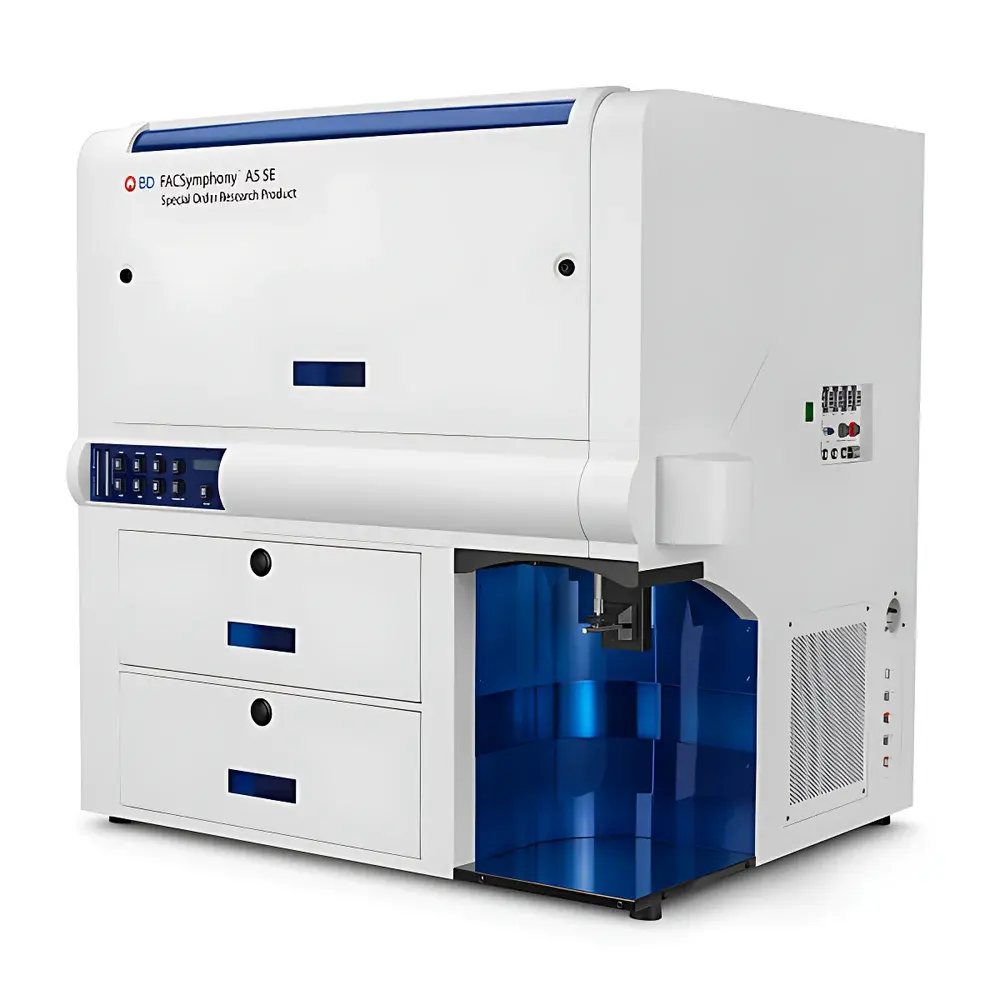
BD FACSymphony™ A5 SE Flow Cytometer
| Brand | BD |
|---|---|
| Origin | USA |
| Manufacturer | BD Biosciences |
| Type | Spectral and Conventional Flow Cytometer |
| Model | BD FACSymphony™ A5 SE |
| Product Category | Flow Cytometry Analyzer |
| Regulatory Status | CE-IVD, FDA 510(k) cleared |
Overview
The BD FACSymphony™ A5 SE Flow Cytometer is a high-parameter, benchtop flow cytometer engineered for both spectral unmixing and traditional compensation-based analysis within a single platform. It integrates BD’s proprietary spectral detection architecture—featuring 5 lasers (355, 405, 488, 561, and 640 nm) and 40 photodetectors—with optimized optical filtering and high-quantum-efficiency silicon photomultipliers (SiPMs) to capture full emission spectra across the visible to near-infrared range (360–800 nm). Unlike conventional cytometers that rely solely on bandpass filters and manual compensation, the A5 SE acquires raw spectral data from each event, enabling post-acquisition unmixing of fluorochromes with highly overlapping emission profiles—such as BV421/V450 or BV510/BV480—without requiring hardware reconfiguration. This dual-mode capability supports seamless transition between legacy panel designs and next-generation spectral panels, making it suitable for core facilities, translational research labs, and GMP-aligned immunophenotyping workflows.
Key Features
- Spectral acquisition mode with real-time unmixing and retrospective reanalysis—no need to re-run samples when changing fluorochrome combinations
- Conventional compensation mode compatible with existing BD FACSDiva™-based panel setups and instrument control logic
- Integrated 5-laser excitation system (UV, violet, blue, yellow-green, red) supporting up to 30+ simultaneous parameters in a single tube
- High-sensitivity SiPM detectors with low dark current and extended dynamic range (up to 5 decades), optimized for dim markers and rare-event detection
- Automated alignment and daily QC via BD CS&T (Cytometer Setup & Tracking) beads and BD FACSCount™ software protocols
- Benchtop footprint with integrated fluidics, sheath delivery, and waste management—designed for ISO Class 5 cleanroom-compatible operation
Sample Compatibility & Compliance
The BD FACSymphony™ A5 SE accommodates suspension cells—including primary human PBMCs, murine splenocytes, cultured cell lines, and bead-based standards—across sample volumes from 50 µL to 2 mL per acquisition. It supports standard 12×75 mm polystyrene tubes and optional 96-well plate loading via BD AutoLoader™ integration. The system complies with IEC 61010-1 (safety), IEC 61326-1 (EMC), and ISO 13485:2016 for in vitro diagnostic device manufacturing. For regulated environments, it supports 21 CFR Part 11-compliant audit trails, electronic signatures, and user-access controls when operated with BD FACSDiva™ Software v10.0 or later and BD FACSuite™ Clinical Software (CE-IVD marked). All spectral unmixing algorithms are validated per ISO/IEC 17025 requirements for method verification in accredited laboratories.
Software & Data Management
Data acquisition and analysis are managed through BD FACSDiva™ Software (v10.0+), which provides synchronized spectral and compensated display modes, automated spillover spreading matrix (SSM) generation, and batch processing for multi-sample comparative analysis. Raw FCS 3.1 files retain full spectral intensity vectors per event, enabling offline unmixing using BD Spectral Analyzer™ or third-party tools compliant with the Open Spectral Format (OSF) specification. BD FACSuite™ Clinical Software offers additional features for clinical labs, including predefined gating templates, LIS integration via ASTM E1384, and configurable reporting aligned with CLIA and CAP checklist requirements. All software modules support encrypted local storage, role-based permissions, and version-controlled protocol archiving.
Applications
The BD FACSymphony™ A5 SE is routinely deployed in immunology, oncology, hematology, and vaccine development research. Specific use cases include deep immune profiling of tumor-infiltrating lymphocytes (TILs) using ≥30-parameter panels; longitudinal monitoring of CAR-T persistence and exhaustion markers (e.g., PD-1, TIM-3, LAG-3, CD25, CD127); multiplexed cytokine detection via intracellular staining; and high-resolution discrimination of hematopoietic stem/progenitor subsets (HSC/MPP/LMPP) in bone marrow aspirates. Its spectral fidelity enables reliable resolution of tandem dyes (e.g., PE-Cy7 vs. APC-Cy7) and polymer dyes (e.g., Brilliant Violet series) in complex matrices—critical for studies involving C57BL/6J splenocyte phenotyping, humanized mouse models, and longitudinal clinical trial sample analysis.
FAQ
Does the BD FACSymphony™ A5 SE require specialized training to operate in spectral mode?
Yes—while basic acquisition follows standard flow cytometry workflows, spectral unmixing requires understanding of reference control selection, autofluorescence subtraction, and unmixing matrix validation. BD offers certified instructor-led courses and online modules through BD University.
Can I import legacy compensated panels into spectral analysis mode?
Yes—BD FACSDiva™ allows side-by-side viewing of compensated and unmixed data from the same acquisition file, facilitating direct comparison and iterative panel optimization.
Is the instrument compatible with single-cell RNA-seq sample preparation workflows?
It supports viability staining (e.g., 7-AAD, DAPI) and surface marker sorting for downstream scRNA-seq, though sorting functionality requires optional BD FACSAria™ Fusion integration—not natively available on the A5 SE standalone configuration.
What maintenance intervals are recommended for optimal spectral performance?
Daily CS&T calibration, monthly optical alignment verification, and annual PM by BD Field Service Engineers—including laser power validation and detector gain recalibration—are required to maintain spectral accuracy per BD’s Technical Performance Specifications.
Are there limitations on fluorochrome combinations in spectral mode?
No hard upper limit exists, but optimal unmixing requires ≥3 reference controls per fluorochrome and adherence to BD’s Spectral Panel Design Guidelines—particularly for fluorochromes with <15 nm spectral separation (e.g., BV421/V450).



