
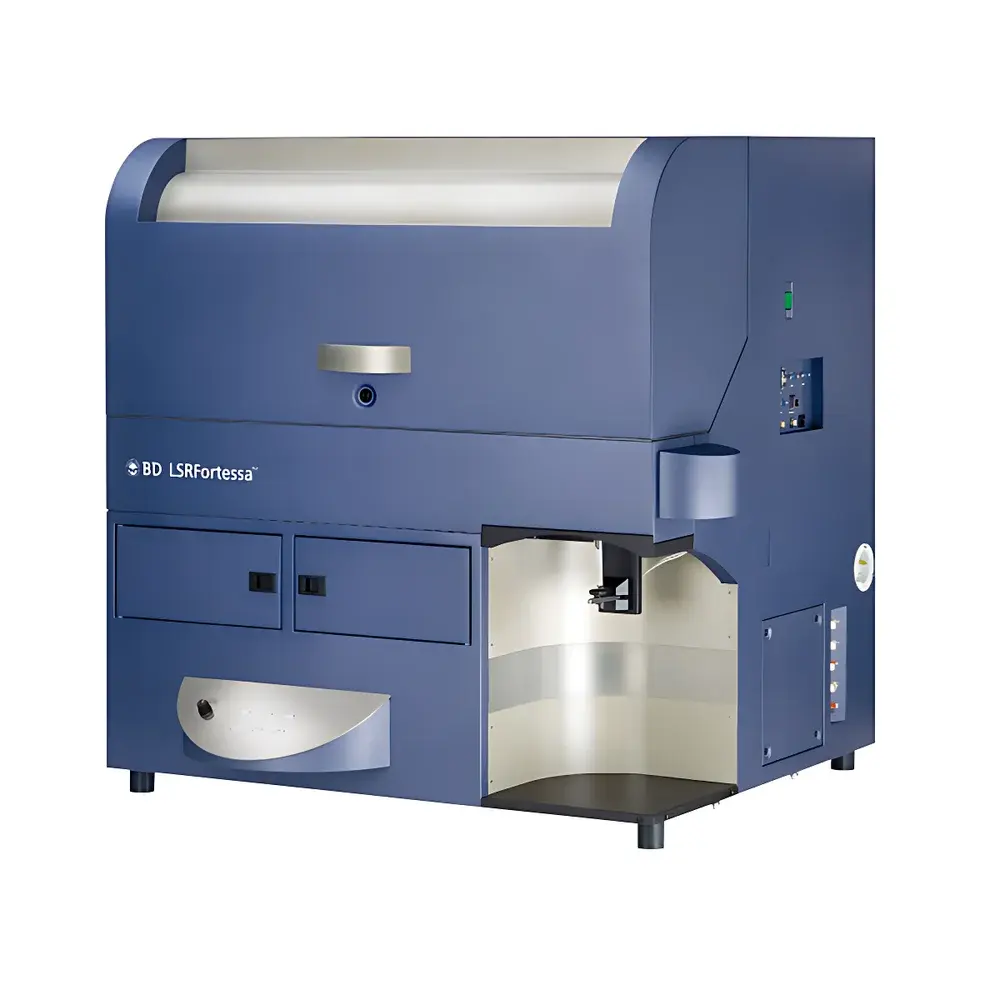
BD LSRFortessa™ High-Performance Research-Grade Flow Cytometer
| Brand | BD |
|---|---|
| Origin | USA |
| Manufacturer | BD Biosciences |
| Product Type | Analytical Flow Cytometer |
| Laser Configuration | Up to 5 lasers (355 nm UV, 405 nm violet, 488 nm blue, 561 nm yellow-green, 640 nm red) |
| Detection Parameters | Up to 20 parameters simultaneously |
| Optical Architecture | Patented octagonal–triangular fluorescence collection system with quartz flow cell and optical coupling |
| Software Platform | BD FACSDiva™ v8.0+ with automated acquisition, compensation, and batch analysis |
| Compliance | Designed for GLP/GMP-aligned workflows |
| Optional Accessories | BD HTS Sampler (96-/384-well plate auto-loader), BD FACSFlow™ Supply System (dual 20 L Cubitainers®), forward-scatter PMT upgrade |
Overview
The BD LSRFortessa™ is a high-performance, research-grade analytical flow cytometer engineered for demanding multicolor immunophenotyping, rare-event detection, and longitudinal cellular profiling in academic, translational, and core facility laboratories. It operates on the principle of hydrodynamic focusing combined with multi-laser excitation and spatially resolved fluorescence emission detection. Cells in suspension are precisely focused into a single-file stream within a quartz flow cell that is optically coupled to both excitation lasers and photomultiplier tube (PMT) detectors—minimizing photon loss and maximizing signal-to-noise ratio. Its architecture integrates pressure-driven fluidics, stable laser alignment, and a patented octagonal–triangular optical collection path that enables simultaneous detection of up to 20 parameters across five discrete laser lines (355 nm UV, 405 nm violet, 488 nm blue, 561 nm yellow-green, and 640 nm red). This design delivers exceptional sensitivity for low-abundance markers (e.g., Foxp3 in regulatory T cells) and high-resolution discrimination of spectrally overlapping fluorochromes—critical for deep immunological phenotyping and biomarker discovery.
Key Features
- Modular five-laser platform supporting configurable excitation wavelengths from ultraviolet to red (355–640 nm), with factory-aligned beam paths and thermally stabilized optics.
- Quartz flow cell with optical coupling technology ensuring consistent laser focus, reduced signal variability, and enhanced long-term reproducibility.
- Patented octagonal–triangular fluorescence collection system enabling efficient reflection-based light routing—reducing transmission losses through glass interfaces and improving collection efficiency per PMT channel.
- Standard configuration includes up to 20 detection channels with bandpass filters and dichroic mirrors pre-aligned for rapid reconfiguration without recalibration.
- Compact footprint (50% smaller than BD LSR II), optimized for benchtop deployment in space-constrained laboratories while maintaining full optical and fluidic performance.
- Integrated fluidics management with external 8 L sheath reservoir and 10 L waste container; optional BD FACSFlow™ Supply System provides dual 20 L Cubitainers® and automated pressure regulation with real-time fluid level monitoring and audible/visual alerts.
Sample Compatibility & Compliance
The BD LSRFortessa™ accommodates a broad range of biological samples—including peripheral blood mononuclear cells (PBMCs), dissociated tissues, cultured cell lines, and microorganism suspensions—when prepared according to standard flow cytometry protocols. Its forward-scatter PMT upgrade option extends detection capability to submicron particles (e.g., extracellular vesicles or bacteria), enhancing utility in microbiology and exosome research. The instrument meets international standards for analytical instrumentation in regulated environments: optical alignment stability supports ISO 21501-4 particle sizing traceability principles; fluidic pressure control aligns with ASTM E2877 guidelines for flow rate consistency; and when deployed with the BD FACSDiva Compliance Pack, it fulfills FDA 21 CFR Part 11 requirements for electronic records and signatures—including user authentication, audit trail logging, and secure data export. Routine QC procedures—including daily startup checks, automated voltage optimization, and bead-based calibration—are fully integrated into the instrument’s operational workflow.
Software & Data Management
BD FACSDiva™ software (v8.0 or later) serves as the unified interface for experimental design, acquisition, compensation, and analysis. It supports template-driven acquisition for multi-sample studies, intuitive drag-and-drop gating hierarchies (including Boolean logic and sequential gating), and automated compensation matrix generation using single-stained controls. Advanced analysis features include batch processing with customizable reporting templates, statistical overlays across sample groups, and export of FCS 3.1-compliant files compatible with third-party platforms (e.g., FlowJo, Cytobank, R/Bioconductor). For compliance-sensitive applications, the optional FACSDiva Compliance Pack enables role-based access control, electronic signatures, and immutable audit trails documenting all instrument settings, compensation changes, and data modifications—fully aligned with GLP and GMP documentation expectations.
Applications
The BD LSRFortessa™ is routinely deployed in immunology for high-dimensional T-cell subset characterization (e.g., CD4+CD25hiFoxp3+ regulatory T-cell enumeration), hematopoietic stem/progenitor cell phenotyping, and cytokine intracellular staining assays. Its sensitivity and multiplexing capacity support virology applications such as HIV reservoir quantification and SARS-CoV-2 spike-specific B-cell profiling. In oncology, it facilitates minimal residual disease (MRD) detection in leukemia and lymphoma using 10–15-color panels. Core facilities leverage its HTS sampler for high-throughput screening of compound libraries affecting immune cell activation states. The system’s expandability—via field-upgradable lasers, additional PMTs, or custom optical configurations—ensures sustained relevance across evolving research priorities without hardware replacement.
FAQ
What is the maximum number of lasers supported on the BD LSRFortessa™?
The standard configuration supports up to five lasers. Custom configurations may integrate additional solid-state lasers under BD’s Special Order Program (SORP), subject to optical path feasibility and thermal management validation.
Can the BD LSRFortessa™ be used in GLP-compliant studies?
Yes—when operated with the BD FACSDiva Compliance Pack and validated SOPs, it meets key elements of GLP requirements including audit trail integrity, user access control, and electronic record retention.
Is the quartz flow cell user-replaceable?
No—the optically coupled quartz flow cell is a factory-installed, sealed component requiring service engineer intervention for replacement to maintain optical alignment and fluidic integrity.
Does the system support automated plate-based acquisition?
Yes—the optional BD HTS Sampler enables direct aspiration from 96-well or 384-well microplates with programmable sampling order, volume control, and mixing cycles.
How does the octagonal–triangular optical design improve detection sensitivity?
By routing emitted fluorescence via reflective surfaces rather than transmissive optics, the design minimizes photon loss across fewer optical interfaces—particularly beneficial for dim fluorochromes and low-expression antigens.




