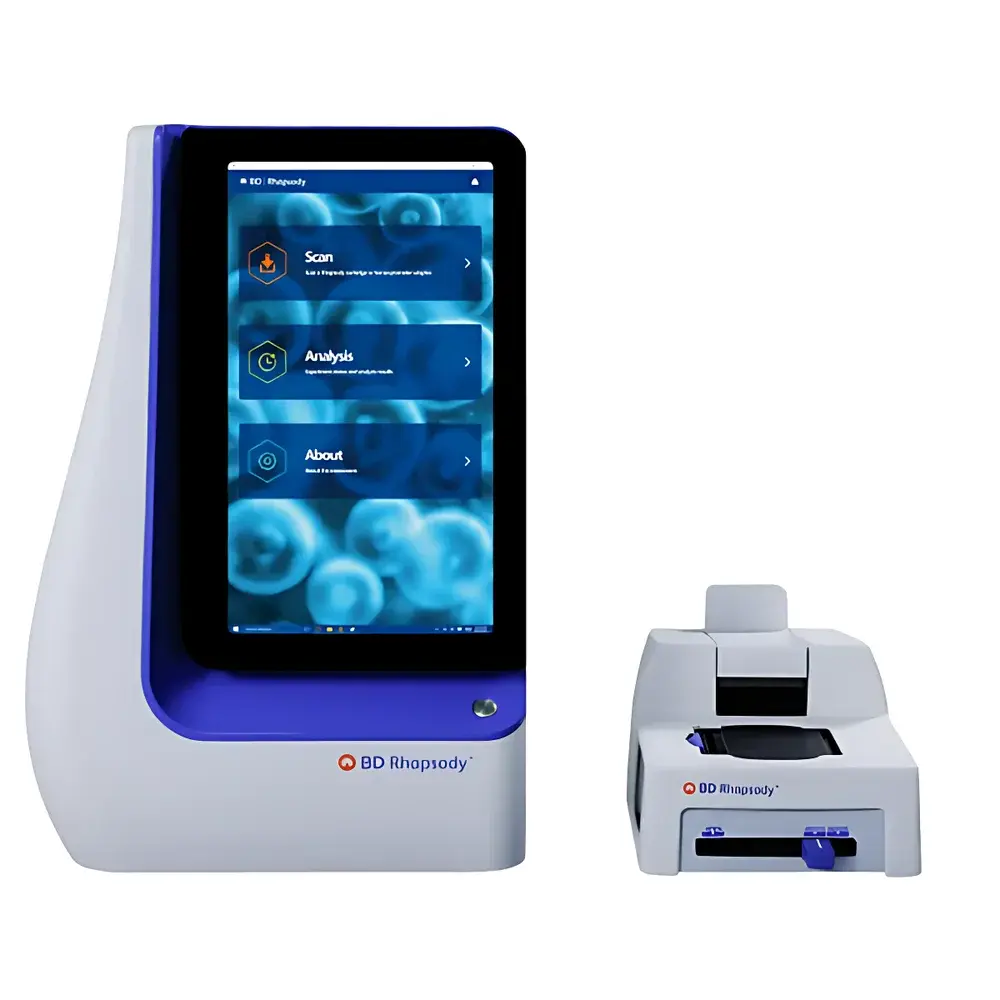
BD Rhapsody™ HT Xpress High-Throughput Single-Cell Multi-Omics Platform
| Brand | BD |
|---|---|
| Origin | USA |
| Manufacturer | BD Biosciences |
| Product Category | Imported Instrument |
| Model | BD Rhapsody™ HT Xpress |
| Pricing | Available Upon Request |
Overview
The BD Rhapsody™ HT Xpress is a high-throughput, integrated single-cell multi-omics platform engineered for precision, scalability, and reproducibility in translational and discovery research. Built upon BD’s proprietary microfluidic cartridge-based capture technology and molecular indexing architecture, the system enables simultaneous profiling of transcriptome, surface protein expression (via antibody-derived tags), T-cell and B-cell receptor repertoires (immune repertoire), and sample multiplexing—all from the same single-cell suspension. Unlike droplet-based or nanowell approaches, the BD Rhapsody platform utilizes a deterministic, imaging-guided microwell array format that ensures visual confirmation of cell loading, bead occupancy, and lysis efficiency at critical workflow checkpoints. This architecture supports robust performance across broad input cell ranges (100–1,000,000+ viable cells per run) and delivers high capture efficiency with low doublet rates—validated at ≤2.5% for 10,000 loaded cells and ≤5.2% for 25,000 cells under standardized protocols.
Key Features
- 8-channel modular microplate design: Enables flexible experimental scaling—use only the channels required per run; unused channels remain sterile and available for future use without reagent waste.
- Integrated BD Rhapsody™ Imager: Provides real-time, high-resolution brightfield and fluorescence imaging at three critical QC stages—pre-capture (cell viability assessment), post-loading (bead occupancy verification), and post-lysis (nucleic acid release confirmation)—ensuring data integrity before costly library preparation and sequencing.
- Molecular indexing with BD Multiplexing Technology: Supports up to 192-sample multiplexing per run using sample-specific oligonucleotide barcodes, minimizing batch effects and enabling cross-cohort normalization in large-scale studies.
- Compatible magnetic bead archiving: Validated equivalency between freshly prepared and cryopreserved capture beads ensures reproducible library quality and facilitates longitudinal study designs, inter-lab collaboration, and experimental redundancy planning.
- Low inter-run and inter-operator variability: Demonstrated consistency across technical replicates, biological replicates, and multi-site user studies—critical for GLP-aligned preclinical development and clinical biomarker discovery workflows.
Sample Compatibility & Compliance
The BD Rhapsody™ HT Xpress accepts fresh or cryopreserved single-cell suspensions derived from human or model organism tissues—including PBMCs, dissociated tumors, sorted immune subsets, and primary organoids. It complies with ISO 13485:2016 for medical device quality management systems and supports audit-ready documentation for GxP environments. Software-generated logs include timestamped imaging metadata, user-defined annotations, and instrument calibration records—fully traceable per FDA 21 CFR Part 11 requirements when deployed with BD’s validated software configuration. All reagents are manufactured under controlled conditions and supplied with CoA documentation aligned with ICH Q5A and Q5B guidelines for biologics characterization.
Software & Data Management
BD Rhapsody™ Software v4.x provides end-to-end workflow orchestration—from instrument control and image-based QC to FASTQ generation and initial alignment metrics. The software integrates natively with standard NGS analysis pipelines (e.g., CellXGene, Seurat, Scanpy) via BAM and feature-barcode matrix exports. Audit trails record all user actions, parameter modifications, and imaging decisions, supporting retrospective review and regulatory submissions. Raw image files (TIFF) and processed metadata are stored in vendor-agnostic formats compliant with MIAME and MINSEQE standards. Optional integration with BD’s enterprise data management solutions enables centralized storage, role-based access control, and automated backup policies aligned with HIPAA and GDPR frameworks.
Applications
This platform is routinely deployed in oncology (tumor microenvironment deconvolution, resistance mechanism mapping), immunology (vaccine response profiling, autoimmunity signature discovery), infectious disease (host-pathogen interaction at single-cell resolution), and cell therapy development (CAR-T persistence tracking, clonal dynamics monitoring). Its ability to co-profile RNA and surface proteins from the same cell enables direct correlation of transcriptional states with functional phenotypes—supporting target identification, biomarker qualification, and mechanistic hypothesis testing in both academic and industry settings.
FAQ
What is the maximum number of cells supported per run?
The system is validated for inputs ranging from 100 to over 1,000,000 viable single cells per cartridge, with optimal performance observed between 10,000 and 250,000 cells depending on sample type and desired sequencing depth.
Can I reuse partially used microplates across experiments?
Yes—the 8-channel plate design allows selective channel activation; unused channels retain sterility and can be reserved for subsequent runs without compromising reagent integrity or assay sensitivity.
Is the BD Rhapsody™ Imager required for routine operation?
Yes—it is an integral component of the platform’s QC framework and must be used at designated workflow checkpoints to ensure data fidelity and regulatory compliance.
Does BD provide application support for assay development?
Yes—BD’s global Field Applications Scientists offer protocol optimization, troubleshooting, and training services, including custom panel design for novel protein targets and multi-omics integration strategies.
How does the system handle sample multiplexing errors?
BD Multiplexing Technology incorporates dual-indexing and error-correction algorithms during demultiplexing, achieving >99.8% assignment accuracy across 192-plex experiments when used with recommended QC thresholds.