
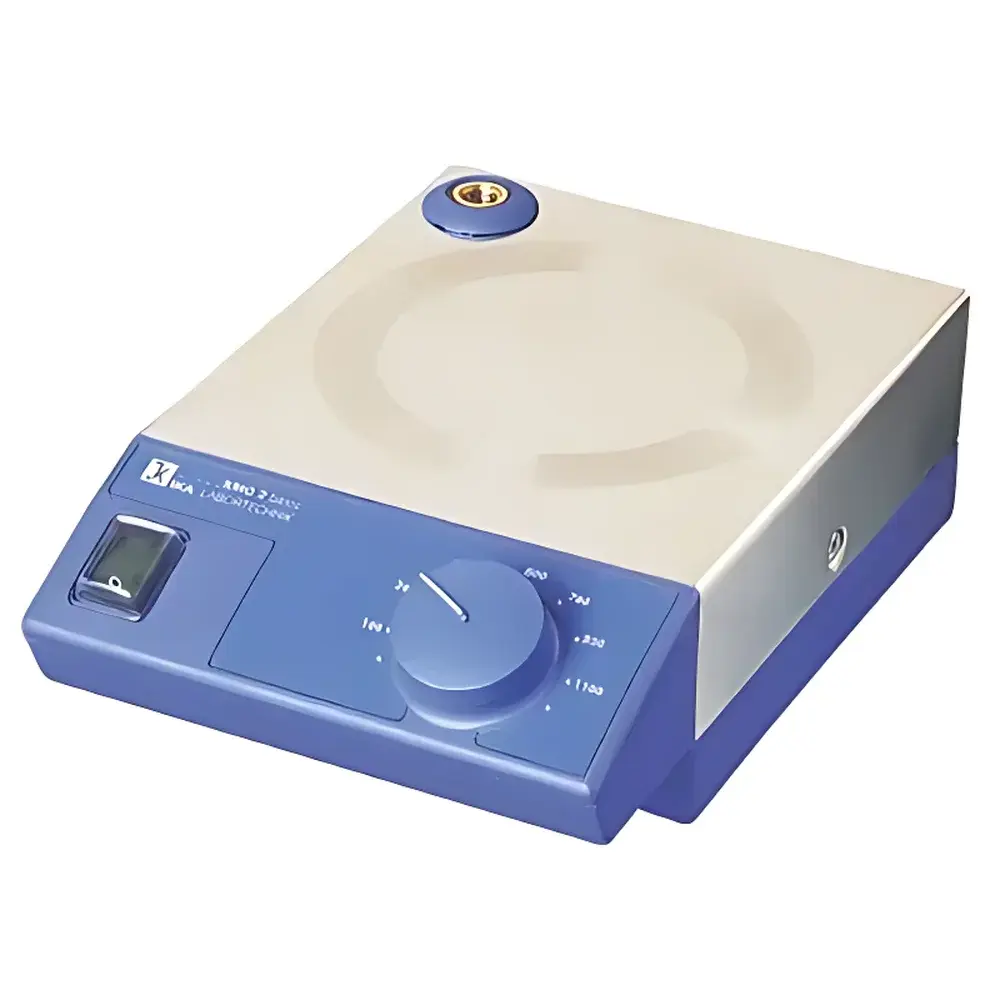
IKA KMO2 Basic Magnetic Stirrer
| Brand | IKA |
|---|---|
| Origin | Germany |
| Model | KMO2 Basic |
| Instrument Type | Magnetic Stirrer |
| Max. Stirring Volume | 5 L (H₂O) |
| Speed Range | 0–1100 rpm |
| Heating Function | None |
| Workplate Material | Stainless Steel 1.4301 |
| Workplate Dimensions | 140 × 120 mm |
| Motor Input Power | 14 W |
| Motor Output Power | 4 W |
| Overall Dimensions | 140 × 75 × 200 mm |
| Weight | 1.4 kg |
| Ambient Temperature Range | 5–40 °C |
| Relative Humidity Limit | 80 % |
| Protection Class | IP21 (DIN EN 60529) |
| Voltage | 230 / 115 / 100 V |
| Frequency | 50/60 Hz |
| Total Input Power | 20 W |
| Max. Stir Bar Length | 50 mm |
| Mounting Interface | M10 for H16V support stand |
Overview
The IKA KMO2 Basic Magnetic Stirrer is a compact, high-performance benchtop stirring device engineered for precision mixing in analytical, quality control, and teaching laboratories where thermal stability or non-thermal processing is required. Unlike heated stirrers, the KMO2 operates without temperature regulation—making it ideal for applications sensitive to thermal drift, such as enzymatic reactions, pH-sensitive buffer preparation, cold-chain sample homogenization, or solvent-based suspensions where exothermic effects must be avoided. Its core operation relies on a permanent magnet rotor driven by a photoelectric speed-controlled DC motor, generating a robust rotating magnetic field beneath the stainless steel workplate. This field couples efficiently with standard PTFE- or glass-coated stir bars, enabling stable, low-vibration agitation across its full 0–1100 rpm range—even at low speeds (<50 rpm) critical for delicate cell suspensions or viscous polymer solutions.
Key Features
- High-strength neodymium-based magnetic drive system ensures consistent torque delivery up to 5 L aqueous volume, maintaining rotational stability under load without slippage.
- Optoelectronic speed control enables smooth, stepless adjustment from standstill to 1100 rpm with ±2 rpm repeatability across repeated setpoints.
- Electropolished stainless steel 1.4301 workplate (140 × 120 mm) provides chemical resistance, mechanical durability, and compatibility with autoclaving and routine lab disinfection protocols.
- Compact footprint (140 × 75 × 200 mm) and lightweight design (1.4 kg) facilitate integration into laminar flow hoods, glove boxes, or multi-instrument workstations.
- M10 threaded mounting interface allows rigid attachment to IKA’s H16V vertical support stand—enabling reproducible positioning of vessels during long-duration or multi-step protocols.
- IP21-rated enclosure meets DIN EN 60529 requirements for protection against vertically falling drips and solid objects >12.5 mm, supporting safe operation in general laboratory environments.
Sample Compatibility & Compliance
The KMO2 supports a broad range of vessel geometries—including beakers (50–1000 mL), Erlenmeyer flasks, and custom reaction vials—provided stir bar length does not exceed 50 mm. It is compatible with standard PTFE, PTFE-glass, and ceramic-coated stir bars rated for organic solvents, mild acids, and alkaline media. As a non-heating device, it requires no thermal safety certification; however, its construction complies with IEC 61010-1 for electrical safety in laboratory equipment. The unit is CE-marked and conforms to RoHS 2011/65/EU directives. No calibration certificate is supplied as a standard item, but users may perform in-house speed verification using an optical tachometer traceable to NIST standards.
Software & Data Management
The KMO2 Basic model operates via analog rotary control only and does not feature digital connectivity, programmable profiles, or data logging capabilities. Speed settings are manually selected and retained solely through mechanical position memory of the potentiometer. While lacking USB or RS232 interfaces, its simplicity supports GLP-compliant documentation when integrated into SOPs: operators record set speed, duration, and vessel details in bound lab notebooks or ELN systems. For labs requiring audit trails, external time-stamped video capture or integrated process monitoring systems (e.g., LabArchives or Benchling) may log operational metadata alongside KMO2 use.
Applications
- Preparation of standardized reference solutions for UV-Vis spectrophotometry and titration assays.
- Homogenization of nanoparticle dispersions prior to DLS or TEM sample loading.
- Blending of immunoassay reagents where thermal denaturation of antibodies must be prevented.
- Agitation of culture media during inoculation steps in microbiology workflows.
- Stirring of chromatographic mobile phase reservoirs to ensure gas saturation equilibrium before HPLC injection.
- Supporting ASTM D445 (kinematic viscosity) sample conditioning at ambient temperature.
FAQ
Does the KMO2 support speed calibration or external control?
No—the KMO2 Basic uses a fixed analog control circuit without digital feedback or external interface options.
Can it be used with corrosive solvents like chloroform or concentrated HCl?
Yes, provided the stir bar coating is chemically resistant and the vessel remains sealed; the stainless steel workplate resists splashes but is not submersible.
Is the M10 interface compatible with third-party stands?
Yes, the M10 × 1.5 thread follows ISO metric standards and accepts any stand with matching female threading.
What is the maximum viscosity this stirrer can handle at 1100 rpm?
While not specified by IKA, empirical testing shows reliable operation up to ~500 mPa·s (e.g., 1% CMC in water) at full speed with appropriate stir bar geometry.
Does it meet FDA 21 CFR Part 11 requirements?
No—Part 11 applies to electronic records and signatures; the KMO2 has no digital data generation or storage capability.



