
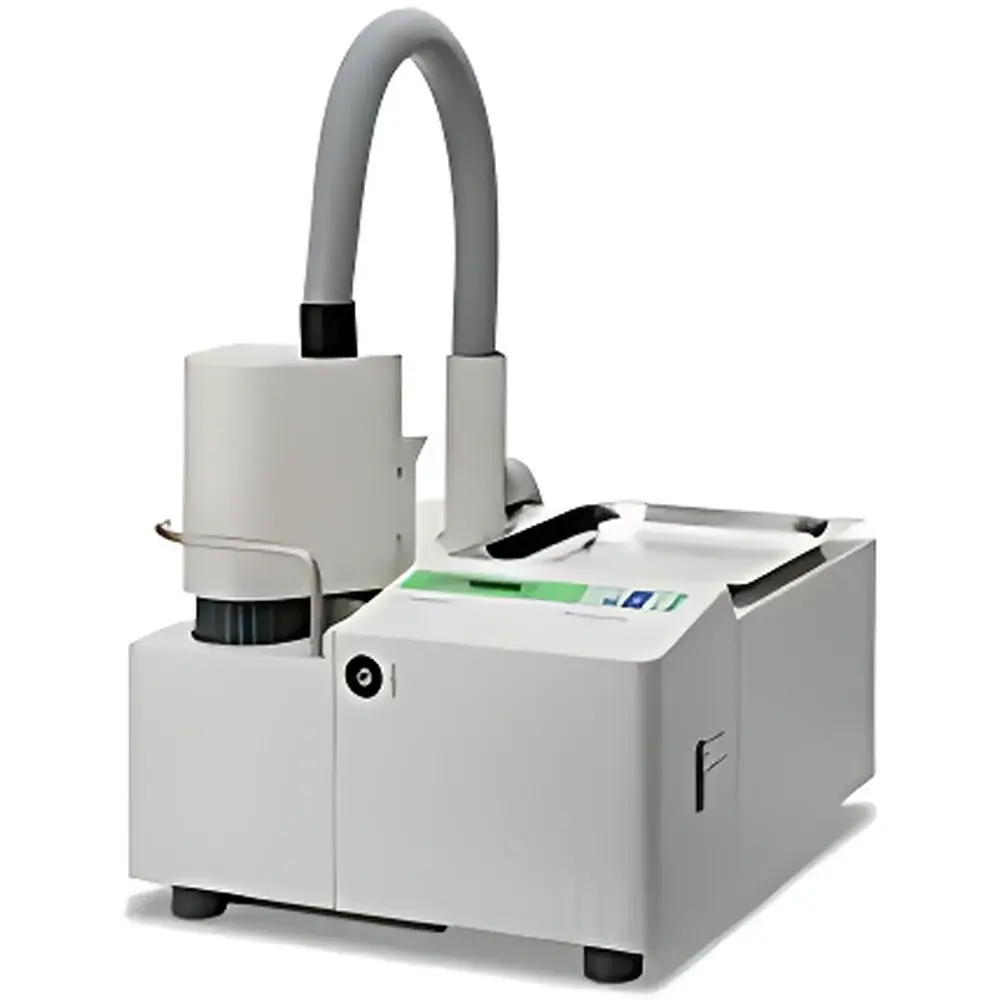
METTLER TOLEDO TMA/SDTA861e Thermomechanical Analyzer
| Brand | METTLER TOLEDO |
|---|---|
| Origin | Switzerland |
| Model | TMA/SDTA861e |
| Temperature Range | −150 to 600 °C (standard), up to 1100 °C with gas-tight furnace option |
| Temperature Accuracy | ±0.5 °C |
| Force Range | 0.001–40 mN |
| Displacement Range | ±1.6 mm |
| Frequency Range | 0.001–1000 Hz |
| Resolution | 1 nm |
| Measurement Modes | Static TMA, Dynamic Load TMA (DLTMA), Simultaneous Differential Thermal Analysis (SDTA) |
Overview
The METTLER TOLEDO TMA/SDTA861e is a high-precision thermomechanical analyzer engineered for quantitative measurement of dimensional changes in solid and semi-crystalline materials under controlled thermal and mechanical conditions. Operating on the principle of contact-based probe displacement sensing, it applies a defined static or dynamic force to a sample while precisely ramping or holding temperature across a broad range (−150 to 600 °C standard; up to 1100 °C with optional gas-tight furnace). The instrument captures linear expansion, contraction, softening, creep, and stress relaxation responses with nanometer-scale resolution (1 nm), enabling rigorous characterization of coefficient of thermal expansion (CTE), glass transition temperature (Tg), softening point, and viscoelastic behavior. Its integrated SDTA capability allows simultaneous acquisition of heat flow signals during TMA experiments—eliminating sequential measurements and ensuring perfect thermal and temporal correlation between dimensional and thermal events. This dual-signal architecture supports comprehensive structure-property analysis essential for polymer development, composite qualification, pharmaceutical solid-state stability studies, and electronic packaging reliability assessment.
Key Features
- Patented low-drift mechanical design with active drift compensation, ensuring long-term baseline stability and reproducible nanoscale displacement detection.
- Dynamic Load TMA (DLTMA) mode: enables frequency-dependent modulus profiling (e.g., Young’s modulus) via sinusoidal force modulation from 0.001 to 1000 Hz—critical for identifying weak transitions and time-dependent mechanical responses.
- Simultaneous Differential Thermal Analysis (SDTA): real-time heat flow measurement co-registered with dimensional data using a dedicated thermocouple array embedded in the furnace and probe assembly.
- Gas-tight furnace option: supports inert, oxidative, or reducing atmospheres (N2, Ar, O2, air) with precise flow control (0–200 mL/min), enabling studies under process-relevant environmental conditions per ASTM E831 and ISO 11359-2.
- Modular sample stage: accommodates diverse geometries—from thin films and fibers to bulk rods and multilayer laminates—with interchangeable probes (fiber, flat, needle, penetration) and load cells calibrated traceably to NIST standards.
- Compliance-ready architecture: firmware and software support audit trails, electronic signatures, and 21 CFR Part 11–compliant data integrity controls when configured for GxP environments.
Sample Compatibility & Compliance
The TMA/SDTA861e accepts rigid, semi-rigid, and viscoelastic solids—including thermoplastics, thermosets, elastomers, ceramics, metals, pharmaceutical tablets, and thin-film coatings. Sample dimensions range from 0.1 mm diameter fibers to 10 mm × 10 mm × 25 mm rectangular specimens. All measurement protocols align with international standards including ISO 11359-1 (general principles), ISO 11359-2 (determination of linear coefficient of thermal expansion), ASTM E831 (linear thermal expansion of solids), and USP (verification of analytical instrument performance). The system’s traceable calibration suite includes certified reference materials for temperature (indium, zinc, tin), displacement (quartz gauge blocks), and force (NIST-traceable deadweight calibrators).
Software & Data Management
Powered by METTLER TOLEDO’s STARe evaluation software, the TMA/SDTA861e provides full experimental control, real-time visualization, and advanced post-processing. Key capabilities include automatic baseline correction, derivative analysis (dTMA/dT), CTE calculation over user-defined intervals, modulus extraction from DLTMA phase lag, and multi-curve overlay with statistical comparison. Data files are stored in secure, encrypted .stf format with embedded metadata (operator, timestamp, instrument ID, calibration status). Export options include CSV, ASCII, and PDF reports compliant with GLP/GMP documentation requirements. Optional STARe Network Edition enables centralized method management, remote monitoring, and role-based access control across laboratory networks.
Applications
- Polymer R&D: Quantification of filler-induced CTE reduction in automotive composites; mapping of crosslink density via modulus evolution during cure.
- Pharmaceuticals: Detection of polymorphic transitions and desolvation events in active pharmaceutical ingredients (APIs) through coupled SDTA-TMA signatures.
- Electronics: Warpage analysis of PCB substrates under thermal cycling; interfacial adhesion assessment in die-attach materials.
- Advanced Materials: Creep compliance modeling of high-temperature ceramics; anisotropic expansion profiling in carbon-fiber laminates.
- Quality Control: Batch-to-batch verification of thermal expansion in aerospace-grade aluminum alloys per AMS 2750E pyrometry requirements.
FAQ
What is the difference between static TMA and DLTMA modes?
Static TMA applies constant force while varying temperature to measure dimensional response; DLTMA superimposes a small oscillatory force at selectable frequencies to extract viscoelastic moduli and identify secondary relaxations not visible in static mode.
Can the TMA/SDTA861e operate under vacuum?
Yes—the gas-tight furnace option supports vacuum operation down to 10−2 mbar when equipped with appropriate pumping and sealing accessories.
Is SDTA signal quantitatively equivalent to DSC?
No. SDTA provides relative, non-calibrated heat flow trends co-located with dimensional change; for absolute enthalpy determination, dedicated DSC (e.g., METTLER TOLEDO DSC3) is recommended per ISO 11357-1.
How is temperature accuracy verified across the full range?
Using certified ITS-90 reference materials (e.g., indium, tin, zinc, aluminum) during routine calibration; system-level validation follows ASTM E1545 procedures.
Does the instrument support automated sample changers?
Yes—optional 16-position auto-sampler (TMA-ASC) enables unattended multi-sample runs with integrated purge gas management and thermal equilibration logic.



