
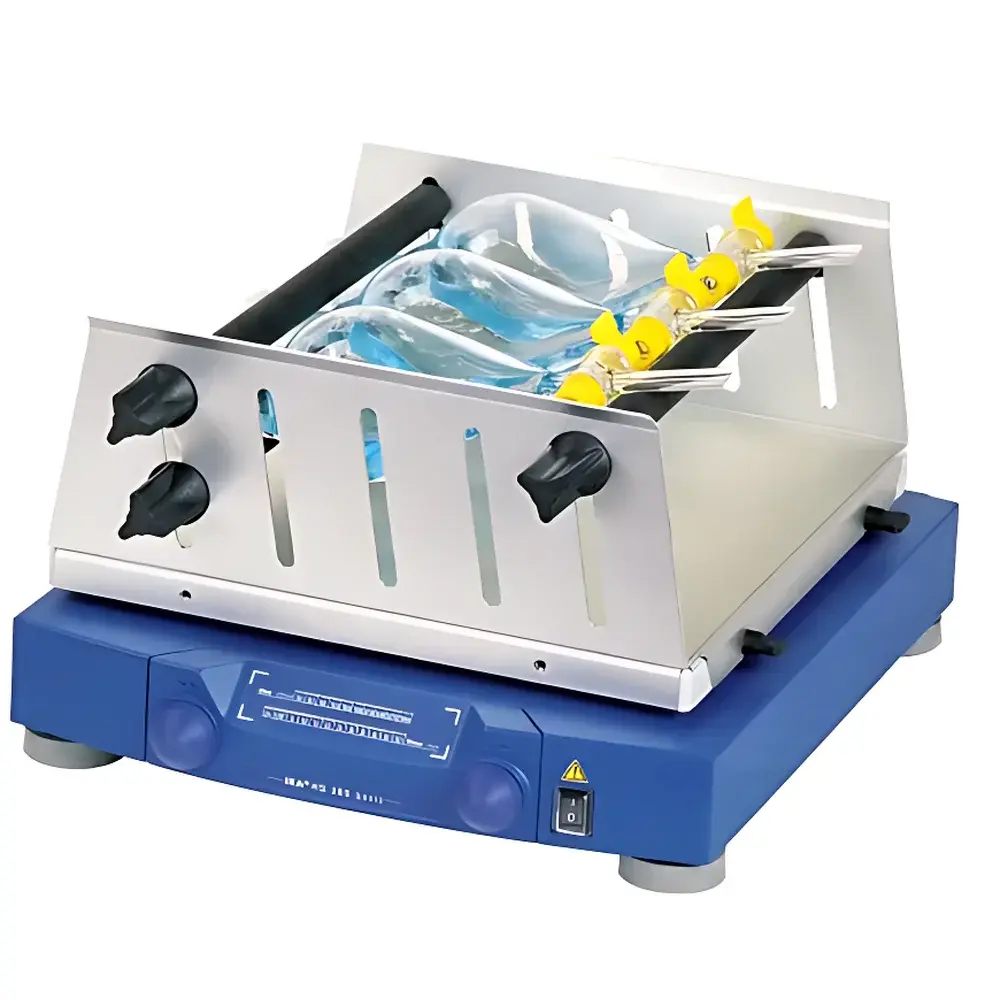
IKA HS260 Basic and Digital Programmable Reciprocal Shaker
| Brand | IKA |
|---|---|
| Origin | Germany |
| Model | HS260 |
| Oscillation Mode | Reciprocal (Linear) |
| Stroke Length | 20 mm |
| Platform Quantity | 1 |
| Max Load Capacity | 7.5 kg |
| Speed Range | 20–300 rpm |
| Timer Options | Continuous (∞) or 5–50 min |
| Speed & Time Display | LED |
| Power Input/Output | 45 W / 10 W |
| Dimensions (W×D×H) | 360 × 420 × 98 mm |
| Net Weight | 8.5 kg |
| Operating Ambient Temperature | 5–50 °C |
| Max Relative Humidity | 80 % RH |
| Clamp Fixtures | Not included — ordered separately |
Overview
The IKA HS260 is a compact, benchtop reciprocal shaker engineered for precision and reliability in routine laboratory applications requiring linear oscillation. Unlike orbital or rotary shakers, the HS260 employs a true reciprocating motion—driven by an eccentric cam mechanism—to generate consistent back-and-forth displacement with a fixed stroke length of 20 mm. This motion profile is particularly suited for gentle yet effective mixing of viscous or sediment-prone samples, including cell suspensions, staining solutions, blotting buffers, and immunoassay plates. Designed and manufactured in Germany, the HS260 adheres to IKA’s long-standing engineering standards for mechanical stability, low-vibration operation, and long-term duty-cycle performance. Its robust aluminum housing, brushless DC motor, and integrated thermal protection ensure continuous operation under variable load conditions up to 7.5 kg. The device operates within a controlled ambient range (5–50 °C, ≤80 % RH), making it compatible with standard laboratory environments—including cold rooms and warm incubator chambers when used with appropriate environmental enclosures.
Key Features
- Reciprocal linear motion with precisely calibrated 20 mm stroke—optimized for uniform mixing without splashing or foaming
- Digitally adjustable speed control (20–300 rpm) with high-resolution LED display for real-time monitoring of both speed and timer status
- Dual timer modes: continuous operation (∞) or programmable countdown (5–50 minutes) with automatic shutdown
- Single-platform design with standardized 360 × 420 mm mounting surface—compatible with universal clamping systems (clamps sold separately)
- Low-noise, brushless DC motor delivering 10 W mechanical output from 45 W electrical input—ensuring energy efficiency and minimal heat generation
- Compact footprint (360 × 420 × 98 mm) and lightweight construction (8.5 kg) for flexible placement on biosafety cabinets, laminar flow hoods, or shared lab benches
- Integrated overload and thermal protection circuitry compliant with IEC 61000-6-2 (immunity) and IEC 61000-6-4 (emission) standards
Sample Compatibility & Compliance
The HS260 supports a broad range of sample containers—including Erlenmeyer flasks (up to 2 L), centrifuge tubes, multi-well microplates (6–96-well), staining trays, and blotting cassettes—when paired with IKA-certified clamps (e.g., universal spring clamps, microplate holders, or flask adapters). While the base unit does not include fixtures, all clamp accessories are designed to ISO 9001-certified specifications and undergo mechanical load testing per DIN EN ISO 13849-1. The instrument meets CE marking requirements under the EU Machinery Directive 2006/42/EC and Electromagnetic Compatibility Directive 2014/30/EU. It is suitable for use in GLP-compliant laboratories when operated within defined SOPs; however, it does not include audit-trail functionality or 21 CFR Part 11 compliance features—making it appropriate for non-GxP research and teaching environments.
Software & Data Management
The HS260 is a stand-alone, hardware-controlled instrument with no embedded microprocessor or digital interface. All operational parameters—speed and timer—are set manually via front-panel rotary dials and confirmed visually on the dual-segment LED display. No software drivers, USB connectivity, or data logging capability is provided. This architecture ensures deterministic behavior, eliminates firmware update dependencies, and guarantees repeatable manual operation across shifts and users—a critical advantage in training labs and high-throughput screening workflows where procedural simplicity and equipment uptime are prioritized over digital integration.
Applications
- Western blot membrane washing and antibody incubation
- Cell dissociation and suspension homogenization prior to centrifugation
- Staining and destaining of electrophoresis gels
- Extraction protocols involving solid-liquid phase contact (e.g., protein purification resins, affinity columns)
- Microbial culture agitation in non-aerobic or low-shear conditions
- ELISA plate washing steps requiring linear motion to prevent well-to-well cross-contamination
- Quality control testing of reagent stability under controlled agitation profiles
FAQ
Is the HS260 suitable for use inside CO₂ incubators or refrigerated chambers?
Yes—provided ambient conditions remain within 5–50 °C and relative humidity does not exceed 80 % RH. Condensation must be prevented; IKA recommends using optional protective covers if operating near dew point thresholds.
Are clamps included with the HS260 unit?
No. All clamping accessories—including universal flask clamps, microplate holders, and tube racks—are sold separately and must be selected based on container geometry and load distribution requirements.
Can the HS260 be integrated into automated lab workflows via RS-232 or Ethernet?
No. The HS260 has no digital communication interface. For networked or protocol-driven applications, consider the IKA HS501 digital shaker series with Labworldsoft™ compatibility.
What maintenance is required for long-term reliability?
Annual inspection of the eccentric drive mechanism and platform mounting screws is recommended. No lubrication is required—the brushless motor and sealed bearing assembly are maintenance-free for ≥10,000 hours of operation.
Does the HS260 comply with FDA 21 CFR Part 11 for electronic records?
No. As a manually operated analog device without electronic data capture, audit trail, or user authentication, it falls outside the regulatory scope of Part 11—but remains fully acceptable for exploratory research and internal method development.





