
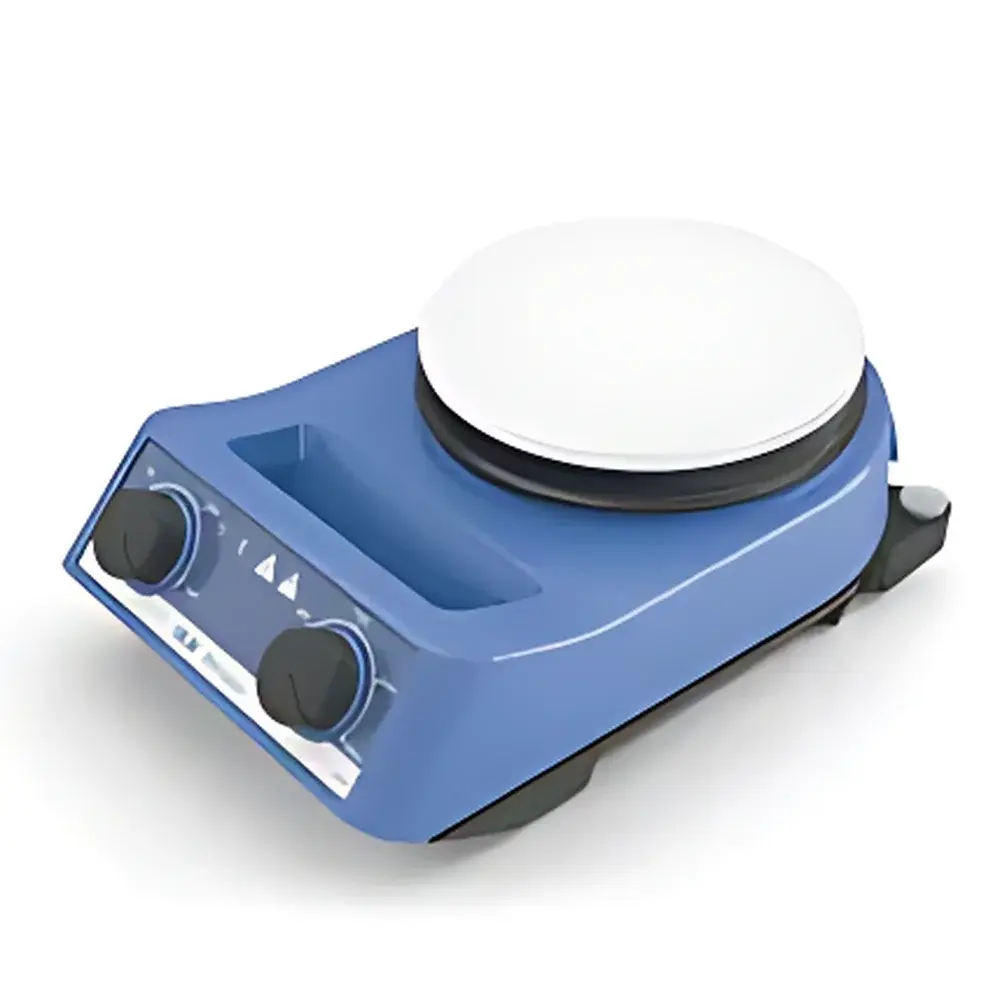
IKA RH basic white Heating Magnetic Stirrer
| Brand | IKA |
|---|---|
| Origin | Germany |
| Model | RH basic white |
| Instrument Type | Magnetic Stirrer |
| Maximum Stirring Volume | 15 L |
| Speed Range | 100–2000 rpm |
| Heating Temperature Range | 50–320 °C |
| Heating Power | 600 W |
| Safety Temperature Limit | 50–360 °C |
| Plate Material | White Ceramic |
| Plate Diameter | 135 mm |
| Dimensions (W × D × H) | 160 × 100 × 250 mm |
| Weight | 2.8 kg |
| Protection Class | IP21 |
| Operating Ambient | 5–40 °C, ≤80% RH |
| Input Voltage | 230 / 115 / 100 V, 50/60 Hz |
| Total Power Consumption | 620 W |
| External Temperature Sensor Interface | ETS-D5 compatible |
| Temperature Control Accuracy (with sensor) | ±1 K |
| Heating Rate (1 L water) | 6 K/min |
| Max Stir Bar Length | 80 mm |
| Motor Output Power | 2 W |
| Motor Input Power | 20 W |
Overview
The IKA RH basic white is a DIN 12878-compliant heating magnetic stirrer engineered for precision, reliability, and operational simplicity in routine laboratory workflows. Designed around Couette flow principles, it employs a rotating magnetic field to drive PTFE- or glass-coated stir bars within vessels, enabling homogeneous mixing of low- to medium-viscosity liquids. Integrated resistive heating via a white ceramic plate delivers rapid thermal response and uniform surface temperature distribution—critical for applications requiring controlled thermal activation alongside agitation. Its fixed single-position configuration supports standard round-bottom flasks, beakers, and reaction vessels up to 15 L capacity (water-equivalent), making it suitable for synthesis, dissolution testing, buffer preparation, and sample conditioning in QC, teaching, and R&D labs.
Key Features
- White ceramic heating plate with high emissivity and chemical resistance—enables fast, even heat transfer and easy cleaning after exposure to solvents or reagents.
- DIN 12878-standard heating mantle interface allows direct connection of external contact thermometers (e.g., IKA ETS-D5) for closed-loop temperature regulation with ±1 K accuracy when used with immersed Pt100 or NTC sensors.
- Adjustable safety temperature limit (50–360 °C) provides hardware-level overtemperature protection independent of sensor feedback—essential for unattended operation and GLP-compliant environments.
- Mechanically robust DC motor delivering consistent torque across the full speed range (100–2000 rpm), optimized for stable rotation of stir bars up to 80 mm in length—even under load variations caused by viscosity shifts or vessel geometry changes.
- Compact footprint (160 × 100 × 250 mm) and lightweight design (2.8 kg) facilitate integration into fume hoods, laminar flow cabinets, or shared benchtop spaces without compromising stability during extended operation.
- IP21-rated enclosure ensures protection against vertically falling drips and solid objects >12.5 mm—meeting minimum environmental robustness requirements for general laboratory use per EN 60529.
Sample Compatibility & Compliance
The RH basic white accommodates standard laboratory glassware including borosilicate beakers (up to 15 L), Erlenmeyer flasks, and jacketed reactors. Its open-heating architecture supports both air- and liquid-phase heating protocols. The device complies with IEC 61010-1 for electrical safety in laboratory equipment and conforms to DIN 12878 for standardized thermal interface dimensions—ensuring interchangeability with certified external temperature probes. While not equipped with digital audit trail or electronic signature capabilities, its analog control architecture meets baseline requirements for non-GxP educational and industrial prep labs where traceability is managed externally. No RS232, USB, or analog output interfaces are included; temperature and speed settings are manually adjusted via calibrated dials.
Software & Data Management
This is a stand-alone, analog-operated instrument with no embedded microprocessor, firmware, or connectivity options. All parameters—including speed (100–2000 rpm) and heating setpoint (50–320 °C)—are adjusted manually using dual concentric dials with tactile feedback and engraved scales. Temperature monitoring relies exclusively on optional external probes connected via the DIN 12878 port; no onboard data logging, real-time graphing, or export functionality is provided. Consequently, it does not support FDA 21 CFR Part 11 compliance or electronic record retention. Users intending to meet GLP/GMP documentation standards must implement manual logbooks or integrate the unit into validated external data acquisition systems.
Applications
- Preparation of calibration standards and reference solutions under controlled thermal conditions.
- Accelerated dissolution testing of pharmaceutical excipients and active ingredients in aqueous or organic media.
- Heating and homogenization of culture media prior to sterilization or inoculation in microbiology workflows.
- Synthesis support for Grignard reactions, esterifications, and other thermally sensitive organic transformations requiring inert-atmosphere compatibility.
- Environmental lab procedures including BOD bottle mixing, soil suspension preparation, and leachate equilibration at defined temperatures.
- Teaching laboratories where intuitive operation, mechanical durability, and cost-effective performance are prioritized over automation.
FAQ
Does the RH basic white support programmable ramping or timer-based operation?
No. It features only manual, continuous adjustment of speed and temperature—without time-based control, preset profiles, or automatic shut-off functions.
Can it be used with corrosive solvents such as concentrated acids or halogenated hydrocarbons?
Yes—the white ceramic plate exhibits excellent resistance to most common laboratory chemicals; however, prolonged exposure to molten alkalis or hydrofluoric acid is not recommended.
Is the heating plate compatible with PT100 sensors from third-party manufacturers?
Only if they conform mechanically and electrically to the DIN 12878 standard; IKA recommends using certified accessories like the ETS-D5 to ensure optimal accuracy and signal integrity.
What is the maximum viscosity this stirrer can handle effectively?
While rated for water-equivalent volumes up to 15 L, effective agitation depends on stir bar geometry and fluid rheology; for viscosities exceeding 5,000 mPa·s, consider models with higher torque output or overhead stirring configurations.
Does the unit include overload or stall detection?
No. It lacks electronic motor protection circuits; users should visually verify stir bar rotation and adjust speed downward if audible motor strain or inconsistent motion occurs.



