
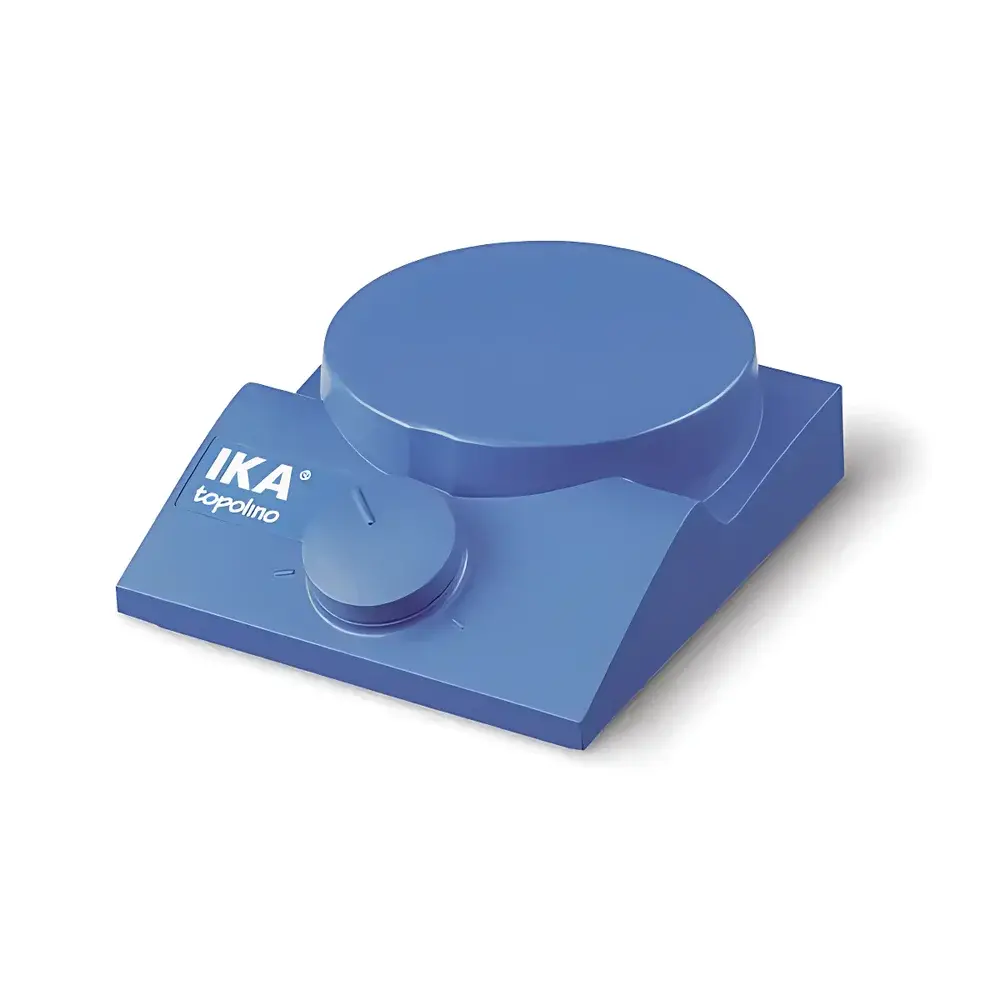
IKA topolino Portable Magnetic Stirrer
| Brand | IKA |
|---|---|
| Origin | Germany |
| Model | topolino |
| Instrument Type | Magnetic Stirrer |
| Max. Stirring Volume (H₂O) | 0.25 L |
| Speed Range | 500–1800 rpm |
| Stirrer Position Count | 1 |
| Max. Load Capacity | 0.5 kg |
| Motor Output Power | 0.8 W |
| Speed Control | Continuously Variable |
| Max. Stir Bar Length | 30 mm |
| Plate Material | Polypropylene (PP) |
| Plate Diameter | Ø 80 mm |
| Dimensions (W × H × D) | 95 × 37 × 115 mm |
| Weight | 0.484 kg |
| Ambient Temperature Range | 5–40 °C |
| Relative Humidity Limit | 80 % RH |
| Ingress Protection | IP21 (per DIN EN 60529) |
| Voltage | 100–240 V AC |
| Frequency | 50/60 Hz |
| Input Power | 10 W |
Overview
The IKA topolino is a compact, lightweight, and energy-efficient portable magnetic stirrer engineered for precision mixing in space-constrained laboratory environments—including fume hoods, biosafety cabinets, teaching labs, and field-deployable analytical setups. Utilizing a brushless DC motor architecture, the device eliminates carbon brush wear, ensuring long-term operational stability and consistent torque delivery across its full speed range. Its core principle relies on rotating magnetic fields generated beneath a chemically resistant polypropylene (PP) plate to induce controlled rotation of ferromagnetic stir bars immersed in samples. Designed for low-heat, low-vibration operation, the topolino maintains thermal and mechanical stability during extended use—critical for temperature-sensitive reactions, buffer preparation, and dissolution testing where sample integrity must be preserved without external heating.
Key Features
- Brushless DC motor delivering maintenance-free performance and high reproducibility over thousands of operating hours
- Continuously variable speed control (500–1800 rpm) with intuitive rotary dial interface for precise rotational adjustment
- Optimized magnetic circuit design providing strong coupling force—prevents stir bar “jumping” or decoupling even at higher speeds or with viscous media
- Compact footprint (Ø 80 mm plate, overall dimensions 95 × 37 × 115 mm) and ultra-low mass (0.484 kg) enabling true portability and benchtop flexibility
- Polypropylene (PP) work surface offering excellent resistance to acids, bases, and organic solvents—suitable for routine chemical handling without risk of plate degradation
- Universal power input (100–240 V, 50/60 Hz) with integrated safety isolation and IP21-rated enclosure for protection against vertically falling solid objects and limited ingress of moisture
Sample Compatibility & Compliance
The topolino supports standard laboratory glassware including beakers, Erlenmeyer flasks, and vials up to 250 mL volume, accommodating stir bars up to 30 mm in length. Its non-heating design makes it compatible with thermally labile solutions, enzymatic assays, and pH-sensitive preparations where uncontrolled exothermic effects must be avoided. The device complies with DIN EN 60529 (IP21), IEC 61010-1 (Safety Requirements for Electrical Equipment for Measurement, Control, and Laboratory Use), and meets CE marking requirements for electromagnetic compatibility (EMC Directive 2014/30/EU) and low-voltage safety (LVD Directive 2014/35/EU). While not certified for GMP or GLP-regulated production environments, its stable speed output and mechanical robustness support documentation-ready workflows in QC laboratories adhering to internal SOPs.
Software & Data Management
The IKA topolino operates as a standalone analog instrument without digital connectivity, firmware, or software integration. All operational parameters are manually set and monitored via physical controls—eliminating dependency on drivers, updates, or network infrastructure. This architecture ensures deterministic behavior, zero cybersecurity exposure, and full traceability through operator-recorded settings (e.g., speed value, duration, vessel type). For laboratories requiring audit trails under FDA 21 CFR Part 11 or ISO/IEC 17025, manual logbook entries—including date, time, user ID, and observed performance—constitute the primary record of usage. No data export, remote control, or calibration certificate is provided; periodic verification of speed accuracy using an external tachometer is recommended per laboratory quality protocols.
Applications
- Preparation of standard solutions, buffers, and reagent dilutions in analytical chemistry and clinical diagnostics
- Mixing of cell culture media and low-viscosity biological suspensions in microbiology and molecular biology labs
- Homogenization of coating formulations, nanoparticle dispersions, and polymer solutions in materials science research
- Supporting dissolution testing in pharmaceutical development where heating interference must be excluded
- Field-based environmental sampling preparation—e.g., extraction of aqueous contaminants prior to on-site analysis
- Undergraduate and graduate teaching laboratories requiring reliable, safe, and intuitive stirring tools for introductory experiments
FAQ
Does the topolino include a heating function?
No. The topolino is a non-heated magnetic stirrer. It provides only rotational mixing and must be used in conjunction with external heating sources (e.g., hot plates or water baths) if temperature control is required.
Can it be used with stainless steel stir bars?
Yes—provided the stir bar is magnetically responsive (e.g., PTFE-coated or glass-coated magnets). Stainless steel stir bars are generally non-magnetic and incompatible; only ferromagnetic or rare-earth magnet-based stir bars should be used.
What is the maximum viscosity this stirrer can handle?
While rated for aqueous solutions up to 0.25 L, effective mixing depends on stir bar geometry and medium rheology. For viscosities above ~500 mPa·s, performance may diminish; users should verify homogeneity visually or via conductivity/pH monitoring.
Is calibration required or supported?
The topolino does not feature built-in calibration capability. Speed accuracy should be verified externally using a handheld optical or contact tachometer at regular intervals per laboratory quality policy.
Is the PP plate resistant to acetone or chloroform?
Polypropylene exhibits limited resistance to chlorinated solvents (e.g., chloroform) and ketones (e.g., acetone); prolonged exposure may cause swelling or stress cracking. For such solvents, use only briefly and wipe clean immediately after use.



