
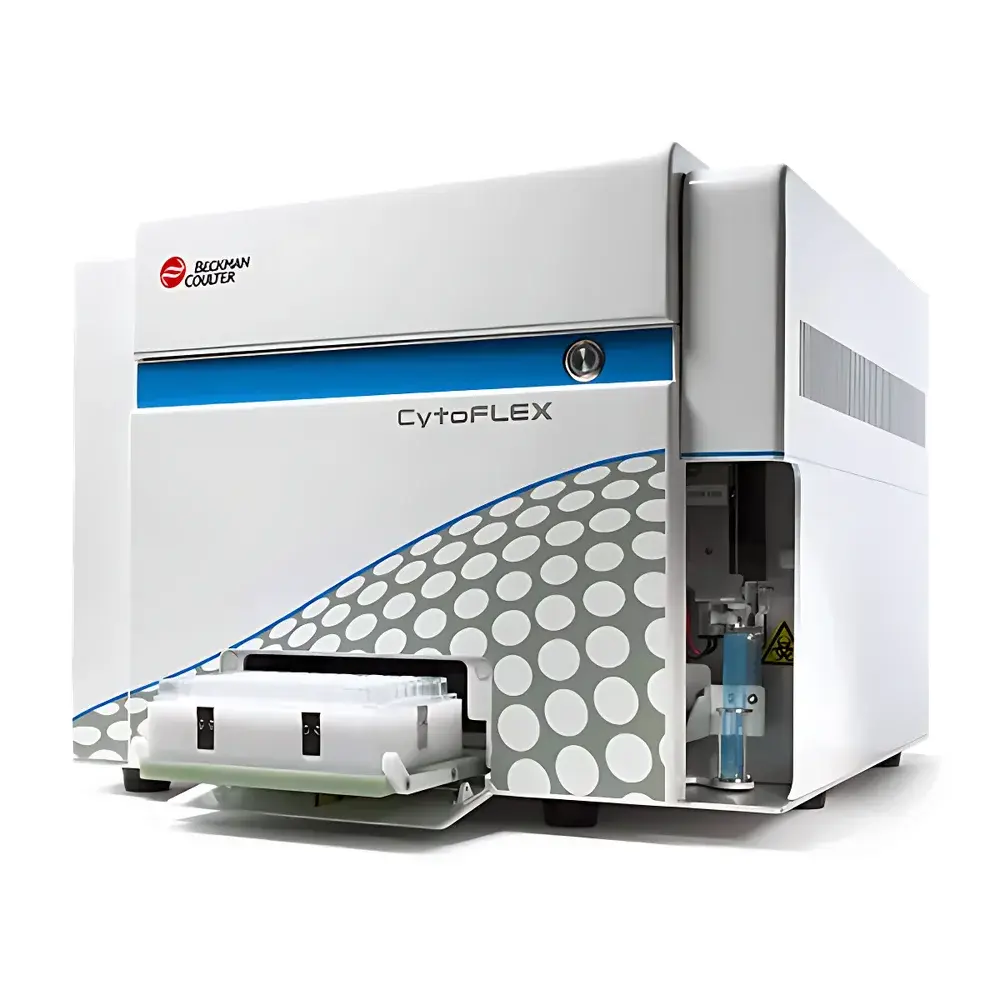
CytoFLEX Research-Grade Flow Cytometer by Beckman Coulter
| Brand | Beckman Coulter |
|---|---|
| Origin | Jiangsu, China (Manufactured under Beckman Coulter’s global quality system) |
| Type | Analytical Flow Cytometer |
| Laser Configuration | 1–3 lasers (violet 405 nm, blue 488 nm, red 638 nm) |
| Detection Channels | Up to 13 parameters (including FSC, SSC, and fluorescence) |
| Optical Resolution | rCV < 3% across all channels |
| side scatter resolution | < 300 nm (488 nm laser), < 80 nm (405 nm laser) vs. polystyrene beads |
| Flow Rate | Fixed settings at 10, 30, and 60 µL/min |
| user-defined range | 10–240 µL/min |
| Fluorescence Sensitivity | ≤30 MESF (FITC), ≤10 MESF (PE) at 15-parameter configuration |
| Throughput | Up to 30,000 events per second (EPS) |
| Automation | Integrated autosampler with plate loader (96-/384-well compatible) |
| Compensation | Real-time automated compensation (spillover matrix-based) |
| Sorting Capability | Optional integrated cell sorting module (12-way sorting) |
| Voltage Control | User-adjustable PMT voltage per detector |
| Compliance | Designed for GLP/GMP-aligned workflows |
Overview
The CytoFLEX Research-Grade Flow Cytometer by Beckman Coulter is an advanced analytical flow cytometry platform engineered for high-parameter, high-reproducibility cellular phenotyping and functional analysis in academic, translational, and core facility laboratories. Based on hydrodynamic focusing and laser-induced light scattering/fluorescence detection principles, the system employs a compact, air-cooled solid-state laser architecture (405 nm violet, 488 nm blue, and 638 nm red) to enable simultaneous interrogation of up to 13 optical parameters—including forward scatter (FSC), side scatter (SSC), and multicolor fluorescence emission—per single-cell event. Its optical path is optimized for low background noise and high signal-to-noise ratio, delivering sub-100 nm side scatter resolution (at 405 nm excitation) and consistent coefficient of variation (rCV < 3%) across all detection channels—critical for detecting subtle shifts in marker expression or rare subpopulations. The instrument operates at precisely controlled laminar flow rates (10–240 µL/min), ensuring stable event acquisition kinetics and minimizing shear-induced cell damage during extended runs.
Key Features
- Modular laser configuration supporting 1–3 lasers (405/488/638 nm) with factory-aligned optics and thermally stabilized diodes for long-term signal stability.
- High-sensitivity photomultiplier tube (PMT) detectors with user-adjustable voltage per channel, enabling dynamic range optimization across diverse fluorophore brightness levels.
- Integrated autosampler with programmable 96- and 384-well plate handling, temperature-controlled sample chamber (4–40 °C), and customizable aspiration protocols for unattended overnight acquisition.
- Real-time automated compensation using spillover matrix algorithms, eliminating manual gate-based compensation and reducing inter-user variability in multicolor panel setup.
- Fluidic architecture featuring pressure-regulated sheath delivery and microfluidic nozzle design (no traditional quartz cuvette or jet-in-air system), minimizing carryover (<0.1%) and enabling rapid wash cycles between samples.
- Optional integrated cell sorting module offering 12-way electrostatic sorting at up to 20,000 sorted events per second with purity >98% and recovery >85% for validated populations.
Sample Compatibility & Compliance
The CytoFLEX accommodates suspension cells (mammalian, primary, PBMCs, yeast), fixed or live stained samples, and microparticles (e.g., exosomes, synthetic beads). It supports standard cytometry reagents including tandem dyes (e.g., PE-Cy7, APC-H7), polymer dyes (e.g., Brilliant Violet™), and DNA/RNA intercalators. All hardware and firmware comply with IEC 61010-1 (safety) and IEC 61326-1 (EMC) standards. When operated with CytExpert Software v2.10 or later, the system supports audit trail generation, electronic signatures, and role-based access control—fully aligned with FDA 21 CFR Part 11 requirements for regulated environments. Routine performance verification follows ISO 13245 and ISAC Standardization Guidelines for flow cytometry instrument qualification.
Software & Data Management
CytExpert Software provides a unified interface for instrument control, experimental design, real-time visualization, and offline analysis. It includes template-driven acquisition protocols, batch processing for multiplate studies, and built-in tools for dimensionality reduction (t-SNE, UMAP), clustering (FlowSOM), and population annotation. Raw FCS 3.1 files are natively generated and exportable to third-party platforms (e.g., FlowJo, R/Bioconductor). Data integrity is ensured through checksum validation, automatic backup to network drives, and optional integration with LIMS via HL7/FHIR APIs. For GLP/GMP labs, software validation packages—including IQ/OQ/PQ documentation and change control logs—are available upon request.
Applications
The CytoFLEX is routinely deployed in immunophenotyping (e.g., T-cell subset profiling, checkpoint marker co-expression), stem cell characterization, apoptosis/necrosis assays, intracellular cytokine staining, phospho-flow signaling analysis, and extracellular vesicle enumeration. Its high-resolution SSC capability enables discrimination of small particles (e.g., platelet-derived microvesicles, virus-like particles) without centrifugation enrichment. In cancer research, it supports minimal residual disease (MRD) detection at 0.01% sensitivity thresholds when combined with optimized antibody panels and gating strategies. Core facilities leverage its plate-based automation for high-throughput screening of CRISPR-modified lines or drug-response libraries.
FAQ
Does the CytoFLEX require daily alignment or optical recalibration?
No. The solid-state laser modules and fixed optical path eliminate routine alignment; only annual preventive maintenance per Beckman Coulter service protocol is recommended.
Can I upgrade from a 3-laser to a 4-laser configuration post-purchase?
No. Laser configurations are hardware-defined at time of manufacture; expansion beyond three lasers requires replacement of the optical bench assembly.
Is the sorting module compatible with sterile sorting into 96-well plates?
Yes—when equipped with the optional sterile sorting kit, including HEPA-filtered enclosure, UV decontamination cycle, and aerosol containment features.
What file formats does CytExpert support for data export?
FCS 3.0/3.1, CSV, PDF reports, and native .cye project files; TIFF/PNG for figures, with metadata preservation.
How is voltage optimization performed for new fluorophores?
Via the built-in “Voltage Optimization Wizard,” which uses single-stained controls and iterative PMT gain adjustment to maximize separation index (SI) while avoiding saturation.



