
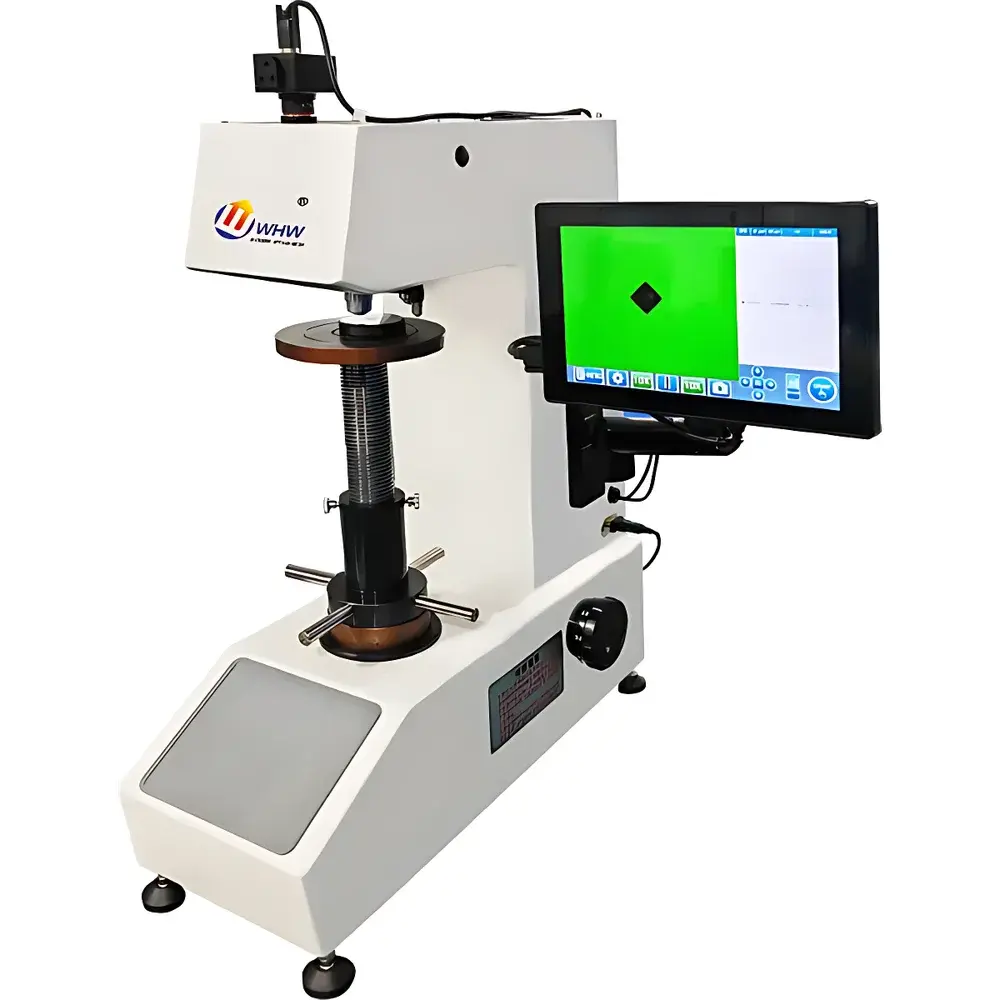
YANRUN MVS-30T Vision-Based Vickers Hardness Tester
| Brand | YANRUN |
|---|---|
| Origin | Shanghai, China |
| Manufacturer Type | Direct Manufacturer |
| Country of Origin | China |
| Model | MVS-30T |
| Price Range | USD 2,800–5,600 (FOB) |
| Instrument Type | Vickers Hardness Tester |
| Hardness Measurement Range | 8–3000 HV |
| Maximum Test Force | 30 kgf |
| Maximum Specimen Height | 240 mm |
| Maximum Specimen Depth (Throat Depth) | 130 mm |
| Objective Magnification for Measurement | 100× |
| Total Optical Magnification (Measurement/Viewing) | 100× |
| Measurement Resolution | ≈0.14 µm (with 10× objective) |
| Dwell Time Range | 0–99 s (1 s increment) |
| Illumination Control | 20-step adjustable brightness (step = 1) |
| Machine Frame | Cast aluminum housing (8–10 mm wall thickness) |
| Dimensions (W×D×H) | 570 × 220 × 680 mm |
| Net Weight | ≈60 kg |
| Power Supply | AC 220 V / 50 Hz |
| Standards Compliance | GB/T 4340.2, ISO 6507-2, ASTM E384 |
| Turret Mechanism | Motor-assisted manual turret with ≤2 µm positioning repeatability |
| Load Application Speed | ≈0.05 mm/s (fully automated loading–dwell–unloading cycle) |
| Force Selection | External rotary knob with auto-recognition |
| Load Options | 1.0, 3.0, 5.0, 10, 20, 30 kgf |
| Screw Drive | Trapezoidal lead screw for Z-axis elevation |
| Display | 10.1-inch Android-based touchscreen interface |
| Measurement Method | Digital image-based diagonal length detection with real-time Vickers hardness calculation |
| Hardness Scale Conversion | Automatic cross-reference between GB, ISO, and ASTM equivalents |
Overview
The YANRUN MVS-30T Vision-Based Vickers Hardness Tester is a precision-engineered materials characterization instrument designed for quantitative micro- and macro-hardness evaluation using the standardized Vickers indentation method. It operates on the principle of applying a precisely controlled diamond pyramid indenter (136° included angle) under defined test forces onto a polished specimen surface, followed by optical measurement of the resulting diagonal impressions. Unlike conventional analog or semi-automatic systems, the MVS-30T integrates a high-resolution digital imaging subsystem with an embedded Android platform to automate indentation measurement, hardness computation, scale conversion, and data logging—eliminating operator-dependent parallax errors and subjective interpretation. Its dual-mode capability supports both routine quality control in heat-treated steel components and high-resolution depth profiling of case-hardened layers, thin films, and brittle ceramics. The system meets the metrological requirements of ISO 6507-2 (2018), GB/T 4340.2 (2012), and ASTM E384-22 for verification and calibration of hardness testing machines, ensuring traceability and inter-laboratory comparability.
Key Features
- Fully integrated 10.1-inch Android touchscreen interface enabling intuitive navigation, real-time video feed, and on-device data review without external PCs
- Digital vision metrology engine with sub-micron resolution (≈0.14 µm at 10× objective), supporting automatic diagonal detection and iterative edge refinement
- Motor-assisted manual turret with ≤2 µm positional repeatability for seamless, vibration-damped switching between 100× measurement objective and Vickers indenter
- Precise force delivery system utilizing trapezoidal lead screw elevation and closed-loop load sensing; achieves stable dwell time control from 0–99 s in 1-second increments
- Comprehensive hardness scale conversion compliant with GB, ISO, and ASTM standards—including HV to HRC, HBW, and HK equivalents—with configurable rounding rules
- Robust cast aluminum frame (8–10 mm wall thickness) optimized for mechanical stability and thermal inertia, minimizing drift during extended testing sessions
- Adjustable LED illumination (20-step intensity control) with uniform Köhler illumination geometry for consistent contrast across heterogeneous microstructures
Sample Compatibility & Compliance
The MVS-30T accommodates specimens up to 240 mm in height and 130 mm in throat depth, making it suitable for large forged parts, turbine blades, and extruded profiles. Its 30 kgf maximum test force enables reliable macro-Vickers testing of coarse-grained alloys and composite laminates, while low-force settings (1.0–5.0 kgf) support microhardness mapping of diffusion zones, weld heat-affected zones (HAZ), and semiconductor substrates. All operational parameters—including force selection, dwell duration, and magnification—are logged with timestamps and user IDs to support GLP/GMP audit trails. The instrument complies with ISO/IEC 17025 documentation requirements for hardness testing laboratories and includes built-in verification routines aligned with ISO 6507-2 Annex B for indirect verification using certified reference blocks.
Software & Data Management
The embedded Android OS runs proprietary hardness analysis firmware supporting CSV export, PDF report generation (with customizable templates), and USB mass storage integration. Raw image files (TIFF), indentation coordinates, and hardness values are stored with metadata (operator ID, date/time, force, dwell time, objective used). Optional cloud synchronization (via secure HTTPS API) enables centralized data aggregation across multi-site manufacturing facilities. Software architecture adheres to FDA 21 CFR Part 11 principles—enabling electronic signatures, role-based access control, and immutable audit logs for regulated environments such as medical device component validation or aerospace material certification.
Applications
- Depth profiling of carburized, nitrided, or induction-hardened case depths in automotive transmission gears and bearing steels
- Quality assurance of sintered tungsten carbide inserts and ceramic cutting tools per ISO 28080
- Research-grade hardness mapping of functionally graded materials (FGMs) and metal matrix composites (MMCs)
- Educational demonstration of hardness–microstructure relationships in metallurgy and materials science curricula
- Non-destructive acceptance testing of additively manufactured (AM) Ti-6Al-4V and Inconel 718 components per AMS7000
- Calibration verification of secondary hardness reference blocks in accredited metrology labs
FAQ
Does the MVS-30T support automatic focus or Z-height compensation?
No—the system relies on manual fine-focus via coaxial coarse/fine adjustment knobs; however, its rigid mechanical design and high-contrast illumination minimize refocusing needs during sequential measurements.
Can the instrument be integrated into a factory MES or LIMS environment?
Yes—through optional RS-232/USB-to-Ethernet gateway modules and RESTful API endpoints, enabling bidirectional data exchange with enterprise systems.
Is calibration certificate traceable to NIM or NIST?
Factory calibration uses NIM-traceable reference blocks; users may request third-party NIST-traceable certification (additional fee applies).
What maintenance intervals are recommended for long-term accuracy?
Annual verification against certified reference blocks is advised; optical alignment check every 6 months; indenter replacement after 5,000 indentations or visible wear under 100× inspection.
Does the software support statistical process control (SPC) charting?
Basic SPC functions (X-bar/R charts, Cp/Cpk calculation) are available in the Pro software module, which requires separate licensing.



