
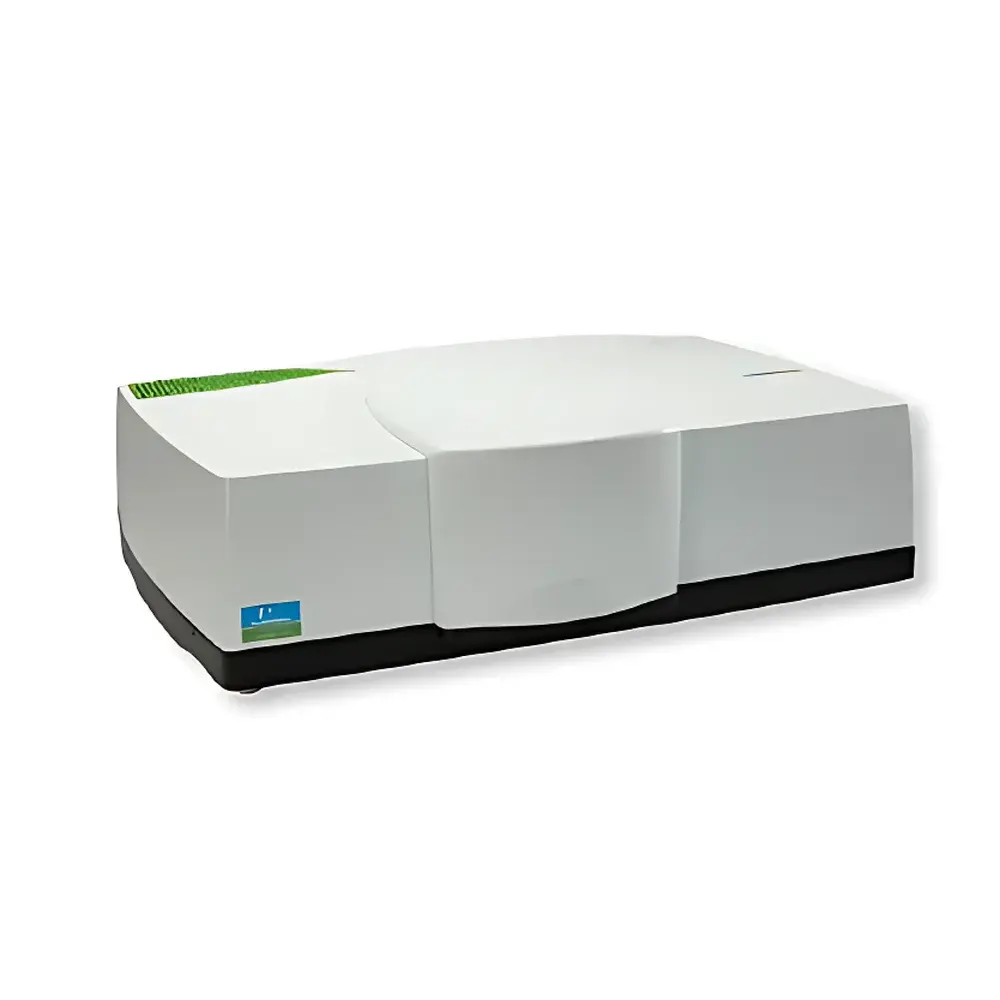
PerkinElmer LAMBDA 1050+ UV-Vis-NIR Spectrophotometer
| Brand | PerkinElmer |
|---|---|
| Origin | United Kingdom |
| Manufacturer Type | Original Equipment Manufacturer (OEM) |
| Product Origin | Imported |
| Model | LAMBDA 1050+ |
| Optical Design | Double-beam |
| Detector Type | Photomultiplier Tube (PMT) for UV-Vis |
| Wavelength Range | 175–3300 nm |
| Wavelength Accuracy | ±0.025 nm (UV-Vis), ±0.02 nm (NIR) |
| Automation | Motorized wavelength scanning and accessory control |
Overview
The PerkinElmer LAMBDA 1050+ UV-Vis-NIR Spectrophotometer is a high-performance, double-beam optical instrument engineered for precision spectral measurement across an exceptionally broad wavelength range—from deep ultraviolet (175 nm) through visible light to extended near-infrared (3300 nm). Its optical architecture integrates a grating-free PMT detector for the UV-Vis region and a thermoelectrically cooled PbS detector for the NIR, enabling high signal-to-noise ratio, low dark current, and exceptional photometric stability across the full spectrum. Designed for metrological-grade applications in research, quality control, and regulatory environments, the LAMBDA 1050+ delivers traceable wavelength accuracy (±0.025 nm in UV-Vis) and robust long-term repeatability—meeting the performance expectations of ISO/IEC 17025-accredited laboratories and supporting compliance with ASTM E275, ASTM E387, ISO 9050, and CIE S 014/E:2006 standards.
Key Features
- Ultra-broad spectral coverage: 175–3300 nm, enabling unified characterization of materials from semiconductor bandgaps to polymer overtone absorptions.
- Double-beam optical design with real-time reference beam correction, minimizing drift and environmental interference during extended scans.
- Dual-detector system: Sealed, low-noise PMT for UV-Vis (175–900 nm) and Peltier-cooled PbS detector for NIR (850–3300 nm), each optimized for quantum efficiency and dynamic range.
- Motorized, software-controlled wavelength drive with sub-pixel encoder feedback ensures <0.025 nm wavelength reproducibility in UV-Vis and <0.02 nm in NIR.
- Modular sampling architecture supporting rapid, tool-free switching between up to two independent sample compartments—each among the largest in its class (≥300 × 200 × 150 mm usable volume).
- Integrated optical calibration routines including dual-slit linearity correction, photometric zero stabilization, and automated wavelength validation using holmium oxide and didymium filters.
Sample Compatibility & Compliance
The LAMBDA 1050+ accommodates diverse sample geometries and optical properties via a suite of rigorously characterized, NIST-traceable accessories. The 150 mm integrating sphere—internally coated with spectrally stable polytetrafluoroethylene (PTFE)—meets ASTM E1331 and CIE Publication 177 requirements for diffuse reflectance and transmittance measurements, with >99% reflectance across 350–1500 nm and negligible aging-induced yellowing. The optional 270 mm sphere extends accurate transmission quantification to highly scattering or low-transmittance materials (e.g., textured solar glass, frosted polymers). The Universal Reflection Accessory (URA) enables automated, angle-resolved absolute reflectance measurements from 0° to 80° without manual reconfiguration—validated per ISO 9050 Annex B for architectural glazing analysis. All accessories support GLP-compliant operation with electronic logging of configuration metadata, alignment status, and calibration history.
Software & Data Management
Controlled by PerkinElmer’s UV WinLab™ 6.4 software platform, the LAMBDA 1050+ supports audit-trail-enabled workflows compliant with FDA 21 CFR Part 11 and EU Annex 11. Software features include: method-driven acquisition with embedded SOP templates; multi-step sequence scripting for complex protocols (e.g., angle-resolved reflectance + transmittance + haze); real-time spectral overlay and derivative analysis; export of ASTM E1331-compliant data files (.spc, .csv, .jdx); and integrated uncertainty propagation for photometric and wavelength parameters. Data integrity is enforced via user-role permissions, electronic signatures, and immutable audit logs recording every instrument parameter change, calibration event, and result export.
Applications
- Architectural & Automotive Glazing: Quantitative determination of solar heat gain coefficient (SHGC), luminous transmittance (LT), and UV rejection per ISO 9050 and EN 410—enabling thermal modeling and energy code compliance verification.
- Flat Panel Display Development: Spectral radiance, color coordinates (CIE 1931 xy, u’v’), viewing angle dependence, and micro-LED emission profiling across 380–780 nm and beyond.
- Photovoltaic Materials Characterization: External quantum efficiency (EQE) mapping of silicon, perovskite, and tandem cells; anti-reflective coating optimization via 6° specular reflectance; and backsheet reflectivity analysis up to 1600 nm.
- Advanced Optical Coatings: High-precision measurement of narrowband filter passbands, edge steepness, and out-of-band rejection—critical for laser optics, hyperspectral sensors, and biomedical imaging systems.
- Large-Area Material Testing: Direct measurement of tempered, laminated, or curved glass panels up to 3 m × 2 m using the dedicated Large Glass Accessory—eliminating cutting or sectioning artifacts.
FAQ
What regulatory standards does the LAMBDA 1050+ support for GLP/GMP environments?
It supports full 21 CFR Part 11 compliance via UV WinLab™ 6.4, including electronic signatures, audit trails, and secure user authentication.
Can the instrument perform simultaneous transmission and reflection measurements without realignment?
Yes—the 150 mm integrating sphere with built-in light trap allows sequential T% and R% acquisition under identical optical conditions using a single sample placement.
Is wavelength calibration traceable to national standards?
Yes—factory calibration uses NIST-traceable holmium oxide (360–640 nm) and didymium (730–900 nm) reference filters, with optional on-site validation using mercury and deuterium lamp lines.
How does the URA improve measurement throughput for multi-angle reflectance studies?
The URA automates angular positioning from 0° to 80° in ≤2 seconds per angle, eliminating manual goniometer adjustments and reducing operator-induced misalignment errors.
What is the maximum sample thickness accommodated in the dual large-volume sample compartments?
Each compartment accepts samples up to 150 mm in height with unobstructed beam path clearance, compatible with custom holders for irregular or oversized specimens.



