
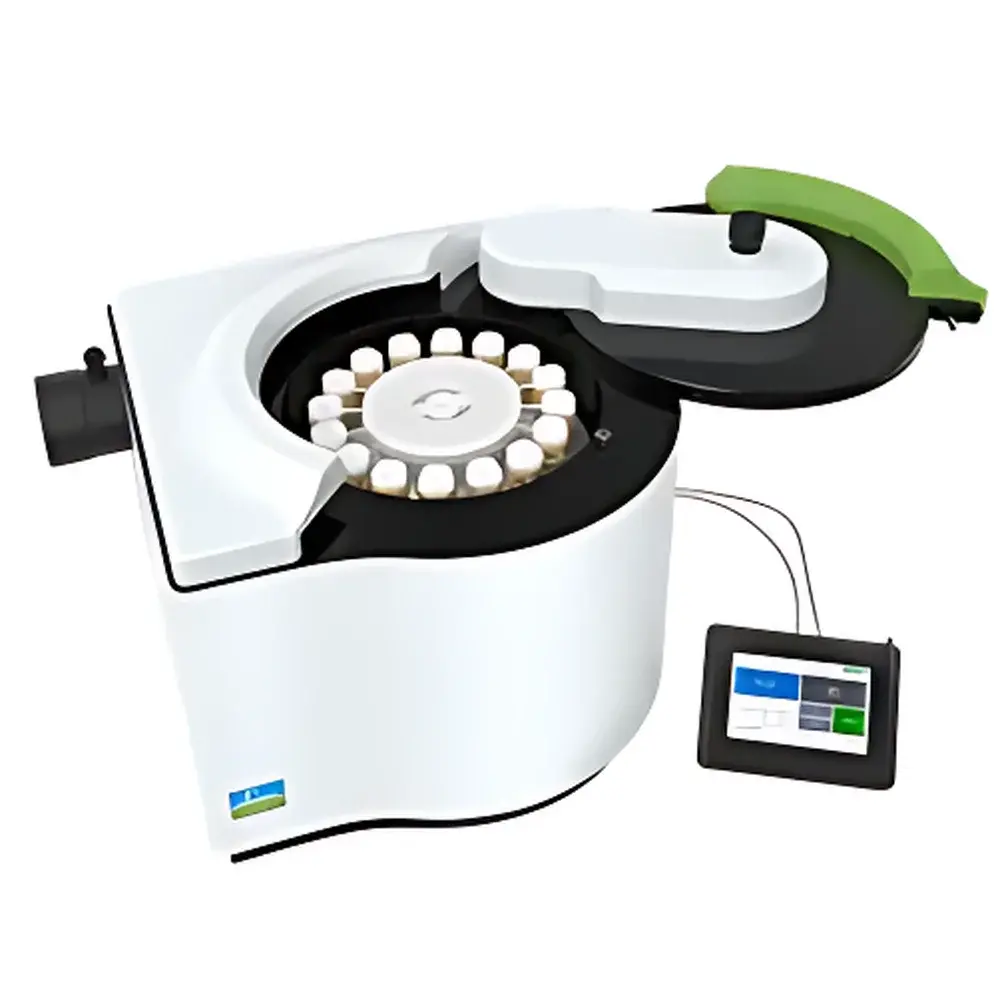
PerkinElmer MPS 320™ Microwave Digestion System
| Brand | PerkinElmer |
|---|---|
| Origin | USA |
| Manufacturer Type | Original Equipment Manufacturer (OEM) |
| Product Origin | Imported |
| Model | MPS 320™ |
| Pricing | Available Upon Request |
Overview
The PerkinElmer MPS 320™ Microwave Digestion System is an engineered platform for high-efficiency, reproducible sample preparation in trace elemental analysis workflows. It operates on the principle of controlled microwave-assisted acid digestion—utilizing monomode or multimode cavity design (depending on configuration) to deliver precise, uniform energy coupling into sealed or vented reaction vessels. Unlike conventional hotplate or open-vessel digestion methods, the MPS 320™ enables rapid, complete mineralization of complex organic and inorganic matrices—including biological tissues, soils, polymers, pharmaceutical excipients, and industrial sludges—under elevated temperature and pressure conditions. Its core architecture integrates patented Dynamic Temperature Control (DTC) and Dynamic Pressure Control (DPC) technologies, which continuously monitor and adjust microwave power output in real time based on non-contact infrared temperature sensing and piezoresistive pressure transduction across all vessels simultaneously. This closed-loop regulation ensures consistent thermal profiles and prevents thermal runaway, directly supporting method robustness required for regulatory compliance in environmental, food safety, and pharmaceutical applications.
Key Features
- Non-contact real-time monitoring of temperature and pressure for every vessel—eliminating sensor drift and cross-contamination risks associated with immersed probes.
- Top-rotating, electronically actuated lid with integrated safety interlock—enabling rapid, ergonomic loading/unloading while maintaining Class I microwave shielding integrity per IEC 61000-4-3 and FDA 21 CFR Part 1040.10 standards.
- Circular multimode cavity with optimized mode stirrer and forced-air ventilation—ensuring uniform field distribution and preventing hot-spot formation; validated via ASTM E2953-14 for microwave field homogeneity.
- Modular rotor system supporting 8-, 16-, and 32-position configurations—compatible with both high-pressure sealed vessels (up to 150 bar / 2200 psi) and self-venting PTFE-TFM® vessels for low-risk, routine digestions.
- Vessel lifetime rated for ≥10,000 digestion cycles—reducing long-term consumables cost and minimizing downtime associated with frequent replacement.
- Integrated fume management: continuous cavity ventilation with acid-resistant HEPA-filtered exhaust and optional scrubber interface—meets OSHA 29 CFR 1910.1200 (Hazard Communication Standard) requirements for operator exposure control.
Sample Compatibility & Compliance
The MPS 320™ accommodates a broad range of solid and semi-solid samples, including but not limited to plant tissue, animal feed, wastewater sludge, catalyst residues, metal alloys, and polymer composites. It supports EPA Methods 3050B, 3051A, 3052, and ASTM D5511 for landfill leachate analysis, as well as ISO 11885 (water quality—determination of selected elements by ICP-AES/MS) and USP heavy metals testing protocols. All digestion methods developed on this platform are fully traceable and audit-ready, with electronic records compliant with 21 CFR Part 11 when used with PerkinElmer’s Syngistix™ software suite. The system undergoes annual factory calibration verification against NIST-traceable reference standards, and its pressure/temperature sensors are certified to EN 61326-1 for electromagnetic compatibility in laboratory environments.
Software & Data Management
Controlled via Syngistix™ for Microwave Digestion software, the MPS 320™ provides full method development, execution logging, and electronic signature capability. Each run generates a tamper-evident digital record—including timestamped temperature/pressure curves, power modulation history, rotor identification, and user authentication logs. Data export is compatible with LIMS platforms via CSV, XML, and ASTM E1384-compliant formats. Audit trail functionality satisfies GLP and GMP documentation requirements, and role-based access control aligns with ISO/IEC 17025:2017 clause 7.5.2 for data integrity assurance.
Applications
- Environmental laboratories: Rapid digestion of soil, sediment, and fly ash prior to ICP-MS quantification of As, Cd, Pb, Hg, and U isotopes.
- Food safety testing: Complete decomposition of fortified cereals, infant formula, and seafood matrices for multi-element analysis under EU Commission Regulation (EU) No 2023/2074.
- Pharmaceutical QC: Residual catalyst (e.g., Pd, Pt, Rh) determination in active pharmaceutical ingredients (APIs) per ICH Q2(R2) validation guidelines.
- Metallurgical R&D: Acid dissolution of Ni-based superalloys and rare-earth magnets for trace impurity profiling.
- Clinical research: Digestion of blood, hair, and biopsy specimens for biomonitoring studies requiring sub-ppt detection limits.
FAQ
What safety certifications does the MPS 320™ hold?
It complies with IEC 61010-1 (Safety Requirements for Electrical Equipment), IEC 61000-4-3 (EMC immunity), and UL 61010-1, with full CE marking for use in EU laboratories.
Can the system be integrated with ICP-OES or ICP-MS autosamplers?
Yes—via standardized 12V TTL trigger outputs and RS-232/USB communication ports, enabling synchronized start/stop and status reporting between digestion and analytical instruments.
Is method transfer from older PerkinElmer digestion systems supported?
Syngistix™ includes backward-compatible method import tools for legacy programs from Titan and Anton Paar Multiwave systems, with automatic parameter mapping and validation prompts.
How is calibration traceability maintained over time?
Each instrument ships with a Certificate of Calibration referencing NIST SRM 1921b (temperature) and NIST SRM 2821 (pressure), with optional annual recalibration services available through PerkinElmer Field Service Engineers.
Does the system support unattended overnight operation?
Yes—programmable cooldown delay, automatic power-down after completion, and continuous cavity monitoring allow secure 24/7 batch processing without manual supervision.
Related Products



