
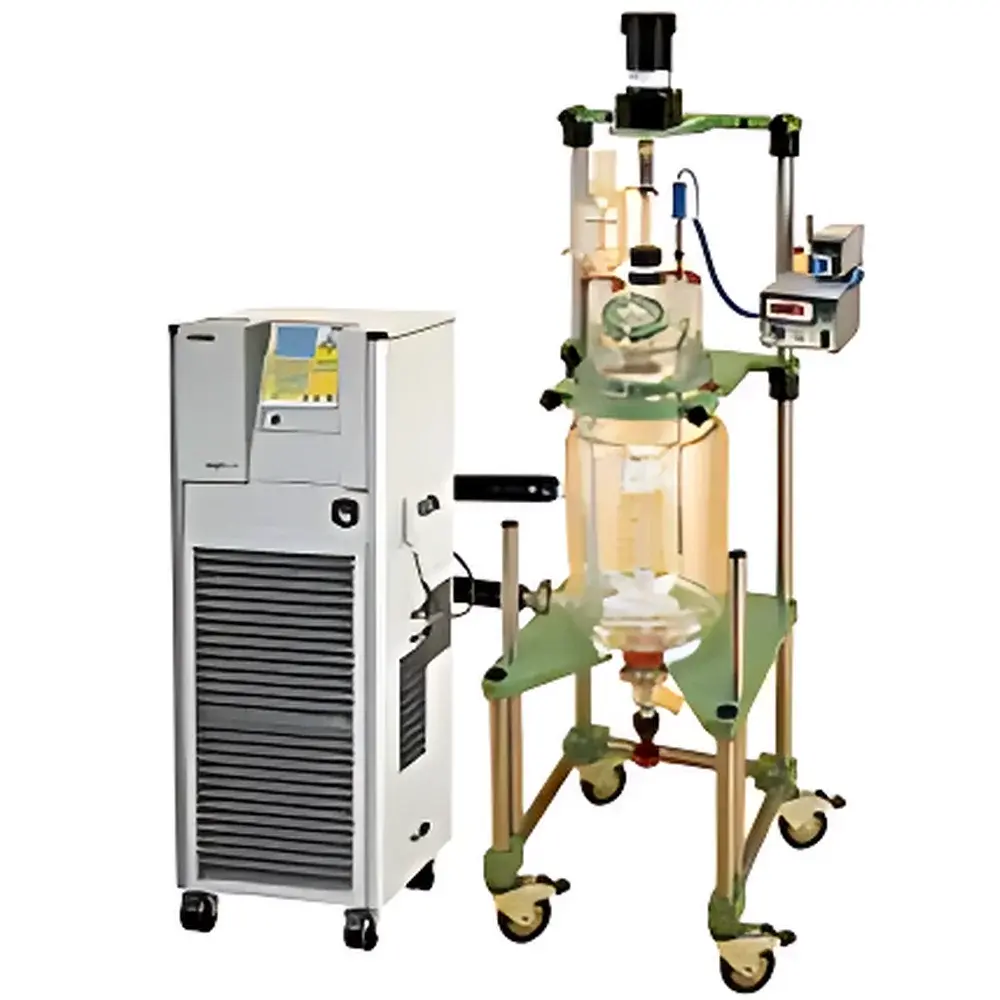
LAUDA XT 150 Air-Cooled Circulating Thermostat
| Origin | Germany |
|---|---|
| Manufacturer Type | Authorized Distributor |
| Origin Category | Imported |
| Model | XT 150 |
| Pricing | Upon Request |
Overview
The LAUDA XT 150 Air-Cooled Circulating Thermostat is an industrial-grade temperature control system engineered for precise, stable, and reliable external temperature regulation in pilot-scale and process-oriented laboratory environments. Based on forced-convection air cooling and high-efficiency electric heating, the XT 150 employs a closed-loop circulation principle to maintain setpoint accuracy across demanding thermal loads. Its core architecture integrates a large-volume expansion chamber (5.5 L), enabling seamless compensation for thermal expansion/contraction of heat transfer fluids—critical when interfacing with large-volume external reactors, jacketed vessels, or analytical instrumentation requiring long fluid lines. Designed and manufactured in Germany, the unit operates within a wide working temperature range of –45 °C to +220 °C, with temperature stability as tight as ±0.05 K at –10 °C—meeting stringent requirements for reaction calorimetry, polymer synthesis, and material testing protocols.
Key Features
- Compact footprint with air-cooled condenser—eliminates need for chilled water supply or glycol loops
- High-precision PID temperature control with adaptive tuning and real-time deviation monitoring
- Robust stainless-steel circulation pump delivering up to 45 L/min at 2.9 bar max pressure
- Integrated expansion chamber (5.5 L) ensures stable flow and pressure under dynamic thermal load conditions
- Heating power of 3.5 kW and refrigeration capacity of 1.5 kW at 20 °C—optimized for rapid ramping and overshoot suppression
- Intelligent safety architecture including dry-run protection, overtemperature cutoff, low-level fluid alarm, and pump stall detection
- Front-panel interface with high-resolution TFT display, intuitive navigation, and configurable setpoint profiles
Sample Compatibility & Compliance
The XT 150 is compatible with standard heat transfer fluids including silicone oils (e.g., DC200 series), polyalkylene glycols (PAGs), and specialized low-temperature baths (e.g., ethanol/water or ethylene glycol/water mixtures). It supports external systems with minimum fluid volume requirements of 2.6 L and accommodates typical laboratory reactor jackets (5–50 L), HPLC column ovens, and spectroscopic sample cells. The device conforms to IEC 61000-6-3 (EMC emission standards), IEC 61000-6-2 (immunity), and EN 61010-1 for electrical safety in laboratory equipment. Its control firmware supports audit-ready operation under GLP and GMP frameworks, with optional time-stamped event logging and password-protected parameter access—facilitating compliance with FDA 21 CFR Part 11 where electronic records are required.
Software & Data Management
While the XT 150 operates autonomously via its embedded controller, it features RS232 and optional Ethernet (Modbus TCP) interfaces for integration into centralized lab management systems. LAUDA’s optional PC software—Thermostat Control Suite—enables remote monitoring, multi-unit synchronization, profile-based temperature programming, and export of time-series data in CSV format. All temperature readings, alarm states, and operational events are timestamped and stored locally (non-volatile memory) for traceability. Data export functions support ISO/IEC 17025-compliant calibration documentation and internal QA/QC reporting workflows.
Applications
- Temperature control of jacketed glass reactors and pilot-scale stirred tanks
- Stabilization of analytical instruments including FTIR spectrometers, XRD stages, and rheometers
- Process validation studies requiring strict thermal ramping and hold profiles (per ASTM E2893 or ISO 11357)
- Material testing under controlled thermal cycling (e.g., TMA, DSC reference baths, or thermal aging chambers)
- Chemical synthesis requiring sub-zero initiation temperatures followed by exothermic control up to 220 °C
- Calibration laboratories performing temperature uniformity mapping per ISO/IEC 17025 clause 5.10.4
FAQ
What is the minimum recommended heat transfer fluid volume for safe operation?
The XT 150 requires a minimum fill volume of 2.6 L in the external circuit; however, optimal stability and response time are achieved when the total system volume—including expansion chamber (5.5 L)—is ≥8 L.
Can the XT 150 be used with flammable heat transfer media?
No. Only non-flammable, thermally stable fluids certified for use in closed-loop circulation systems should be employed. LAUDA recommends silicone oils meeting DIN 51524 Part 2 or PAG-based fluids compliant with ISO 6743-12.
Is remote monitoring and control supported out of the box?
RS232 serial communication is standard; Ethernet connectivity and advanced software integration require optional hardware modules and licensed Thermostat Control Suite.
Does the unit meet requirements for regulated pharmaceutical environments?
Yes—when configured with audit trail logging, user access levels, and electronic signature options, the XT 150 supports 21 CFR Part 11 readiness and can be included in IQ/OQ/PQ validation protocols.
How does the air-cooled design impact ambient operating conditions?
The XT 150 requires ≥50 cm clearance around the rear air intake and top exhaust grilles, and ambient temperatures must remain between +10 °C and +35 °C for rated performance. Operation above 35 °C may reduce maximum achievable cooling capacity.



