
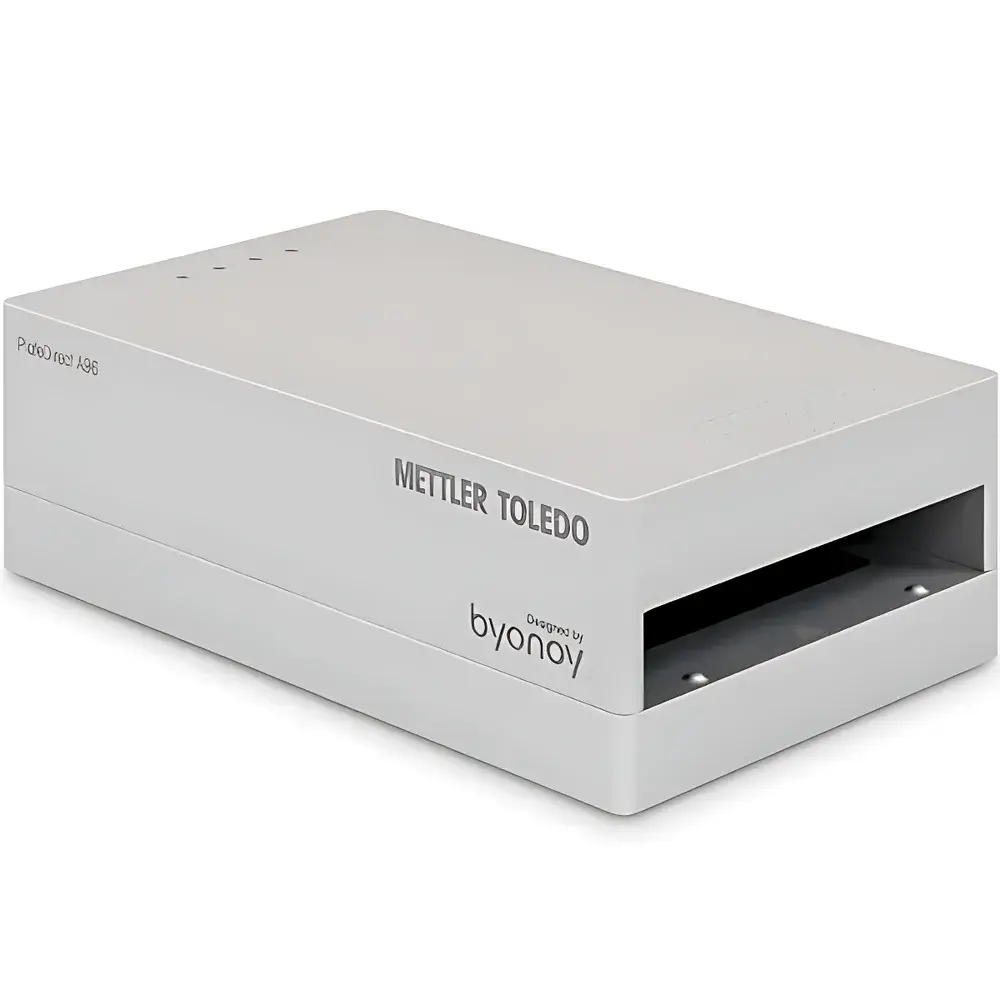
METTLER TOLEDO PlateDirect A96 Absorbance Microplate Reader
| Brand | METTLER TOLEDO |
|---|---|
| Origin | Germany |
| Model | PlateDirect A96 |
| Detection Method | Absorbance (Optical Density) |
| Function Type | Single-Mode Absorbance Reader |
| Automation Level | Fully Automated |
| Measurement Mode | Endpoint and Kinetic Scanning |
| Microplate Format | 96-well, Flat-Bottom |
| Wavelength Options | Variant 1: 405 nm, 450 nm, 492 nm, 620 nm |
| Variant 2 | 492 nm, 570 nm, 600 nm, 650 nm |
| Absorbance Range | 0–4.0 OD |
| Resolution | 0.001 OD |
| Read Time | ≤5 seconds per 96-well plate |
Overview
The METTLER TOLEDO PlateDirect A96 Absorbance Microplate Reader is an engineered solution for quantitative photometric analysis in life science laboratories requiring high reproducibility, minimal operational overhead, and strict adherence to routine assay protocols. Based on fixed-wavelength LED-based absorbance detection—operating within the visible spectrum—the instrument applies the Beer–Lambert principle to determine analyte concentration via optical density (OD) measurements across standard 96-well microplates. Its architecture eliminates moving optical components (e.g., monochromators or filter wheels), relying instead on discrete, temperature-stabilized LEDs matched to common assay wavelengths. This design ensures long-term photometric stability, reduced calibration drift, and immunity to mechanical wear—critical for labs operating under GLP or ISO 17025-aligned quality systems. The device is not intended for fluorescence, luminescence, or time-resolved measurements; it is purpose-built for robust, low-maintenance absorbance workflows in academic research, clinical diagnostics support, and QC environments where assay traceability and inter-laboratory comparability are essential.
Key Features
- Fully automated, single-mode absorbance measurement with ≤5-second read time for full 96-well plates—enabled by parallel detection using dedicated photodiodes per well.
- Fixed-wavelength LED optics with factory-calibrated, narrow-band emission profiles (±2 nm bandwidth) at four user-selectable wavelengths per configuration—ensuring compliance with standardized ELISA and protein assay protocols (e.g., USP & CLSI guidelines).
- Compact footprint (slightly larger than a standard microplate) and USB-powered operation—eliminating need for AC adapters, warm-up periods, or dedicated bench space; ideal for shared core facilities or mobile lab deployments.
- Integrated thermal management system maintains LED output stability across ambient temperatures from 15–30 °C, minimizing wavelength shift and signal drift during extended kinetic runs.
- No consumables or alignment procedures required—optical path is sealed and pre-aligned at manufacture, supporting audit-ready documentation per FDA 21 CFR Part 11 when paired with validated software.
Sample Compatibility & Compliance
The PlateDirect A96 supports all ANSI/SLAS-compliant 96-well microplates with flat-bottom wells—including polystyrene, polypropylene, and UV-transparent variants—enabling direct compatibility with commercial ELISA kits, BCA/Bradford reagents, MTT/MTS viability assays, and NAD(P)H-coupled enzymatic reactions. It complies with ISO 8655-7 (volumetric accuracy of liquid handling systems used in conjunction), EN 61326-1 (EMC for laboratory equipment), and meets IEC 61010-1 safety requirements. While the instrument itself does not perform data integrity functions, its USB interface and deterministic read protocol support integration into LIMS or ELN platforms that enforce ALCOA+ principles (Attributable, Legible, Contemporaneous, Original, Accurate) and audit-trail generation.
Software & Data Management
The included Absorbance 96 PC application provides a lightweight, installer-free interface compatible with Windows 10/11 (64-bit). It supports method templates for endpoint and kinetic assays, automatic background subtraction, multi-point standard curve fitting (linear, 4PL, 5PL), and export of raw OD values, calculated concentrations, and residual plots in CSV, Excel, and PDF formats. All measurement metadata—including timestamp, wavelength, plate ID, operator name, and instrument serial number—is embedded in exported files. The software does not require network activation or cloud synchronization, preserving data sovereignty—a key consideration for institutions subject to GDPR or HIPAA-regulated workflows.
Applications
- Immunoassays: Quantitative ELISA for cytokines, hormones, and infectious disease markers (e.g., anti-HIV p24, SARS-CoV-2 IgG).
- Protein quantification: Colorimetric assays including BCA, Bradford, Lowry, and biuret—validated against NIST-traceable BSA standards.
- Cell health assessment: MTT, MTS, SRB, and LDH release assays for cytotoxicity, proliferation, and membrane integrity studies.
- Enzyme kinetics: Continuous monitoring of dehydrogenase activity (e.g., lactate dehydrogenase, glucose-6-phosphate dehydrogenase) via NAD(P)H formation/consumption at 340 nm (via optional external filter adapter).
- Microbial growth monitoring: Turbidimetric OD600 measurements for bacterial culture density estimation in antibiotic susceptibility testing or fermentation optimization.
FAQ
Does the PlateDirect A96 support wavelength scanning or spectral acquisition?
No. It operates exclusively at four pre-configured fixed wavelengths per variant—designed for assay-specific repeatability rather than spectral flexibility.
Can it be used with 384-well plates?
No. The optical and mechanical design is optimized only for ANSI-standard 96-well plates with flat-bottom geometry.
Is calibration traceable to NIST standards?
Yes. Each unit ships with a factory calibration certificate referencing NIST-traceable neutral density filters, with recalibration recommended annually or after impact events.
What is the maximum kinetic measurement duration?
Unlimited—data acquisition intervals are software-defined (1 second to 60 minutes), constrained only by available system memory and storage.
Does the device meet FDA 21 CFR Part 11 requirements?
The hardware and firmware provide foundational controls (unique user IDs, electronic signatures via Windows login, audit-log-capable software); full Part 11 compliance requires validation of the complete system—including PC environment, network policies, and procedural SOPs.



