
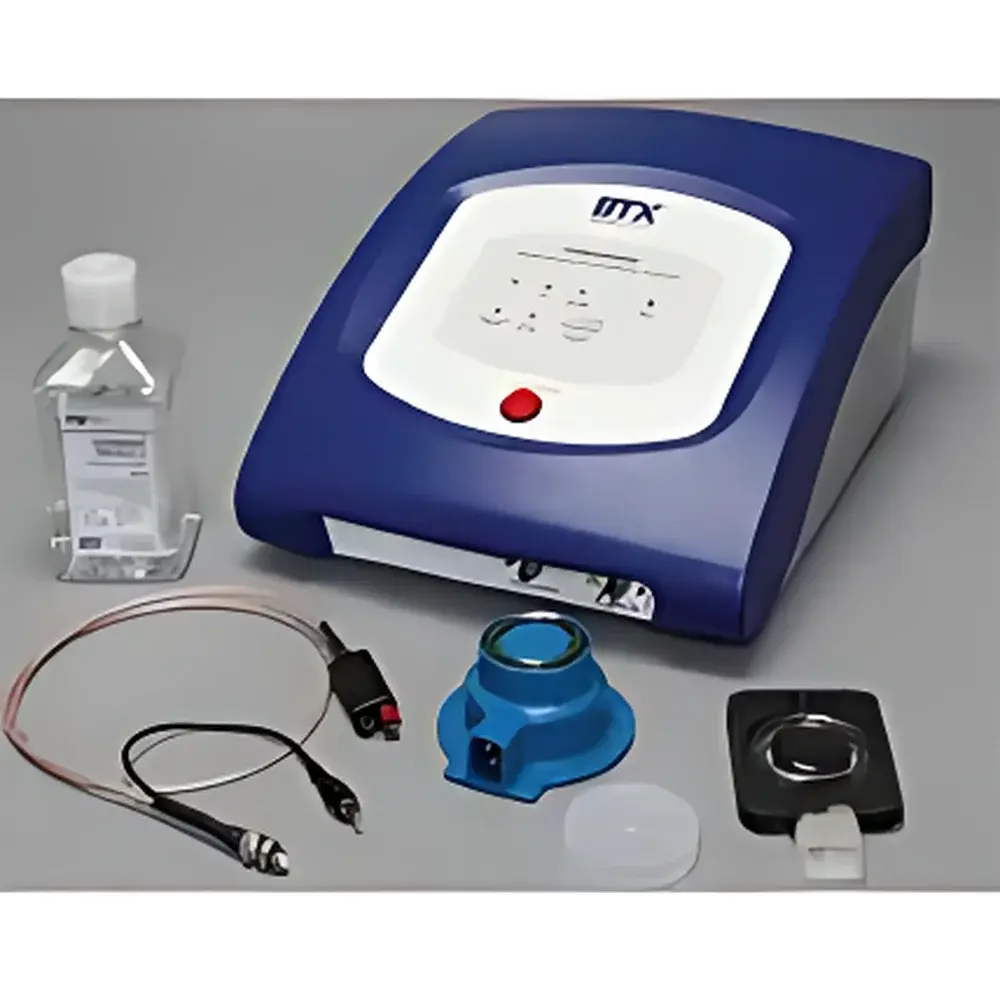
BTX Hybrimune Large-Volume Electrofusion System
| Origin | USA |
|---|---|
| Manufacturer Type | Authorized Distributor |
| Origin Category | Imported |
| Model | BTX Hybrimune Large-Volume Electrofusion System |
| Pricing | Available Upon Request |
| AC Parameters | Sine-wave frequency (0.2–2.0 MHz, 0.2 MHz step), Voltage range (5–75 V, 5 V step), Amplitude factor (k = 0.1–20, unitless, 1-step increment), Pulse duration (0–60 s, 1 s step) |
| DC Parameters | Square-wave voltage (100–1000 V, 5 V step), Pulse width (20–1000 µs, 10 µs step), Number of pulses (0–10), Inter-pulse interval (0.125–10 s, 0.001 s step) |
| Fusion Chamber Dimensions | Volume capacity (2 mL and 9 mL configurations), Chamber height (5 mm and 18 mm), Outer diameter (45.72 mm), Inner diameter (38.10 mm), Electrode gap (3.81 mm) |
| Sterilization | Compatible with NaOH, ethanol, and Spor-Klenz for repeated use |
Overview
The BTX Hybrimune Large-Volume Electrofusion System is an engineered platform for high-efficiency, scalable electrofusion of mammalian cells—specifically optimized for monoclonal antibody development workflows requiring large-scale hybridoma generation. Unlike conventional electroporation-based fusion systems limited to microliter-scale volumes, the Hybrimune system employs a proprietary three-step electroporation protocol combining precisely timed AC alignment, DC membrane destabilization, and post-fusion recovery modulation. This sequence leverages dielectrophoretic forces to orient cells into stable chains prior to irreversible membrane poration, minimizing thermal accumulation and maximizing viable heterokaryon formation. Designed for reproducible operation under GLP-aligned laboratory conditions, the system supports process transfer from research-scale discovery to preclinical cell line development.
Key Features
- Three-phase electrofusion protocol: AC pre-alignment (0.2–2.0 MHz sine wave), DC fusion pulse (100–1000 V square wave), and controlled post-pulse recovery—enabling consistent hybridoma yields across 2 mL to 9 mL sample volumes.
- Thermally optimized fusion chamber architecture: Precision-machined stainless-steel electrodes with 3.81 mm fixed gap and low-resistance geometry reduce Joule heating by >40% versus standard parallel-plate designs, preserving membrane integrity and post-fusion viability.
- Programmable waveform flexibility: Independent control over AC amplitude factor (k = 0.1–20), pulse timing resolution (10 µs for DC; 1 s for AC), and inter-pulse intervals (down to 1 ms) enables empirical optimization for diverse cell types—including primary B-cells, myeloma lines (e.g., SP2/0, NS0), and stem-derived progenitors.
- Interchangeable chamber formats: Dual-volume configuration (5 mm height / 2 mL; 18 mm height / 9 mL) accommodates both pilot-scale parameter screening and GMP-adjacent production runs without hardware modification.
- Integrated safety and traceability: Automatic impedance monitoring before each pulse train prevents arcing; all parameter sets and execution logs are timestamped and exportable in CSV format for audit readiness.
Sample Compatibility & Compliance
The Hybrimune system demonstrates validated compatibility with murine, human, and hybrid rodent-human cell lines used in therapeutic antibody discovery. It supports suspension-adapted cultures processed in Cytofusion™ Electrofusion Buffer—a low-conductivity, non-ionic formulation optimized for osmotic stability during high-voltage pulsing. Chamber materials (316L stainless steel electrodes, borosilicate glass body) comply with USP Class VI biocompatibility requirements. Cleaning protocols using 0.1 M NaOH, 70% ethanol, or Spor-Klenz® meet ISO 14644-1 Class 5 cleanroom maintenance standards. While not FDA-cleared as a medical device, the system’s operational logging and parameter locking features align with FDA 21 CFR Part 11 expectations for electronic records in regulated bioprocess development environments.
Software & Data Management
Control is executed via BTX’s Windows-based Electrofusion Suite v4.x, supporting fully automated sequence execution, real-time voltage/current waveform visualization, and multi-user permission tiers (Operator, Supervisor, Administrator). All fusion events are logged with metadata including ambient temperature, chamber impedance, actual delivered energy (J/mL), and user ID. Raw data exports include .csv time-series traces and .xml protocol definitions compatible with LIMS integration. Audit trails record parameter changes, software updates, and login/logout events—retained for ≥36 months per internal SOP-IF-027.
Applications
- High-yield hybridoma generation for monoclonal antibody discovery (≥9 mL scale, supporting >1 × 10⁸ fused cells per run).
- Cell-cell fusion for somatic cell nuclear transfer (SCNT) and induced pluripotent stem cell (iPSC) reprogramming studies.
- Engineering of synthetic syncytia for virology research (e.g., SARS-CoV-2 spike-mediated membrane fusion modeling).
- Development of bispecific antibody-producing cell lines via fusion of two distinct IgG-secreting clones.
- Process qualification studies under ICH Q5A(R2) guidelines for cell line stability assessment.
FAQ
What cell densities are recommended for optimal fusion efficiency in the 9 mL chamber?
For murine hybridoma fusions, a total viable cell density of 1–2 × 10⁶ cells/mL (pre-fusion) is empirically validated; higher densities may increase aggregation but reduce alignment fidelity.
Can the system be integrated into an automated liquid handling workflow?
Yes—the Electrofusion Suite supports TCP/IP command triggering and status polling, enabling synchronization with Hamilton STAR or Tecan Fluent platforms via custom Python or LabVIEW drivers.
Is the Cytofusion buffer supplied sterile-filtered and endotoxin-tested?
All Cytofusion buffer lots undergo 0.22 µm filtration and endotoxin testing (LAL assay; ≤0.1 EU/mL), with CoA provided per batch.
How frequently must the fusion chamber be recalibrated?
No routine calibration is required; however, quarterly verification of voltage delivery accuracy (±2% of setpoint) using a calibrated high-voltage probe is recommended per BTX Technical Bulletin TB-HYB-009.
Does the system support Good Manufacturing Practice (GMP) documentation packages?
Comprehensive DQ/IQ/OQ documentation templates, URS mapping, and 21 CFR Part 11 validation support files are available under NDA upon request from authorized distributors.
Related Products



