
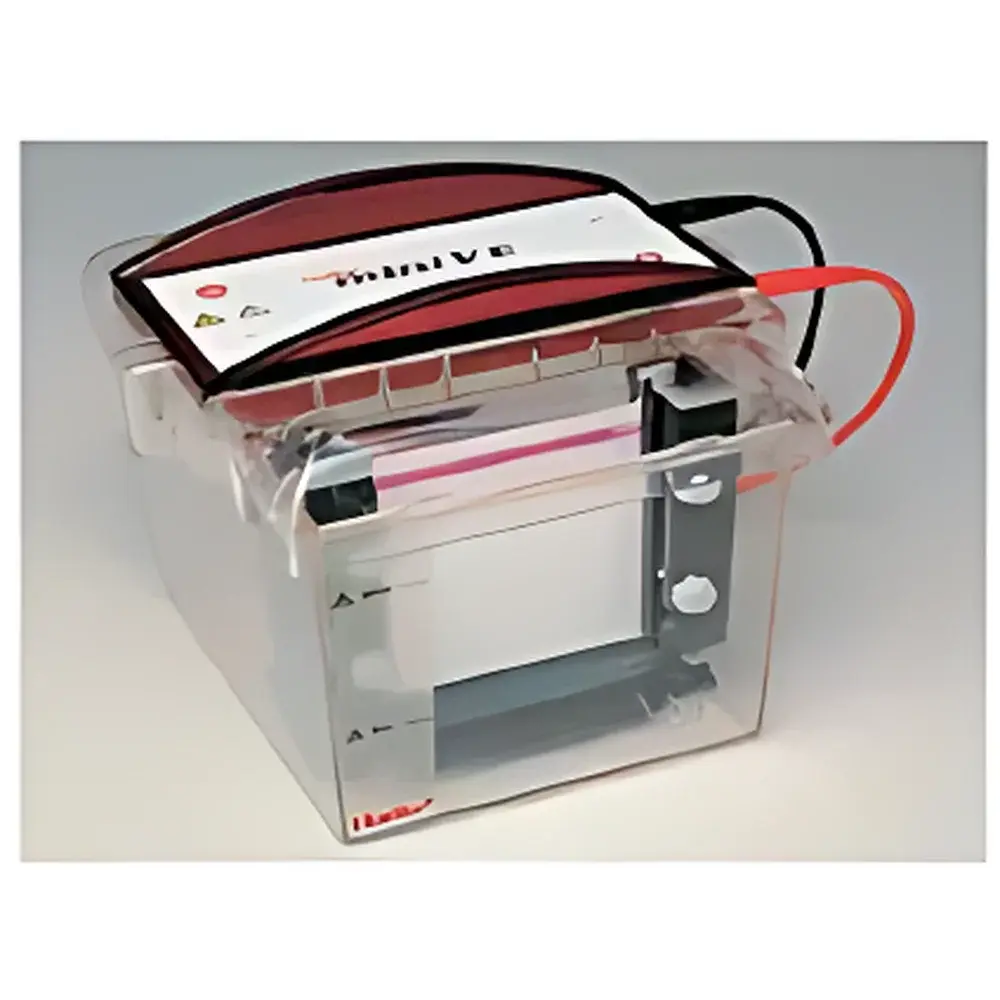
Cytiva MINIVE Vertical Electrophoresis System
| Brand | Cytiva |
|---|---|
| Origin | USA |
| Model | MINIVE |
| Instrument Type | Isoelectric Focusing Electrophoresis System |
| Gel Dimensions | 8 × 9.5 cm (W × L) |
| Capacity | 2 gels simultaneously |
| Max Voltage/Current | 300 V / — |
| Sample Capacity | 2 gels × multiple wells |
| Includes | Electrophoresis chamber, dual-gel casting stand, 3 plain glass plates, 3 notched glass plates, two sets of 1.0 mm thick / 10-well combs, two sets of 1.0 mm spacers, T-shaped spacers, safety lid with automatic power cutoff |
| Optional | Transfer module for western blotting |
Overview
The Cytiva MINIVE Vertical Electrophoresis System is a compact, benchtop electrophoresis apparatus engineered for reproducible vertical slab gel electrophoresis of proteins and nucleic acids. Designed around the principles of constant-voltage or constant-current operation, the system supports standard polyacrylamide gel electrophoresis (PAGE), sodium dodecyl sulfate–PAGE (SDS-PAGE), native PAGE, and isoelectric focusing (IEF)—particularly as the second-dimension separation unit in two-dimensional electrophoresis (2-DE). Its modular architecture enables seamless integration with first-dimension IEF strips (e.g., 7 cm IPG strips), making it suitable for high-resolution proteomic profiling in academic, clinical, and pharmaceutical research laboratories. The system operates within a defined electrical envelope of up to 300 V, ensuring compatibility with common buffer systems (e.g., Tris-Glycine, Tris-Tricine) while maintaining thermal stability during extended runs.
Key Features
- Simultaneous electrophoresis of two independent 8 × 9.5 cm gels—enhancing throughput without compromising resolution or run-to-run consistency.
- T-shaped spacers eliminate lateral gel leakage during polymerization and electrophoresis, improving gel integrity and reducing buffer consumption.
- Integrated safety lid with microswitch-based interlock: power is automatically cut upon lid removal, meeting IEC 61010-1 requirements for laboratory electrical equipment safety.
- Optimized for both hand-cast and pre-cast gels; accommodates standard 1.0 mm thickness gels with 10-well comb configurations (two comb and spacer sets included).
- Dual-gel casting stand allows parallel gel preparation under identical conditions—critical for comparative analysis and technical replicates.
- Modular design supports optional electroblotting: a dedicated transfer module (sold separately) enables semi-dry or tank-based western transfer directly from the same gel cassette.
Sample Compatibility & Compliance
The MINIVE system is validated for use with denatured and native protein samples, peptide mixtures, and nucleic acids ranging from oligonucleotides to genomic DNA fragments. Its gel format (8 × 9.5 cm) aligns with widely adopted standards in proteomics workflows—including compatibility with 7 cm immobilized pH gradient (IPG) strips used in the first dimension of 2-DE. The system complies with general laboratory safety directives per IEC 61010-1 and supports Good Laboratory Practice (GLP) documentation through traceable operational parameters when paired with compatible power supplies featuring logging capabilities. While the MINIVE itself does not embed regulatory-compliant audit trails, its mechanical and electrical design facilitates integration into FDA 21 CFR Part 11–aligned environments when used with validated external controllers and SOP-controlled protocols.
Software & Data Management
As a hardware-only electrophoresis platform, the MINIVE does not include embedded firmware or proprietary software. It functions as a passive electrophoresis chamber requiring an external DC power supply (e.g., Cytiva EPS 300, or equivalent compliant units). Data acquisition and image analysis are performed downstream using third-party imaging systems (e.g., Amersham Imager 600, Bio-Rad ChemiDoc) and open-standard software such as ImageLab, AlphaView SA, or Fiji/ImageJ. Users retain full control over metadata annotation, including gel ID, sample loading order, running conditions, and staining method—enabling alignment with laboratory information management systems (LIMS) via CSV or TIFF export.
Applications
- Two-dimensional electrophoresis (2-DE): Second-dimension SDS-PAGE separation of proteins resolved by isoelectric point in the first dimension.
- Protein purity assessment and molecular weight estimation under denaturing or native conditions.
- Post-translational modification (PTM) screening via shifts in apparent mobility (e.g., phosphorylation, glycosylation).
- Nucleic acid fragment analysis—including restriction digests, PCR product verification, and RNA integrity checks (with appropriate gel matrix and staining).
- Method development and validation for QC/QA in biopharmaceutical manufacturing (e.g., host cell protein profiling, charge variant analysis).
FAQ
Is the MINIVE compatible with commercially available pre-cast gels?
Yes—the chamber accepts standard 8 × 9.5 cm pre-cast polyacrylamide gels with 1.0 mm thickness, provided they are mounted using the included T-spacers and notched glass plates.
Can I run native PAGE and SDS-PAGE on the same unit?
Yes—no hardware modification is required. Simply adjust the gel composition, running buffer, and power settings according to published protocols for native or denaturing conditions.
Does the system support temperature control during electrophoresis?
No—MINIVE lacks integrated cooling. For high-voltage or prolonged runs, users should operate the system in temperature-stabilized rooms (18–22 °C) or place the electrophoresis chamber within a cold room or chilled circulating bath setup.
What power supply is recommended for optimal performance?
A programmable DC power supply capable of delivering up to 300 V and ≥500 mA (e.g., Cytiva EPS 300, Bio-Rad PowerPac Basic, or Thermo Fisher Ettan Power Supply) ensures stable current/voltage regulation and timer-based termination.
Is service and technical support available outside the U.S.?
Yes—Cytiva provides global field service and application support through authorized distributors and regional service centers, with documentation available in English, German, French, Japanese, and Chinese.
Related Products



