
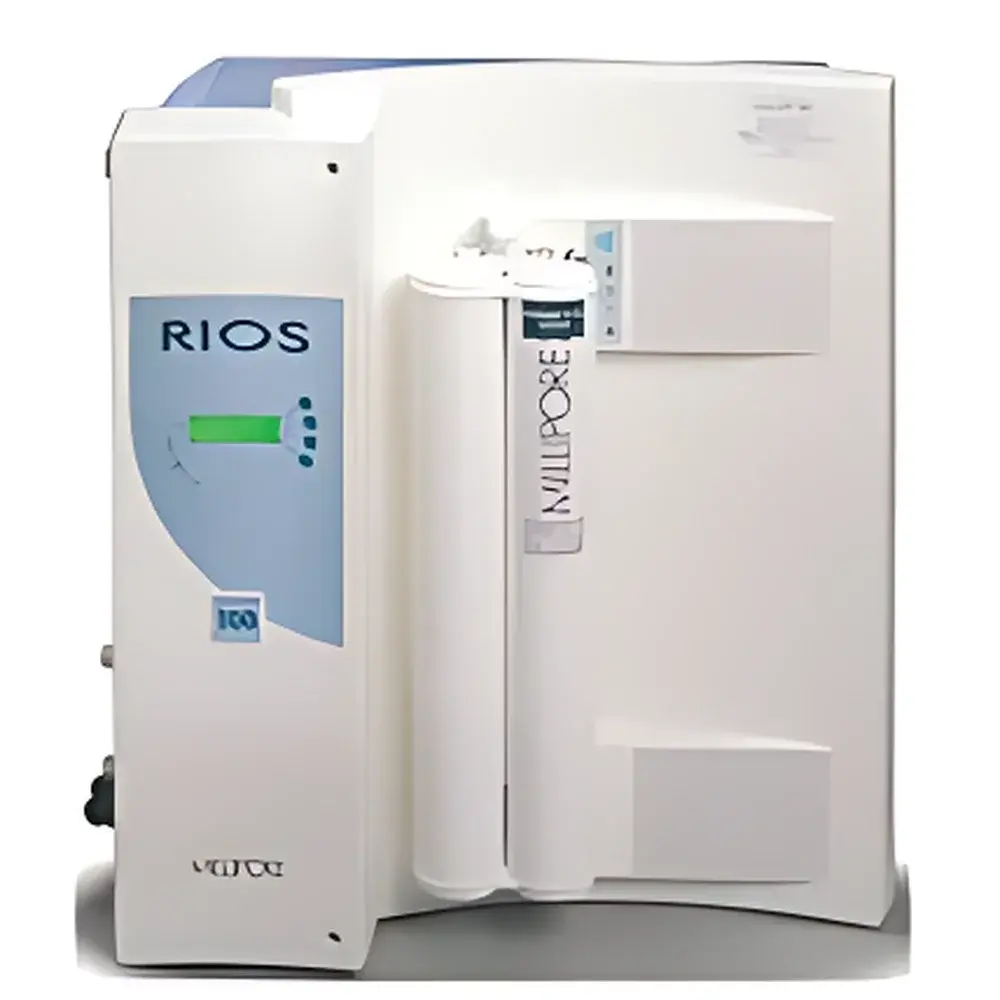
Millipore RiOs 30/50/100/150/200 Pure Water System
| Brand | Millipore |
|---|---|
| Origin | Germany |
| Model | RiOs 30/50/100/150/200 |
| Purified Water Grade | ASTM Type III / ISO 3696 Grade 3 |
| Resistivity | >10 MΩ·cm @ 25°C |
| Total Organic Carbon (TOC) | <30 ppb |
| Feed Water Conductivity | <2000 µS/cm @ 25°C |
| Feed Pressure | 2–6 bar |
| Minimum Flow Rate | >5 L/min @ 2 bar |
| Recovery Rate | Adjustable RO system with reject water recirculation |
Overview
The Millipore RiOs 30/50/100/150/200 Pure Water System is an engineered, modular solution designed for laboratories requiring consistent, high-volume production of ASTM Type III (ISO 3696 Grade 3) purified water. Based on a multi-stage purification architecture—comprising pre-treatment, reverse osmosis (RO), and optional post-RO polishing—the system delivers water meeting stringent specifications for routine laboratory applications including glassware rinsing, autoclave and washer feed, buffer and reagent preparation, and as feedwater for downstream Milli-Q® ultrapure water systems. Its robust design integrates real-time monitoring at critical process points—including feed conductivity, RO permeate conductivity, membrane rejection rate, temperature, and operating pressure—to ensure continuous compliance with defined performance thresholds. All RiOs units are manufactured in Germany under ISO 9001-certified quality management systems and comply with relevant sections of EU GMP Annex 15 and USP for pharmaceutical water systems.
Key Features
- Modular scalability: Five capacity variants (30, 50, 100, 150, and 200 L/h) support daily demand ranging from ~200 L to over 4,000 L, enabling precise matching to facility load profiles.
- Intelligent RO management: Integrated reject water recirculation loop and adjustable recovery rate optimization reduce operational water waste while maintaining stable flux and membrane longevity.
- Comprehensive parameter monitoring: Onboard sensors continuously track feed conductivity, RO inlet/outlet conductivity, temperature, pressure differential, and TOC (with optional UV oxidation module), all logged with time-stamped metadata.
- Pre-treatment flexibility: Standardized cartridge-based pre-filtration (sediment + activated carbon + softening) accommodates variable municipal feed qualities; Millipore Application Specialists perform site-specific feedwater analysis to recommend optimal configuration.
- Self-diagnostics & alarm hierarchy: System autonomously detects anomalies (e.g., low pressure, high conductivity deviation, UV lamp failure) and triggers tiered visual/audible alerts with actionable diagnostic codes per IEC 61508 SIL 1 guidelines.
Sample Compatibility & Compliance
The RiOs system is validated for use with standard municipal tap water meeting specified inlet criteria: conductivity ≤2000 µS/cm, pH 4–10, Langelier Saturation Index (LSI) <0.3, free chlorine <0.5 ppm, and silt density index (SDI) <5. It conforms to ISO 3696:2017 (Grade 3), ASTM D1193-20 (Type III), and supports compliance with FDA 21 CFR Part 11 when paired with Millipore’s IQ/OQ/PQ documentation packages and electronic audit trail-enabled software. All wetted materials (including RO membranes, housings, and distribution piping) are USP Class VI-certified and leachables-tested per ICH Q5A. The system architecture supports GLP/GMP-aligned validation protocols, including installation qualification (IQ), operational qualification (OQ), and performance qualification (PQ) with documented calibration traceability to NIST standards.
Software & Data Management
RiOs units operate via an embedded industrial-grade controller with a 7-inch resistive touchscreen HMI, supporting multilingual interface (English, German, French, Chinese). All operational parameters, alarms, maintenance logs, and event timestamps are stored locally for ≥12 months and exportable via USB or Ethernet (Modbus TCP). Optional integration with Millipore’s Elix® Connect platform enables remote monitoring, predictive maintenance scheduling, and automated report generation compliant with 21 CFR Part 11 requirements—including user authentication, electronic signatures, and immutable audit trails. Data integrity is enforced through role-based access control (RBAC), password-protected configuration changes, and automatic backup to external NAS devices.
Applications
- Routine laboratory operations: Final rinse water for analytical glassware, feedwater for laboratory dishwashers and steam sterilizers (autoclaves), and diluent for non-critical buffers and media.
- Feedwater pretreatment: Primary purification stage for Milli-Q® IQ series ultrapure water systems, reducing particulate and ionic load on subsequent deionization and ultrafiltration stages.
- Industrial QC labs: Supporting ISO/IEC 17025-accredited testing workflows where Type III water is specified for sample preparation and equipment cleaning.
- Pharmaceutical manufacturing support: Compliant with water-for-injection (WFI) pre-purification requirements per EU GMP Annex 1 and USP , particularly in non-sterile API synthesis environments.
- Educational institutions: Scalable deployment across teaching labs with variable usage patterns and limited technical staffing resources.
FAQ
What feedwater quality is required for reliable RiOs operation?
RiOs systems require municipal tap water with conductivity ≤2000 µS/cm, pH 4–10, LSI <0.3, calcium ≤300 ppm (as CaCO₃), and free chlorine <0.5 ppm. Site-specific pre-treatment is recommended based on SDI and hardness profiling.
Can RiOs produce water suitable for cell culture or HPLC?
No—RiOs delivers ASTM Type III water only. For cell culture, HPLC, or molecular biology applications, a downstream Milli-Q® ultrapure system is required, using RiOs water as its feed source.
Is the system compatible with existing lab water distribution networks?
Yes—RiOs units include integrated booster pumps and can be connected to closed-loop recirculating loops with UV irradiation, automatic drain valves, and tank-mounted sanitization modules.
How often must consumables be replaced?
Pre-filters are typically replaced every 6–12 months depending on feed quality; RO membranes last 2–3 years under validated operating conditions. Replacement intervals are tracked automatically and displayed on the HMI.
Does Millipore provide validation support for regulated environments?
Yes—comprehensive IQ/OQ/PQ documentation kits, certified reference materials, and on-site commissioning services are available under Millipore’s GxP Support Program.



